
1990 - 2019年全球因高体重指数导致的中风死亡及伤残调整生命年趋势
Trends in deaths and disability-adjusted life-years of stroke attributable to high body-mass index worldwide, 1990-2019.
作者信息
Guo Xiucai, Li Junxiao, Yin Xueyan, Zhang Ziping, Zhong Qiongqiong, Zhu Feng
机构信息
Pharmaceutical Department and Central Laboratory, Guangzhou Twelfth People's Hospital, Guangzhou, China.
Department of Public Health and Preventive Medicine, School of Medicine, Jinan University, Guangzhou, China.
出版信息
Front Neurol. 2023 Jun 30;14:1211642. doi: 10.3389/fneur.2023.1211642. eCollection 2023.
BACKGROUND
High body mass index (HBMI) is an independent risk factor for stroke. Previous studies on the incremental burden of the rapid growth of stroke attributable to HBMI are incomplete and lag behind. We aim to assess the global burden of stroke attributable to HBMI based on a public database online.
MATERIALS AND METHODS
Study data were taken from the Global Burden of Disease, Injuries, and Risk Factors Study; deaths, the Disability-Adjusted Life-Years (DALYs), and their age-standardized rates were screened. The join point regression was used, wherein age-standardized rates were referred to as temporal trends in disease burden.
RESULTS
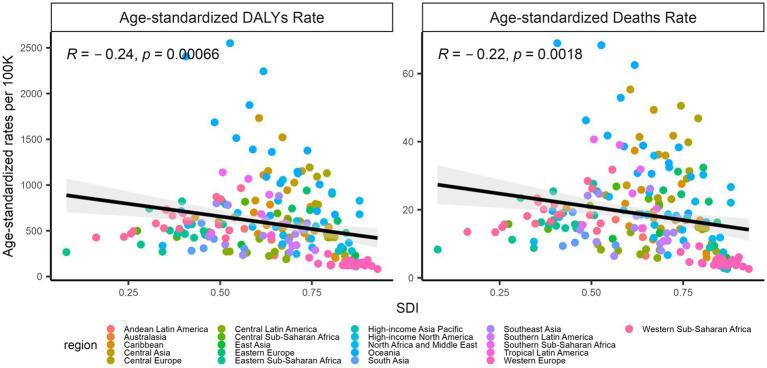
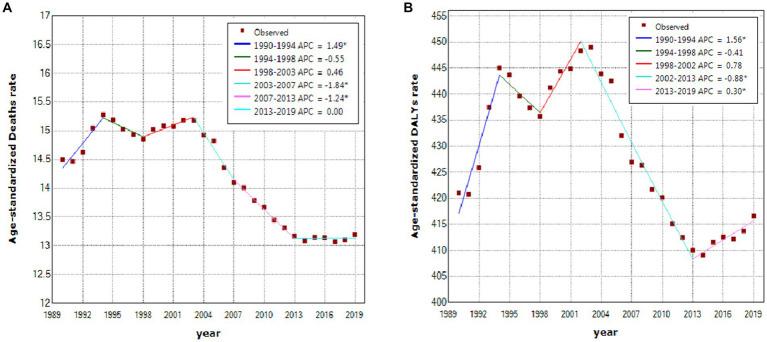
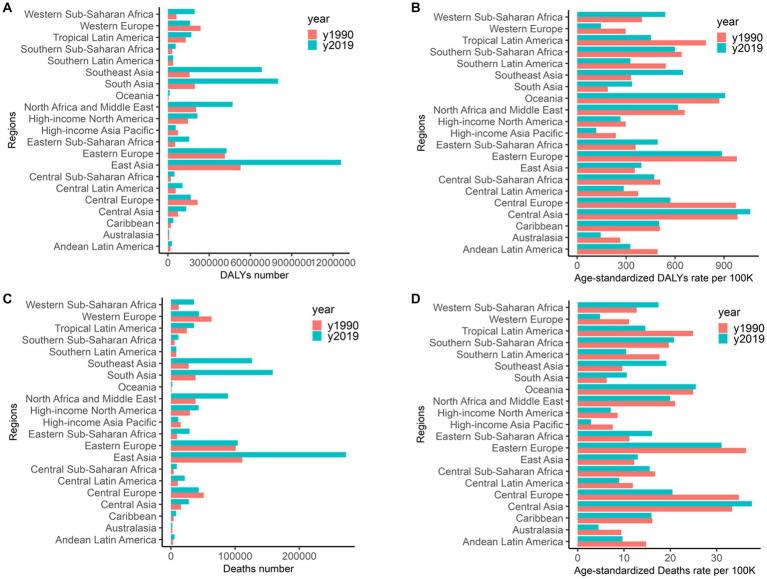
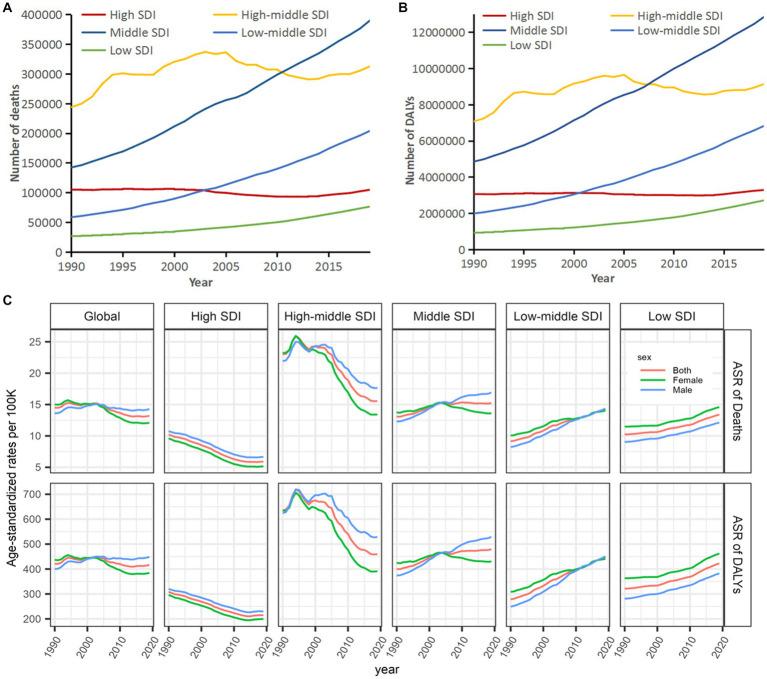
Deaths from stroke attributable to HBMI worldwide were on the rise during 1990-2019, with an increase of 88.75%. Age-standardized DALYs were on the rise during 1990-2003 but declined during 2003-2013, with a turning point in 2013 and an increasing trend since then [ () = 0.30%, < 0.05]. China, India, Indonesia, the Russian Federation, and the United States of America shared in sequence the rate of leading deaths and DALYs in 2019. The Socio-Demographic Index (SDI) was associated with an increasing trend in age-standardized deaths ( = -0.24, < 0.001) and age-standardized DALYs ( = -0.22, = 0.0018).
CONCLUSION
A range of indicators for the global burden of stroke attributable to HBMI have been on the rise for past three decades. Tremendous efforts worldwide should be in place to control and treat stroke attributable to HBMI, especially in regions with high-middle and middle SDIs and among middle-aged and aged populations.
背景
高体重指数(HBMI)是中风的独立危险因素。先前关于HBMI导致中风快速增长的增量负担的研究并不完整且滞后。我们旨在基于在线公共数据库评估HBMI导致的全球中风负担。
材料与方法
研究数据取自全球疾病、伤害及风险因素负担研究;筛选出死亡人数、伤残调整生命年(DALYs)及其年龄标准化率。采用连接点回归,其中年龄标准化率被视为疾病负担的时间趋势。
结果
1990 - 2019年期间,全球HBMI导致的中风死亡人数呈上升趋势,增加了88.75%。年龄标准化DALYs在1990 - 2003年呈上升趋势,但在2003 - 2013年有所下降,2013年出现转折点,此后呈上升趋势[()= 0.30%,< 0.05]。2019年,中国、印度、印度尼西亚、俄罗斯联邦和美利坚合众国依次位列死亡人数和DALYs领先率榜单。社会人口指数(SDI)与年龄标准化死亡人数(= -0.24,< 0.001)和年龄标准化DALYs(= -0.22,= 0.0018)的上升趋势相关。
结论
在过去三十年里,一系列HBMI导致的全球中风负担指标一直在上升。全球应付出巨大努力来控制和治疗HBMI导致的中风,特别是在高中等和中等SDI地区以及中老年人群中。


 Zotero 插件