
急性髓系白血病(AML)如何逃避FMS样酪氨酸激酶3(FLT3)抑制剂?这仍是一个被高估的并发症吗?
How acute myeloid leukemia (AML) escapes from FMS-related tyrosine kinase 3 (FLT3) inhibitors? Still an overrated complication?
作者信息
Perrone Salvatore, Ottone Tiziana, Zhdanovskaya Nadezda, Molica Matteo
机构信息
Hematology, Polo Universitario Pontino, S.M. Goretti Hospital, Latina 04100, Italy.
Department of Biomedicine and Prevention, the University of Rome "Tor Vergata", Rome 00100 Italy.
出版信息
Cancer Drug Resist. 2023 Apr 28;6(2):223-238. doi: 10.20517/cdr.2022.130. eCollection 2023.
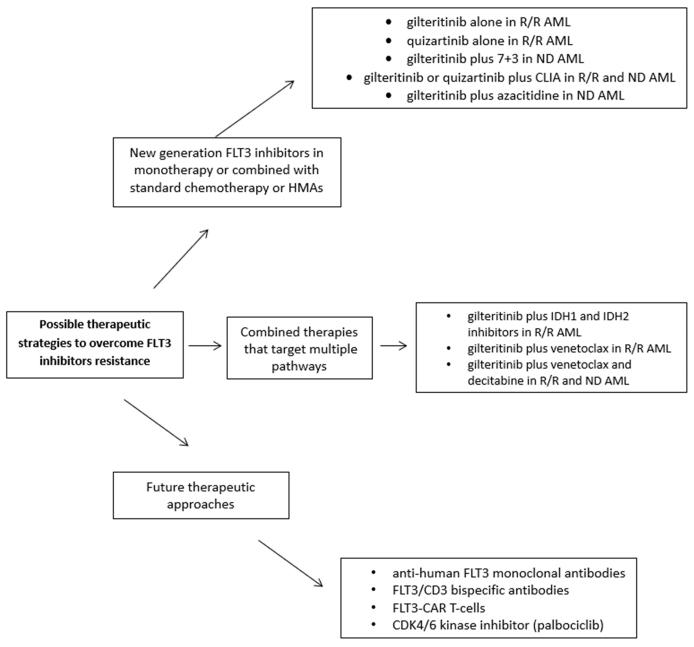
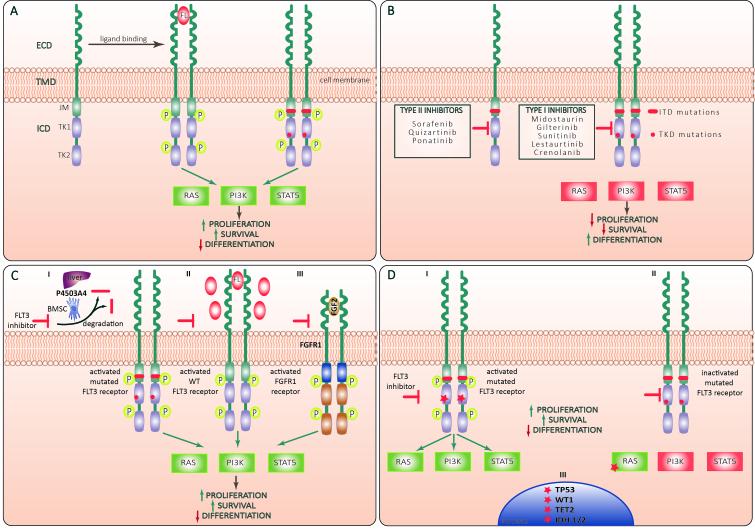
FMS-related tyrosine kinase 3 (FLT3) mutations, present in about 25%-30% of acute myeloid leukemia (AML) patients, constitute one of the most frequently detected mutations in these patients. The binding of FLT3L to FLT3 activates the phosphatidylinositol 3-kinase (PI3K) and RAS pathways, producing increased cell proliferation and the inhibition of apoptosis. Two types of FLT3 mutations exist: FLT3-ITD and FLT3-TKD (point mutations in D835 and I836 or deletion of codon I836). A class of drugs, tyrosine-kinase inhibitors (TKI), targeting mutated FLT3, is already available with 1 and 2 generation molecules, but only midostaurin and gilteritinib are currently approved. However, the emergence of resistance or the selection of clones not responding to FLT3 inhibitors has become an important clinical dilemma, as the duration of clinical responses is generally limited to a few months. This review analyzes the insights into mechanisms of resistance to TKI and poses a particular view on the clinical relevance of this phenomenon. Has resistance been overlooked? Indeed, FLT3 inhibitors have significantly contributed to reducing the negative impact of FLT3 mutations on the prognosis of AML patients who are no longer considered at high risk by the European LeukemiaNet (ELN) 2022. Finally, several ongoing efforts to overcome resistance to FLT3-inhibitors will be presented: new generation FLT3 inhibitors in monotherapy or combined with standard chemotherapy, hypomethylating drugs, or IDH1/2 inhibitors, Bcl2 inhibitors; novel anti-human FLT3 monoclonal antibodies (e.g., FLT3/CD3 bispecific antibodies); FLT3-CAR T-cells; CDK4/6 kinase inhibitor (e.g., palbociclib).
FMS相关酪氨酸激酶3(FLT3)突变存在于约25%-30%的急性髓系白血病(AML)患者中,是这些患者中最常检测到的突变之一。FLT3L与FLT3的结合激活磷脂酰肌醇3激酶(PI3K)和RAS信号通路,导致细胞增殖增加并抑制细胞凋亡。存在两种类型的FLT3突变:FLT3-ITD和FLT3-TKD(D835和I836的点突变或密码子I836的缺失)。一类靶向突变FLT3的药物,即酪氨酸激酶抑制剂(TKI),已有第一代和第二代药物,但目前仅米哚妥林和吉列替尼获得批准。然而,耐药性的出现或对FLT3抑制剂无反应的克隆的选择已成为一个重要的临床难题,因为临床反应的持续时间通常仅限于几个月。本综述分析了对TKI耐药机制的见解,并对这一现象的临床相关性提出了独特观点。耐药性是否被忽视了?事实上,FLT3抑制剂对降低FLT3突变对AML患者预后的负面影响做出了重大贡献,根据欧洲白血病网络(ELN)2022年的标准,这些患者不再被视为高危患者。最后,将介绍几种正在进行的克服FLT3抑制剂耐药性的努力:新一代FLT3抑制剂单药治疗或与标准化疗、去甲基化药物、IDH1/2抑制剂、Bcl2抑制剂联合使用;新型抗人FLT3单克隆抗体(如FLT3/CD3双特异性抗体);FLT3嵌合抗原受体T细胞;CDK4/6激酶抑制剂(如哌柏西利)。
 Zotero 插件