
退伍军人事务部阿片类药物使用障碍患者在发生阿片类药物过量前后的医疗保健费用和使用情况。
Healthcare costs and use before and after opioid overdose in Veterans Health Administration patients with opioid use disorder.
机构信息
VA Health Economics Resource Center, US Department of Veterans Affairs, VA Palo Alto Health Care System, Palo Alto, CA, USA.
VA Center for Innovation to Implementation, US Department of Veterans Affairs, VA Palo Alto Health Care System, Palo Alto, CA, USA.
出版信息
Addiction. 2023 Nov;118(11):2203-2214. doi: 10.1111/add.16289. Epub 2023 Jul 19.
AIMS
To compare healthcare costs and use between United States (US) Veterans Health Administration (VHA) patients with opioid use disorder (OUD) who experienced an opioid overdose (OD cohort) and patients with OUD who did not experience an opioid overdose (non-OD cohort).
DESIGN
This is a retrospective cohort study of administrative and clinical data.
SETTING
The largest integrated national health-care system is the US Veterans Health Administration's healthcare systems.
PARTICIPANTS
We included VHA patients diagnosed with OUD from October 1, 2017 through September 30, 2018. We identified the index date of overdose for patients who had an overdose. Our control group, which included patients with OUD who did not have an overdose, was randomly assigned an index date. A total of 66 513 patients with OUD were included for analysis (OD cohort: n = 1413; non-OD cohort: n = 65 100).
MEASUREMENTS
Monthly adjusted healthcare-related costs and use in the year before and after the index date. We used generalized estimating equation models to compare patients with an opioid overdose and controls in a difference-in-differences framework.
FINDINGS
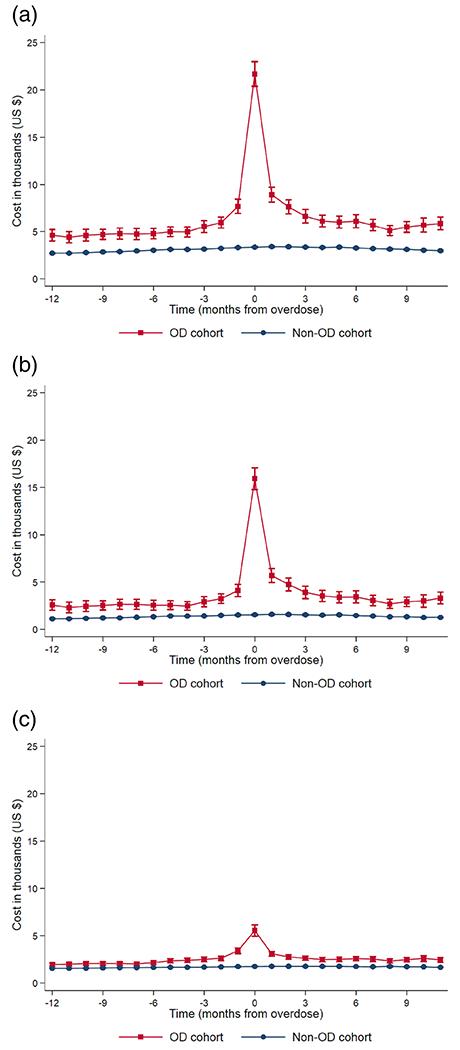
Compared with the non-OD cohort, an opioid overdose was associated with an increase of $16 890 [95% confidence interval (CI) = $15 611-18 169; P < 0.001] in healthcare costs for an estimated $23.9 million in direct costs to VHA (95% CI = $22.1 million, $25.7 million) within the 30 days following overdose after adjusting for baseline characteristics. Inpatient costs ($13 515; 95% CI = $12 378-14 652; P < 0.001) reflected most of this increase. Inpatient days (+6.15 days; 95% CI, = 5.33-6.97; P < 0.001), inpatient admissions (+1.01 admissions; 95% CI = 0.93-1.10; P < 0.001) and outpatient visits (+1.59 visits; 95% CI = 1.34-1.84; P < 0.001) also increased in the month after opioid overdose. Within the overdose cohort, healthcare costs and use remained higher in the year after overdose compared with pre-overdose trends.
CONCLUSIONS
The US Veterans Health Administration patients with opioid use disorder (OUD) who have experienced an opioid overdose have increased healthcare costs and use that remain significantly higher in the month and continuing through the year after overdose than OUD patients who have not experienced an overdose.
目的
比较美国退伍军人事务部 (VHA) 患有阿片类药物使用障碍 (OUD) 并经历阿片类药物过量 (OD 队列) 和未经历阿片类药物过量 (非 OD 队列) 的患者之间的医疗保健费用和使用情况。
设计
这是一项回顾性队列研究,使用了行政和临床数据。
地点
美国最大的综合性国家医疗保健系统是美国退伍军人事务部的医疗保健系统。
参与者
我们纳入了 2017 年 10 月 1 日至 2018 年 9 月 30 日期间被诊断为 OUD 的 VHA 患者。我们确定了经历过过量用药的患者的过量用药日期。我们的对照组包括没有过量用药的 OUD 患者,他们被随机分配了一个指数日期。共有 66513 名患有 OUD 的患者被纳入分析(OD 队列:n=1413;非 OD 队列:n=65100)。
测量
指数日期前和后一年的每月调整后的医疗保健相关费用和使用情况。我们使用广义估计方程模型,在差异中差异框架内比较阿片类药物过量和对照组的患者。
结果
与非 OD 队列相比,阿片类药物过量与医疗保健费用增加 16890 美元(95%置信区间 [CI] = 15611-18169;P < 0.001)有关,这导致退伍军人事务部的直接费用增加了 2390 万美元(95%CI = 2210 万美元,2570 万美元),这是在过量用药后 30 天内调整基线特征后的情况。住院费用(13515 美元;95%CI = 12378-14652;P < 0.001)反映了这一增长的大部分。住院天数(+6.15 天;95%CI = 5.33-6.97;P < 0.001)、住院人数(+1.01 人;95%CI = 0.93-1.10;P < 0.001)和门诊就诊次数(+1.59 次;95%CI = 1.34-1.84;P < 0.001)在阿片类药物过量后的一个月内也有所增加。在过量用药队列中,与过量前的趋势相比,过量后一年的医疗保健费用和使用仍然较高。
结论
经历过阿片类药物过量的美国退伍军人事务部患有阿片类药物使用障碍 (OUD) 的患者,其医疗保健费用和使用增加,在过量后一个月和接下来的一年中仍明显高于未经历过阿片类药物过量的 OUD 患者。

 Zotero 插件