
转移性去势抵抗性前列腺癌患者接受一次[Lu]Lu-PSMA I&T 放射性配体治疗后的早期生化和放射学应答。
Early biochemical and radiographic response after one cycle of [Lu]Lu-PSMA I&T radioligand therapy in metastatic castration-resistant prostate cancer patients.
机构信息
Department of Nuclear Medicine, University Hospital Würzburg, Würzburg, Germany.
Department of Nuclear Medicine, Medical University of Gdańsk, Gdańsk, Poland.
出版信息
Eur J Nucl Med Mol Imaging. 2023 Oct;50(12):3765-3776. doi: 10.1007/s00259-023-06326-w. Epub 2023 Jul 21.
PURPOSE
The aim of this study was to investigate very early radiographic PSMA PET response after one cycle of [Lu]Lu-PSMA I&T radioligand therapy (RLT) of metastatic castration-resistant prostate cancer (mCRPC) and to assess its role in predicting overall response and survival.
METHODS
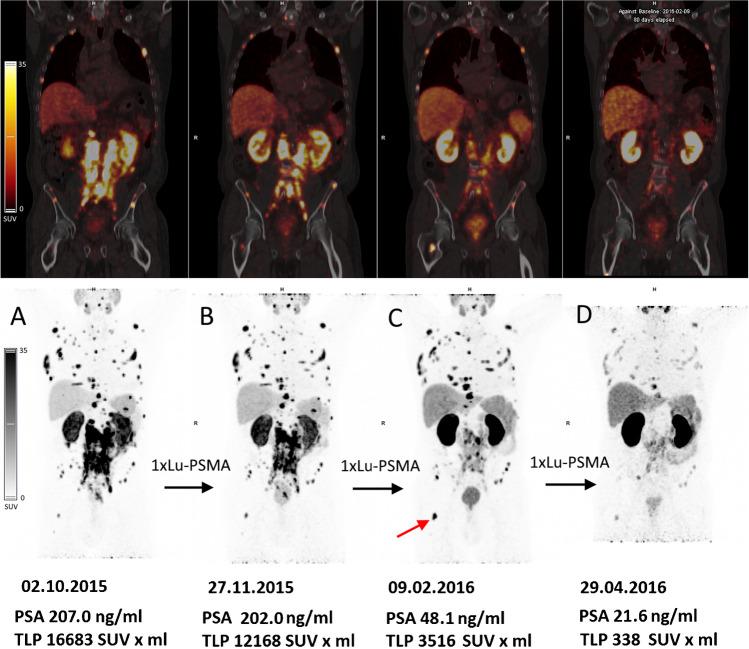
This retrospective study enrolled 40 mCRPC patients who were treated with a median of 3 (2-9) [Lu]Lu-PSMA I&T RLT cycles. Biochemical response was based on the relative change of serum PSA according to PCWG3 criteria, while radiographic response referred to the relative change of PSMA-derived total viable tumor volumes expressed as total lesion PSMA (TLP).
RESULTS
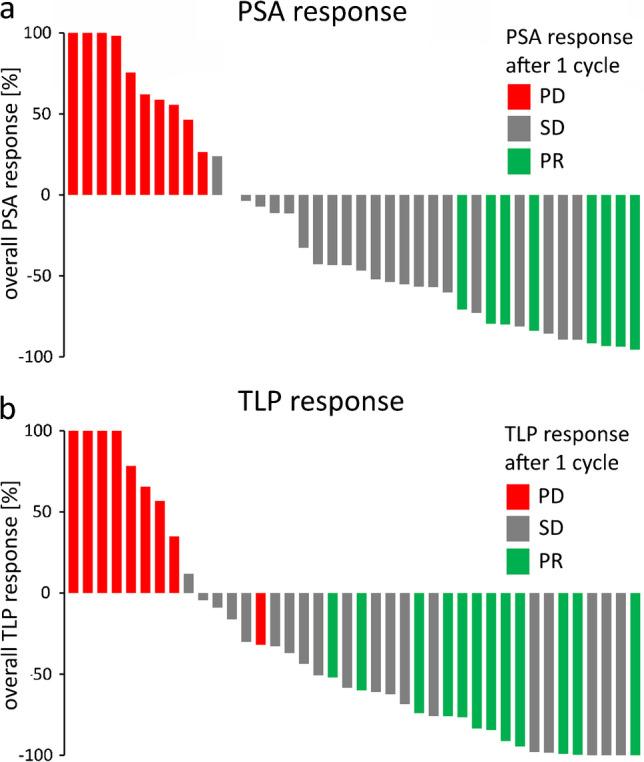
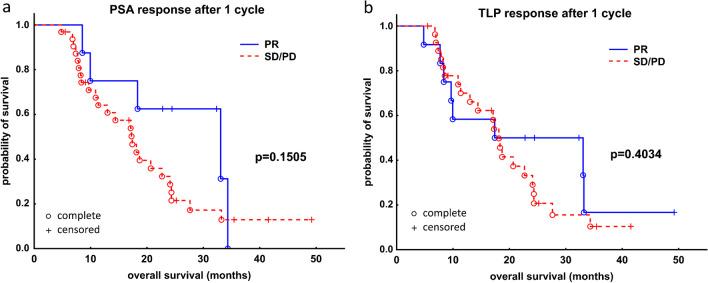
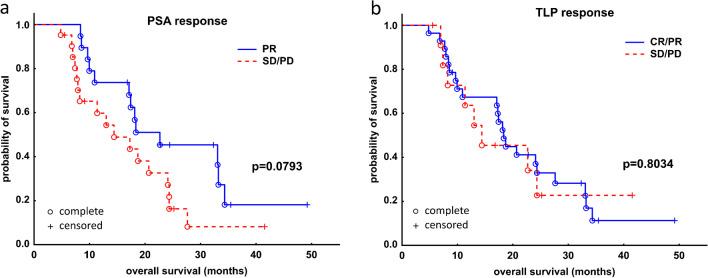
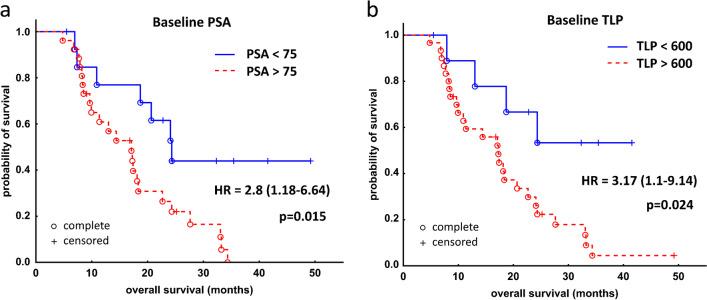
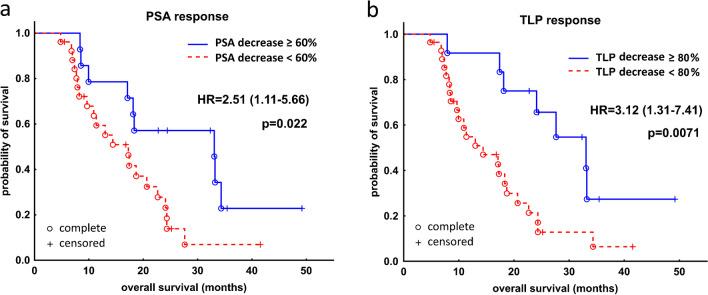
After one cycle of RLT, biochemical partial response (PR) was seen in 8/40 (20.0%), stable disease (SD) in 22/40 (55.0%), and progressive disease (PD) in 10/40 (25%) patients. In PSMA PET, very early molecular PR was observed in 12 (30.0%), SD in 19 (47.5%), and PD in 9 (22.5%) subjects. The PSA and TLP nadir were achieved after a median of 1 (1-5) and 2 (1-6) cycles, respectively. Nineteen (47.5%) patients showed overall biochemical PR, 11 (27.5%) had SD, and 10 (25%) experienced PD. In PSMA-directed PET, 4 patients experienced molecular complete response (CR), 24 (60.0%) had PR, 4 (10.0%) SD, and 8 (20.0%) PD. Early biochemical or radiographic response was not associated with longer overall survival (OS). Overall biochemical responders had a nearly significantly longer median OS (22.7 months) than non-responders (14.4 months, p = 0.08). Early PSA progression was associated with shorter OS (12.2 months), compared to biochemical SD/PR (18.7 months, p = 0.09).
CONCLUSION
In this retrospective cohort, there was no association between early PSMA PET radiographic response and overall survival; hence, treatment should not be prematurely discontinued. In contrast, early PSA progression after one cycle of [Lu]Lu-PSMA I&T RLT was an indicator of overall progression and poor clinical outcome.
目的
本研究旨在探讨转移性去势抵抗性前列腺癌(mCRPC)患者在接受一次[Lu]Lu-PSMA I&T 放射性配体治疗(RLT)后非常早期的 PSMA PET 反应,并评估其在预测总体反应和生存方面的作用。
方法
本回顾性研究纳入了 40 名接受中位数为 3(2-9)次[Lu]Lu-PSMA I&T RLT 治疗的 mCRPC 患者。生化反应基于 PCWG3 标准下血清 PSA 的相对变化,而放射性反应则指 PSMA 衍生的总存活肿瘤体积的相对变化,以总病变 PSMA(TLP)表示。
结果
在一次 RLT 后,8/40(20.0%)的患者出现生化部分缓解(PR),22/40(55.0%)的患者出现稳定疾病(SD),10/40(25%)的患者出现进展性疾病(PD)。在 PSMA PET 中,12 名(30.0%)患者出现非常早期的分子 PR,19 名(47.5%)患者出现 SD,9 名(22.5%)患者出现 PD。PSA 和 TLP 最低值分别在中位数为 1(1-5)和 2(1-6)个周期后达到。19 名(47.5%)患者出现总体生化 PR,11 名(27.5%)患者出现 SD,10 名(25%)患者出现 PD。在 PSMA 定向 PET 中,4 名患者出现分子完全缓解(CR),24 名(60.0%)患者出现 PR,4 名(10.0%)患者出现 SD,8 名(20.0%)患者出现 PD。早期生化或放射性反应与更长的总生存(OS)无关。总体生化反应者的中位 OS(22.7 个月)明显长于无反应者(14.4 个月,p=0.08)。与生化 SD/PR 相比,早期 PSA 进展与较短的 OS(12.2 个月)相关(p=0.09)。
结论
在本回顾性队列中,早期 PSMA PET 放射性反应与总生存之间无关联;因此,不应过早停止治疗。相比之下,在接受一次[Lu]Lu-PSMA I&T RLT 后早期 PSA 进展是总进展和临床预后不良的指标。

 Zotero 插件