
纳米塑料诱导神经毒性的研究进展与未来方向
Recent progress and future directions of the research on nanoplastic-induced neurotoxicity.
作者信息
Han Seung-Woo, Choi Jinhee, Ryu Kwon-Yul
机构信息
Department of Life Science, University of Seoul, Seoul, South Korea.
School of Environmental Engineering, University of Seoul, Seoul, South Korea.
出版信息
Neural Regen Res. 2024 Feb;19(2):331-335. doi: 10.4103/1673-5374.379016.
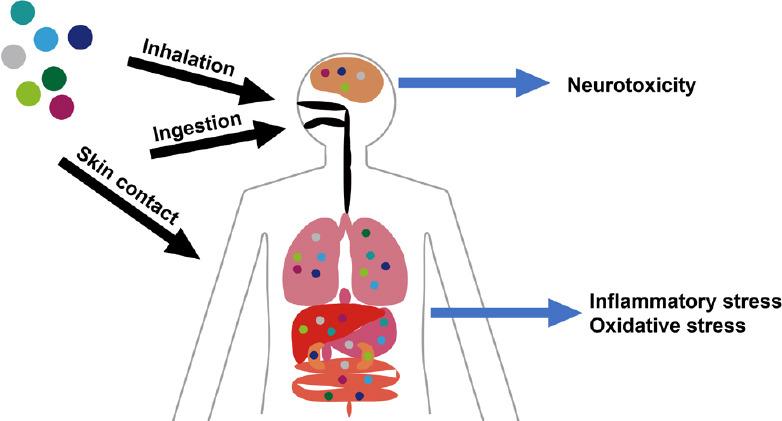
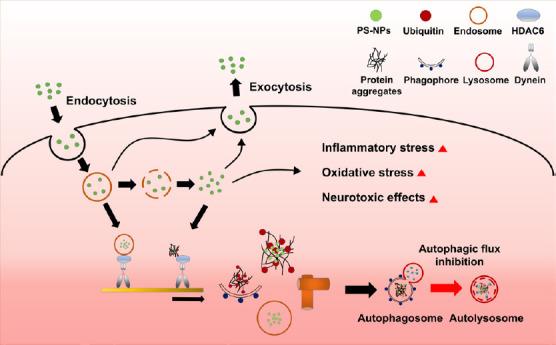
Many types of plastic products, including polystyrene, have long been used in commercial and industrial applications. Microplastics and nanoplastics, plastic particles derived from these plastic products, are emerging as environmental pollutants that can pose health risks to a wide variety of living organisms, including humans. However, it is not well understood how microplastics and nanoplastics affect cellular functions and induce stress responses. Humans can be exposed to polystyrene-microplastics and polystyrene-nanoplastics through ingestion, inhalation, or skin contact. Most ingested plastics are excreted from the body, but inhaled plastics may accumulate in the lungs and can even reach the brain via the nose-to-brain route. Small-sized polystyrene-nanoplastics can enter cells by endocytosis, accumulate in the cytoplasm, and cause various cellular stresses, such as inflammation with increased pro-inflammatory cytokine production, oxidative stress with generation of reactive oxygen species, and mitochondrial dysfunction. They induce autophagy activation and autophagosome formation, but autophagic flux may be impaired due to lysosomal dysfunction. Unless permanently exposed to polystyrene-nanoplastics, they can be removed from cells by exocytosis and subsequently restore cellular function. However, neurons are very susceptible to this type of stress, thus even acute exposure can lead to neurodegeneration without recovery. This review focuses specifically on recent advances in research on polystyrene-nanoplastic-induced cytotoxicity and neurotoxicity. Furthermore, in this review, based on mechanistic studies of polystyrene-nanoplastics at the cellular level other than neurons, future directions for overcoming the negative effects of polystyrene-nanoplastics on neurons were suggested.
包括聚苯乙烯在内的多种塑料制品长期以来一直用于商业和工业应用。微塑料和纳米塑料是源自这些塑料制品的塑料颗粒,正成为环境污染物,可能对包括人类在内的多种生物构成健康风险。然而,人们对微塑料和纳米塑料如何影响细胞功能并引发应激反应还了解甚少。人类可通过摄入、吸入或皮肤接触接触到聚苯乙烯微塑料和聚苯乙烯纳米塑料。大多数摄入的塑料会从体内排出,但吸入的塑料可能会在肺部积聚,甚至可通过鼻脑途径到达大脑。小尺寸的聚苯乙烯纳米塑料可通过内吞作用进入细胞,在细胞质中积累,并引起各种细胞应激,如促炎细胞因子产生增加导致的炎症、活性氧生成导致的氧化应激以及线粒体功能障碍。它们诱导自噬激活和自噬体形成,但由于溶酶体功能障碍,自噬流可能受损。除非长期暴露于聚苯乙烯纳米塑料,它们可通过胞吐作用从细胞中清除,随后恢复细胞功能。然而,神经元对这种类型的应激非常敏感,因此即使是急性暴露也可能导致神经退行性变且无法恢复。本综述特别关注聚苯乙烯纳米塑料诱导的细胞毒性和神经毒性的最新研究进展。此外,在本综述中,基于对聚苯乙烯纳米塑料在除神经元外的细胞水平上的机制研究,提出了克服聚苯乙烯纳米塑料对神经元负面影响的未来方向。

 Zotero 插件