
使用混合建模方法定量餐后血糖反应:在马斯特里赫特研究中结合机理模型和数据驱动模型。
Quantifying postprandial glucose responses using a hybrid modeling approach: Combining mechanistic and data-driven models in The Maastricht Study.
机构信息
TiFN, Wageningen, Netherlands.
MaCSBio Maastricht Centre for Systems Biology, Maastricht University, Maastricht, Netherlands.
出版信息
PLoS One. 2023 Jul 27;18(7):e0285820. doi: 10.1371/journal.pone.0285820. eCollection 2023.
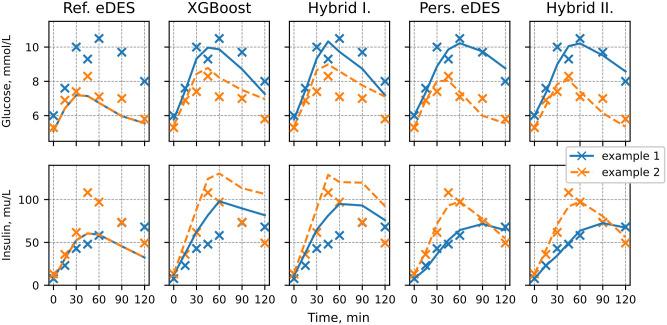
Computational models of human glucose homeostasis can provide insight into the physiological processes underlying the observed inter-individual variability in glucose regulation. Modelling approaches ranging from "bottom-up" mechanistic models to "top-down" data-driven techniques have been applied to untangle the complex interactions underlying progressive disturbances in glucose homeostasis. While both approaches offer distinct benefits, a combined approach taking the best of both worlds has yet to be explored. Here, we propose a sequential combination of a mechanistic and a data-driven modeling approach to quantify individuals' glucose and insulin responses to an oral glucose tolerance test, using cross sectional data from 2968 individuals from a large observational prospective population-based cohort, the Maastricht Study. The best predictive performance, measured by R2 and mean squared error of prediction, was achieved with personalized mechanistic models alone. The addition of a data-driven model did not improve predictive performance. The personalized mechanistic models consistently outperformed the data-driven and the combined model approaches, demonstrating the strength and suitability of bottom-up mechanistic models in describing the dynamic glucose and insulin response to oral glucose tolerance tests.
人体葡萄糖稳态的计算模型可以深入了解观察到的葡萄糖调节个体间差异背后的生理过程。从“自下而上”的机械模型到“自上而下”的数据驱动技术的建模方法已被应用于梳理渐进性葡萄糖稳态紊乱背后的复杂相互作用。虽然这两种方法都有各自的优势,但一种结合两者优势的综合方法尚未得到探索。在这里,我们提出了一种机械和数据驱动建模方法的顺序组合,使用来自大型观察性前瞻性基于人群队列 Maastricht 研究的 2968 个人的横断面数据来量化个体对口服葡萄糖耐量试验的葡萄糖和胰岛素反应。通过 R2 和预测均方误差来衡量,最佳预测性能是由个性化机械模型单独实现的。添加数据驱动模型并没有提高预测性能。个性化机械模型始终优于数据驱动和组合模型方法,证明了自下而上的机械模型在描述口服葡萄糖耐量试验中动态葡萄糖和胰岛素反应方面的强大适用性。


 Zotero 插件