
MSBooster:基于深度学习的特征提高肽段鉴定率。
MSBooster: improving peptide identification rates using deep learning-based features.
机构信息
Department of Computational Medicine and Bioinformatics, University of Michigan, Ann Arbor, MI, USA.
Department of Pathology, University of Michigan, Ann Arbor, MI, USA.
出版信息
Nat Commun. 2023 Jul 27;14(1):4539. doi: 10.1038/s41467-023-40129-9.
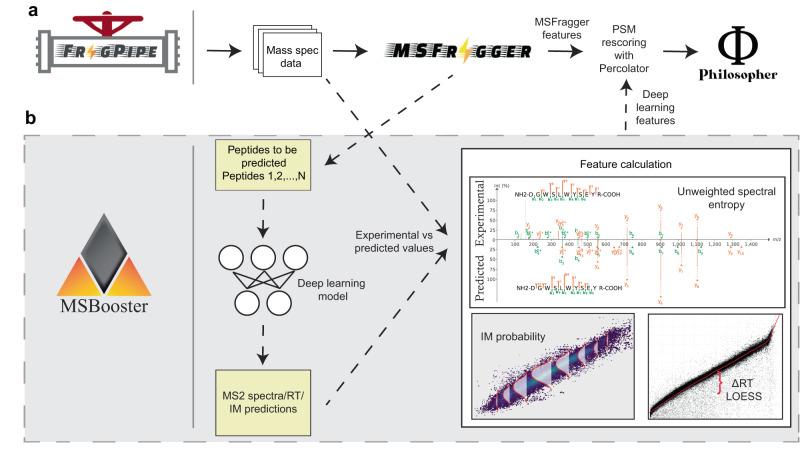
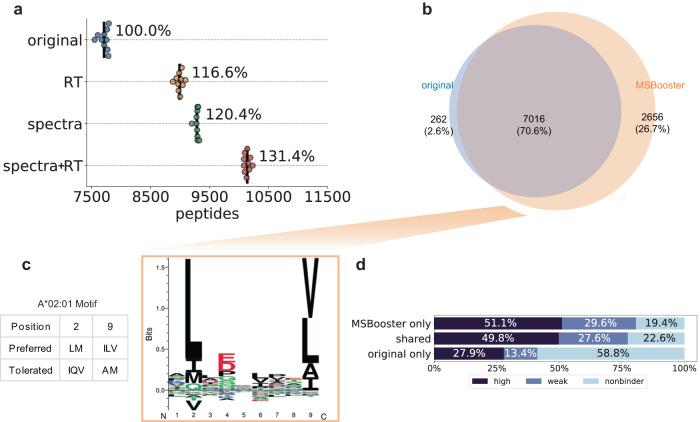
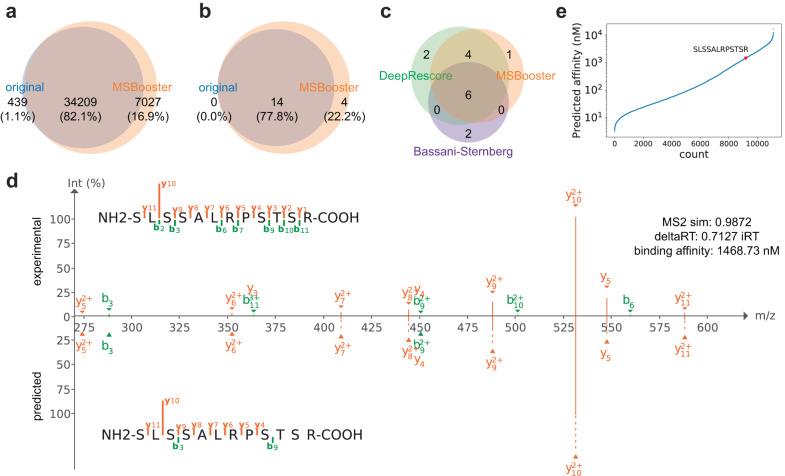
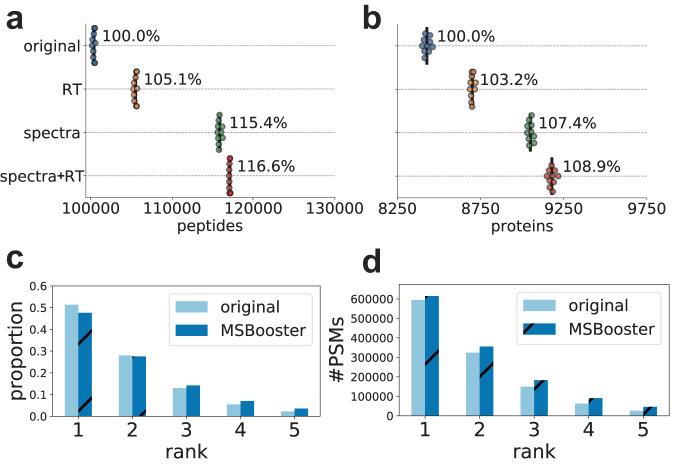
Peptide identification in liquid chromatography-tandem mass spectrometry (LC-MS/MS) experiments relies on computational algorithms for matching acquired MS/MS spectra against sequences of candidate peptides using database search tools, such as MSFragger. Here, we present a new tool, MSBooster, for rescoring peptide-to-spectrum matches using additional features incorporating deep learning-based predictions of peptide properties, such as LC retention time, ion mobility, and MS/MS spectra. We demonstrate the utility of MSBooster, in tandem with MSFragger and Percolator, in several different workflows, including nonspecific searches (immunopeptidomics), direct identification of peptides from data independent acquisition data, single-cell proteomics, and data generated on an ion mobility separation-enabled timsTOF MS platform. MSBooster is fast, robust, and fully integrated into the widely used FragPipe computational platform.
在液相色谱-串联质谱(LC-MS/MS)实验中,肽的鉴定依赖于计算算法,这些算法使用数据库搜索工具(如 MSFragger)将获得的 MS/MS 谱与候选肽的序列进行匹配。在这里,我们提出了一种新工具 MSBooster,用于使用基于深度学习的肽性质预测(如 LC 保留时间、离子淌度和 MS/MS 谱)等附加特征重新评分肽与谱的匹配。我们在几个不同的工作流程中展示了 MSBooster 与 MSFragger 和 Percolator 联合使用的效用,包括非特异性搜索(免疫肽组学)、直接从数据独立采集数据中鉴定肽、单细胞蛋白质组学以及在启用离子淌度分离的 timsTOF MS 平台上生成的数据。MSBooster 快速、稳健,并且完全集成到广泛使用的 FragPipe 计算平台中。


 Zotero 插件