
双特异性和三特异性免疫细胞衔接器在血液系统恶性肿瘤免疫治疗中的应用。
Bi- and trispecific immune cell engagers for immunotherapy of hematological malignancies.
机构信息
Immuno-Oncology and Immunotherapy Group, Biomedical Research Institute Hospital Universitario, 12 de Octubre, Madrid, Spain.
Cancer Immunotherapy Unit (UNICA), Department of Immunology, Hospital Universitario, 12 de Octubre, Madrid, Spain.
出版信息
J Hematol Oncol. 2023 Jul 27;16(1):83. doi: 10.1186/s13045-023-01482-w.
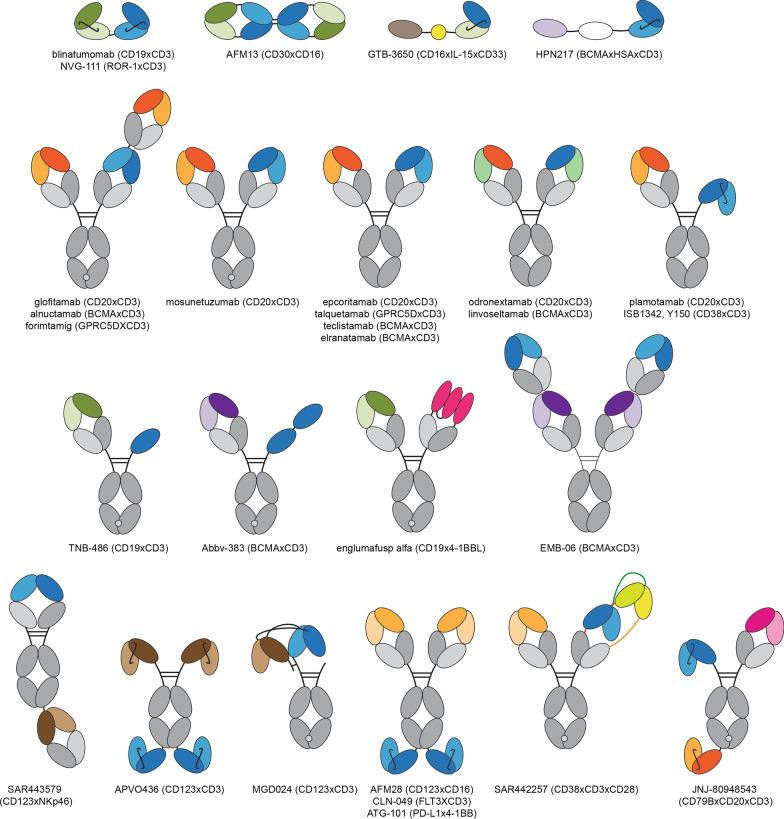
Immune cell engagers are engineered antibodies with at least one arm binding a tumor-associated antigen and at least another one directed against an activating receptor in immune effector cells: CD3 for recruitment of T cells and CD16a for NK cells. The first T cell engager (the anti-CD19 blinatumomab) was approved by the FDA in 2014, but no other one hit the market until 2022. Now the field is gaining momentum, with three approvals in 2022 and 2023 (as of May): the anti-CD20 × anti-CD3 mosunetuzumab and epcoritamab and the anti-B cell maturation antigen (BCMA) × anti-CD3 teclistamab, and another three molecules in regulatory review. T cell engagers will likely revolutionize the treatment of hematological malignancies in the short term, as they are considerably more potent than conventional monoclonal antibodies recognizing the same tumor antigens. The field is thriving, with a plethora of different formats and targets, and around 100 bispecific T cell engagers more are already in clinical trials. Bispecific NK cell engagers are also in early-stage clinical studies and may offer similar efficacy with milder side effects. Trispecific antibodies (engaging either T cell or NK cell receptors) raise the game even further with a third binding moiety, which allows either the targeting of an additional tumor-associated antigen to increase specificity and avoid immune escape or the targeting of additional costimulatory receptors on the immune cell to improve its effector functions. Altogether, these engineered molecules may change the paradigm of treatment for relapsed or refractory hematological malignancies.
免疫细胞衔接器是一种工程化抗体,至少有一个臂结合肿瘤相关抗原,至少另一个臂针对免疫效应细胞中的激活受体:CD3 用于招募 T 细胞,CD16a 用于 NK 细胞。第一个 T 细胞衔接器(抗 CD19 的blinatumomab)于 2014 年获得 FDA 批准,但直到 2022 年才有一种进入市场。现在该领域正在获得动力,2022 年和 2023 年(截至 5 月)有三种批准:抗 CD20×抗 CD3 的 mosunetuzumab 和 epcoritamab 以及抗 B 细胞成熟抗原(BCMA)×抗 CD3 的 teclistamab,还有另外三种药物正在监管审查中。T 细胞衔接器可能会在短期内彻底改变血液恶性肿瘤的治疗方式,因为它们比识别相同肿瘤抗原的常规单克隆抗体有效得多。该领域正在蓬勃发展,有大量不同的格式和靶点,大约有 100 种双特异性 T 细胞衔接器已经在临床试验中。双特异性 NK 细胞衔接器也处于早期临床研究阶段,可能具有类似的疗效和更温和的副作用。三特异性抗体(与 T 细胞或 NK 细胞受体结合)通过第三个结合部分进一步提高了游戏水平,该部分允许靶向额外的肿瘤相关抗原以提高特异性并避免免疫逃逸,或者靶向免疫细胞上的额外共刺激受体以提高其效应功能。总的来说,这些工程化分子可能会改变复发或难治性血液恶性肿瘤的治疗模式。
 Zotero 插件