
黏菌素治疗期间急性肾损伤的患病率及危险因素:来自黎巴嫩的一项回顾性队列研究
The Prevalence and Risk Factors of Acute Kidney Injury during Colistin Therapy: A Retrospective Cohort Study from Lebanon.
作者信息
Moghnieh Rima, Husni Rola, Helou Mariana, Abdallah Dania, Sinno Loubna, Jadayel Marwa, Diab Kawsar, Chami Carmen, Al Rachid Marah, Awad Diana Caroline, Zaiter Aline, Sayegh Mohamed H
机构信息
Department of Internal Medicine, Lebanese American University Medical Center, 13-5053 Beirut, Lebanon.
Department of Internal Medicine, Division of Infectious Diseases, Makassed General Hospital, 11-6301 Beirut, Lebanon.
出版信息
Antibiotics (Basel). 2023 Jul 13;12(7):1183. doi: 10.3390/antibiotics12071183.
INTRODUCTION
The current study aimed to determine the prevalence, risk factors, and stages of severity of acute kidney injury (AKI) caused by colistimethate sodium (CMS) treatment in patients diagnosed with systemic antibiotic-resistant Gram-negative bacterial infections. The predictors of all-cause mortality in this patient population were also examined.
METHODS
This retrospective cohort study included patients who were admitted to a university-affiliated hospital and acute tertiary care referral center in Beirut, Lebanon between January 2015 and December 2018 and underwent CMS treatment for a period of 48 h or more.
RESULTS
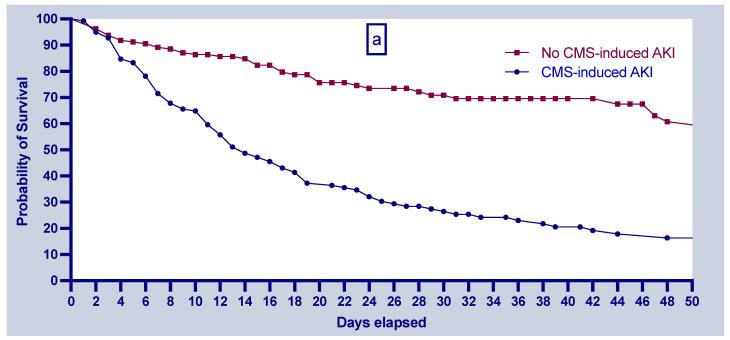
The study sample included 298 adult patients, of which 46.3% ( = 138/298) developed AKI (assessed using the Kidney Disease Improving Global Outcomes (KDIGO) criteria). Of these, 37.7% ( = 51/138) were diagnosed with stage 1 AKI, 23.9% with stage 2 ( = 33/138), and 38.4% with stage 3 ( = 53/138). Nephrotoxicity was reversed in 87.5% of AKI patients who survived until hospital discharge. Independent risk factors for AKI included patient age ≥ 75 years (aOR = 1.854; 95% CI: 1.060-3.241; -value = 0.03); underlying chronic kidney disease (aOR = 4.849; 95% CI: 2.618-9.264; -value < 0.0001); and concomitant use of vasopressors (aOR = 4.305; 95% CI: 2.517-7.456; -value < 0.0001). Multivariate analysis showed that the predictors of severe AKI (stage 2 or 3) included baseline hypoalbuminemia (aOR = 2.542; 95% CI: 1.000-6.564; -value = 0.05); concomitant use of vasopressors (aOR = 6.396; 95% CI: 2.741-15.87; -value < 0.0001); and CMS days of therapy (DOT) prior to development of AKI ≥ 7 days (aOR = 4.728; 95% CI: 2.069-11.60; -value < 0.0001). All-cause mortality was recorded in 51.3% of patients ( = 153/298), and this was significantly higher in patients with AKI (76.8%; = 106/138) compared to those without (29.4%; = 47/160; OR = 7.964; 95% CI: 4.727-13.417; -value < 0.0001). Independent predictors of all-cause mortality included a baseline Charlson comorbidity index score ≥5 (aOR = 4.514; 95% CI: 2.443-8.530; -value < 0.0001); concomitant use of vasopressors (aOR = 7.76; 95% CI: 4.238-14.56; -value < 0.0001); and CMS-induced AKI (aOR = 4.117; 95% CI: 2.231-7.695; -value < 0.0001).
CONCLUSIONS
The findings of this study suggest that old age, history of chronic kidney disease, and concomitant vasopressor treatment are all independent predictors of CMS-induced AKI. The risk of developing severe AKI significantly increases with CMS DOT. Understanding the risk factors of nephrotoxicity is essential for improving prognosis and treatment outcomes.
引言
本研究旨在确定诊断为全身性耐抗生素革兰氏阴性菌感染的患者中,由多粘菌素甲磺酸钠(CMS)治疗引起的急性肾损伤(AKI)的患病率、危险因素和严重程度阶段。还研究了该患者群体全因死亡率的预测因素。
方法
这项回顾性队列研究纳入了2015年1月至2018年12月期间在黎巴嫩贝鲁特一家大学附属医院和急性三级护理转诊中心住院,并接受了48小时或更长时间CMS治疗的患者。
结果
研究样本包括298名成年患者,其中46.3%(=138/298)发生了AKI(根据改善全球肾脏病预后组织(KDIGO)标准评估)。其中,37.7%(=51/138)被诊断为1期AKI,23.9%为2期(=33/138),38.4%为3期(=53/138)。在存活至出院的AKI患者中,87.5%的肾毒性得到逆转。AKI的独立危险因素包括患者年龄≥75岁(调整后比值比[aOR]=1.854;95%置信区间[CI]:1.060 - 3.241;P值=0.03);潜在的慢性肾脏病(aOR = 4.849;95% CI:2.618 - 9.264;P值<0.0001);以及同时使用血管升压药(aOR = 4.305;95% CI:2.517 - 7.456;P值<0.0001)。多变量分析表明,严重AKI(2期或3期)的预测因素包括基线低白蛋白血症(aOR = 2.542;95% CI:1.000 - 6.564;P值=0.05);同时使用血管升压药(aOR = 6.396;95% CI:2.741 - 15.87;P值<0.0001);以及发生AKI前CMS治疗天数(DOT)≥7天(aOR = 4.728;95% CI:2.069 - 11.60;P值<0.0001)。51.3%的患者(=153/298)记录了全因死亡率,与未发生AKI的患者(29.4%;=47/160;比值比[OR]=7.964;95% CI:4.727 - 13.417;P值<0.0001)相比,AKI患者的全因死亡率显著更高。全因死亡率的独立预测因素包括基线Charlson合并症指数评分≥5(aOR = 4.514;95% CI:2.443 - 8.530;P值<0.0001);同时使用血管升压药(aOR = 7.76;95% CI:4.238 - 14.56;P值<0.0001);以及CMS诱导的AKI(aOR = 4.117;95% CI:2.231 - 7.695;P值<0.0001)。
结论
本研究结果表明,老年患者、慢性肾脏病病史以及同时进行血管升压药治疗均是CMS诱导的AKI的独立预测因素。随着CMS治疗天数的增加,发生严重AKI的风险显著增加。了解肾毒性的危险因素对于改善预后和治疗结果至关重要。

 Zotero 插件