
用于人类癌症的p53靶向疗法的发展
The Development of p53-Targeted Therapies for Human Cancers.
作者信息
Lu Yier, Wu Meng, Xu Yang, Yu Lili
机构信息
Department of Medical Oncology, Key Laboratory of Cancer Prevention and Intervention, Ministry of Education, The Second Affiliated Hospital, School of Medicine, Zhejiang University, Hangzhou 310009, China.
Department of Cardiology, The Second Affiliated Hospital, Cardiovascular Key Lab of Zhejiang Province, School of Medicine, Zhejiang University, Hangzhou 310009, China.
出版信息
Cancers (Basel). 2023 Jul 10;15(14):3560. doi: 10.3390/cancers15143560.
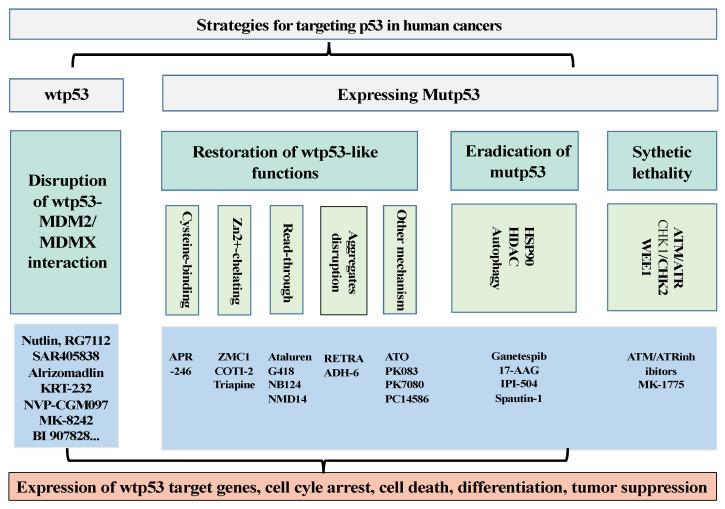
p53 plays a critical role in tumor suppression and is the most frequently mutated gene in human cancers. Most p53 mutants (mutp53) are missense mutations and are thus expressed in human cancers. In human cancers that retain wtp53, the wtp53 activities are downregulated through multiple mechanisms. For example, the overexpression of the negative regulators of p53, MDM2/MDMX, can also efficiently destabilize and inactivate wtp53. Therefore, both wtp53 and mutp53 have become promising and intensively explored therapeutic targets for cancer treatment. Current efforts include the development of small molecule compounds to disrupt the interaction between wtp53 and MDM2/MDMX in human cancers expressing wtp53 and to restore wtp53-like activity to p53 mutants in human cancers expressing mutp53. In addition, a synthetic lethality approach has been applied to identify signaling pathways affected by p53 dysfunction, which, when targeted, can lead to cell death. While an intensive search for p53-targeted cancer therapy has produced potential candidates with encouraging preclinical efficacy data, it remains challenging to develop such drugs with good efficacy and safety profiles. A more in-depth understanding of the mechanisms of action of these p53-targeting drugs will help to overcome these challenges.
p53在肿瘤抑制中发挥关键作用,是人类癌症中最常发生突变的基因。大多数p53突变体(mutp53)为错义突变,因此在人类癌症中表达。在保留野生型p53(wtp53)的人类癌症中,wtp53的活性通过多种机制被下调。例如,p53的负调节因子MDM2/MDMX的过表达也能有效使wtp53不稳定并使其失活。因此,wtp53和mutp53都已成为癌症治疗中很有前景且被深入探索的治疗靶点。目前的努力包括开发小分子化合物,以破坏在表达wtp53的人类癌症中wtp53与MDM2/MDMX之间的相互作用,并在表达mutp53的人类癌症中恢复p53突变体的wtp53样活性。此外,一种合成致死方法已被用于识别受p53功能障碍影响的信号通路,当针对这些通路时可导致细胞死亡。虽然对p53靶向癌症治疗的深入研究已产生了具有令人鼓舞的临床前疗效数据的潜在候选药物,但开发具有良好疗效和安全性的此类药物仍然具有挑战性。对这些p53靶向药物作用机制的更深入理解将有助于克服这些挑战。
 Zotero 插件