
在高收入国家的干预健康研究中使用交叉性理论:范围综述。
Use of Intersectionality Theory in Interventional Health Research in High-Income Countries: A Scoping Review.
机构信息
Population Health Sciences, Bristol Medical School, University of Bristol, Bristol BS8 1UD, UK.
Department of Sociological Studies, The University of Sheffield, The Wave, 2 Whitham Road, Sheffield S10 2AH, UK.
出版信息
Int J Environ Res Public Health. 2023 Jul 15;20(14):6370. doi: 10.3390/ijerph20146370.
BACKGROUND
Intersectionality theory posits that considering a single axis of inequality is limited and that considering (dis)advantage on multiple axes simultaneously is needed. The extent to which intersectionality has been used within interventional health research has not been systematically examined. This scoping review aimed to map out the use of intersectionality. It explores the use of intersectionality when designing and implementing public health interventions, or when analysing the impact of these interventions.
METHODS
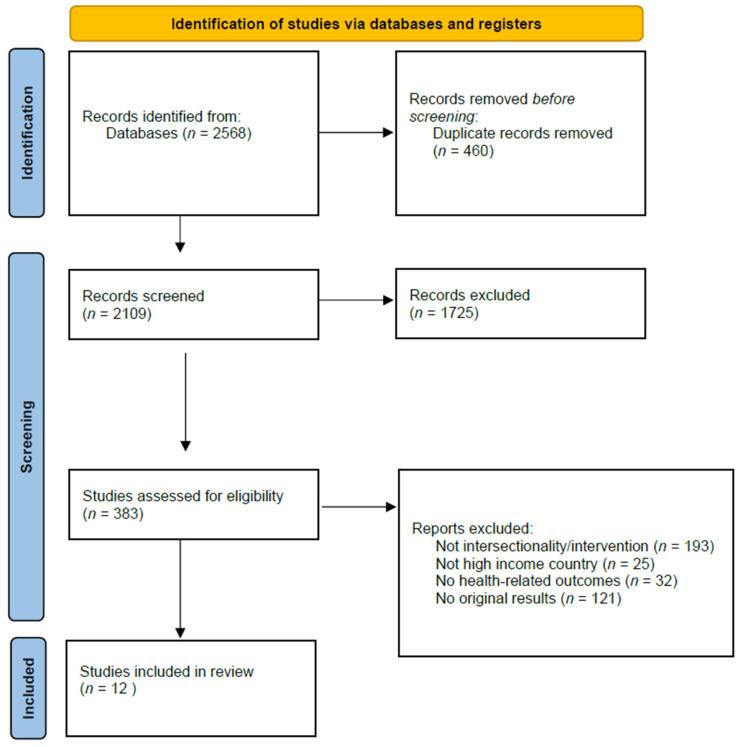
We undertook systematic searches of Medline and Scopus from inception through June 2021, with key search terms including "intersectionality", "interventions" and "public health". References were screened and those using intersectionality and primary data from high-income countries were included and relevant data synthesised.
RESULTS
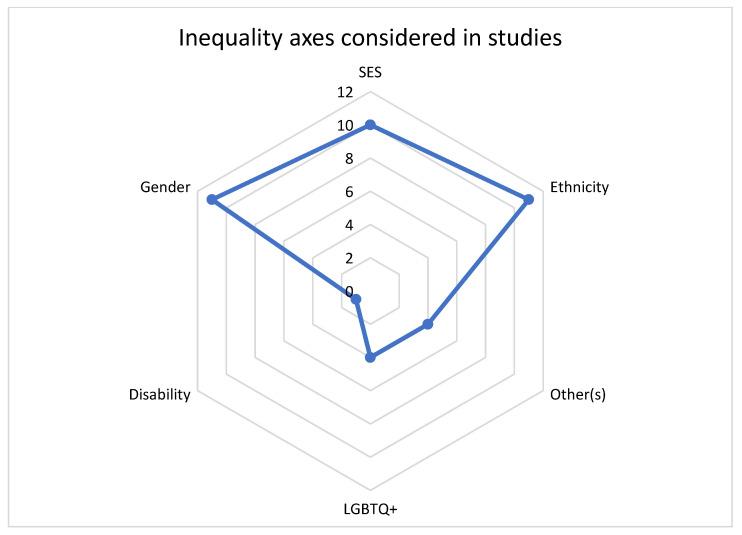
After screening 2108 studies, we included 12 studies. Six studies were qualitative and focused on alcohol and substance abuse (two studies), mental health (two studies), general health promotion (one study) and housing interventions (one study). The three quantitative studies examined mental health (two studies) and smoking cessation (one study), while the three mixed-method studies examined mental health (two studies) and sexual exploitation (one study). Intersectionality was used primarily to analyse intervention effects (eight studies), but also for intervention design (three studies), and one study used it for both design and analysis. Ethnicity and gender were the most commonly included axes of inequality (11 studies), followed by socio-economic position (10 studies). Four studies included consideration of LGBTQ+ and only one considered physical disability. Intersectional frameworks were used by studies to formulate specific questions and assess differences in outcomes by intersectional markers of identity. Analytical studies also recommended intersectionality approaches to improve future treatments and to structure interventions to focus on power and structural dynamics.
CONCLUSIONS
Intersectionality theory is not yet commonly used in interventional health research, in either design or analysis. Conditions such as mental health have more studies using intersectionality, while studies considering LGBTQ+ and physical disability as axes of inequality are particularly sparse. The lack of studies in our review suggests that theoretical and methodological advancements need to be made in order to increase engagement with intersectionality in interventional health.
背景
交叉性理论认为,仅考虑一个不平等的轴是有限的,需要同时考虑多个轴上的(不利)优势。交叉性在干预性健康研究中的应用程度尚未得到系统检查。本范围综述旨在描绘交叉性的应用。它探讨了在设计和实施公共卫生干预措施时,或在分析这些干预措施的影响时,使用交叉性的情况。
方法
我们对从开始到 2021 年 6 月的 Medline 和 Scopus 进行了系统搜索,主要搜索词包括“交叉性”、“干预”和“公共卫生”。筛选参考文献,纳入使用交叉性和来自高收入国家的原始数据的研究,并综合相关数据。
结果
在筛选了 2108 项研究后,我们纳入了 12 项研究。其中 6 项为定性研究,重点关注酒精和药物滥用(2 项研究)、心理健康(2 项研究)、一般健康促进(1 项研究)和住房干预(1 项研究)。3 项定量研究检查了心理健康(2 项研究)和戒烟(1 项研究),而 3 项混合方法研究检查了心理健康(2 项研究)和性剥削(1 项研究)。交叉性主要用于分析干预效果(8 项研究),但也用于干预设计(3 项研究),一项研究同时用于设计和分析。种族和性别是最常被纳入的不平等轴(11 项研究),其次是社会经济地位(10 项研究)。有 4 项研究考虑了 LGBTQ+,只有 1 项研究考虑了身体残疾。交叉性框架被研究用于制定具体问题,并评估身份交叉标记的结果差异。分析性研究还建议采用交叉性方法来改进未来的治疗方法,并构建干预措施,以关注权力和结构动态。
结论
交叉性理论尚未在干预性健康研究中得到广泛应用,无论是在设计还是分析中。心理健康等情况的研究使用交叉性的情况较多,而将 LGBTQ+和身体残疾作为不平等轴的研究则特别稀少。我们的综述中缺乏研究表明,需要在理论和方法上取得进展,以增加干预性健康中对交叉性的参与。
 Zotero 插件