
澳大利亚 1990-2019 年疾病负担和趋势及其危险因素:2019 年全球疾病负担研究的系统分析。
The burden and trend of diseases and their risk factors in Australia, 1990-2019: a systematic analysis for the Global Burden of Disease Study 2019.
出版信息
Lancet Public Health. 2023 Aug;8(8):e585-e599. doi: 10.1016/S2468-2667(23)00123-8.
BACKGROUND
A comprehensive understanding of temporal trends in the disease burden in Australia is lacking, and these trends are required to inform health service planning and improve population health. We explored the burden and trends of diseases and their risk factors in Australia from 1990 to 2019 through a comprehensive analysis of the Global Burden of Disease Study (GBD) 2019.
METHODS
In this systematic analysis for GBD 2019, we estimated all-cause mortality using the standardised GBD methodology. Data sources included primarily vital registration systems with additional data from sample registrations, censuses, surveys, surveillance, registries, and verbal autopsies. A composite measure of health loss caused by fatal and non-fatal disease burden (disability-adjusted life-years [DALYs]) was calculated as the sum of years of life lost (YLLs) and years of life lived with disability (YLDs). Comparisons between Australia and 14 other high-income countries were made.
FINDINGS
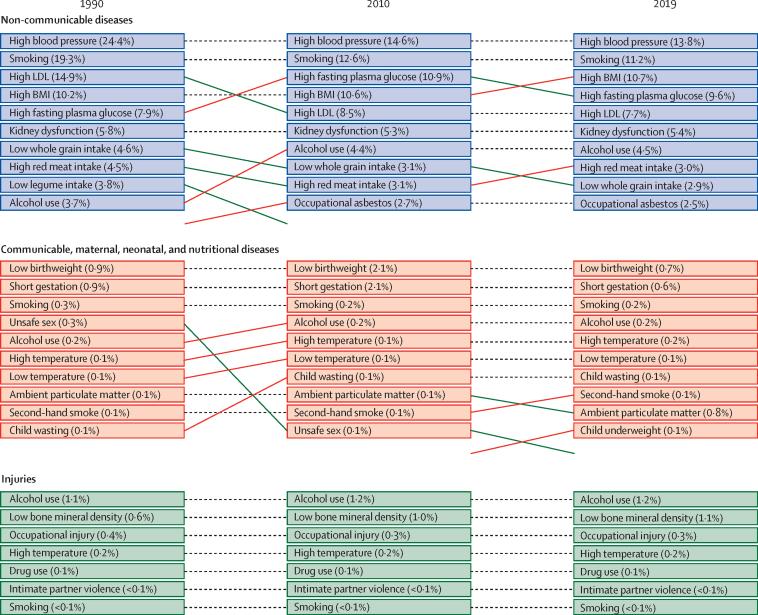
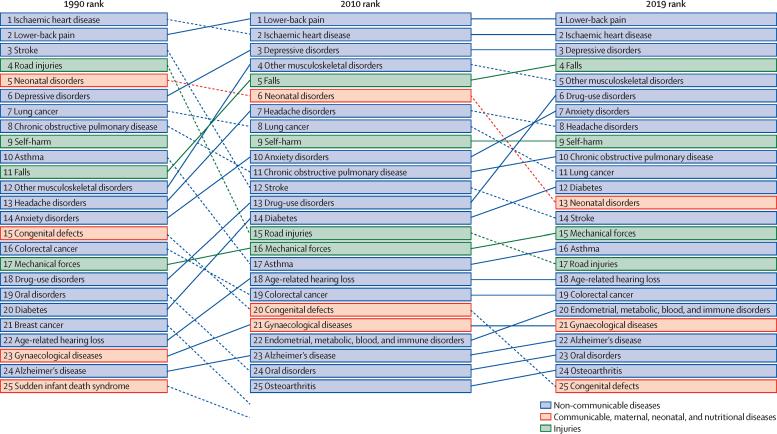
Life expectancy at birth in Australia improved from 77·0 years (95% uncertainty interval [UI] 76·9-77·1) in 1990 to 82·9 years (82·7-83·1) in 2019. Between 1990 and 2019, the age-standardised death rate decreased from 637·7 deaths (95% UI 634·1-641·3) to 389·2 deaths (381·4-397·6) per 100 000 population. In 2019, non-communicable diseases remained the major cause of mortality in Australia, accounting for 90·9% (95% UI 90·4-91·9) of total deaths, followed by injuries (5·7%, 5·3-6·1) and communicable, maternal, neonatal, and nutritional diseases (3·3%, 2·9-3·7). Ischaemic heart disease, self-harm, tracheal, bronchus, and lung cancer, stroke, and colorectal cancer were the leading causes of YLLs. The leading causes of YLDs were low back pain, depressive disorders, other musculoskeletal diseases, falls, and anxiety disorders. The leading risk factors for DALYs were high BMI, smoking, high blood pressure, high fasting plasma glucose, and drug use. Between 1990 and 2019, all-cause DALYs decreased by 24·6% (95% UI 21·5-28·1). Relative to similar countries, Australia's ranking improved for age-standardised death rates and life expectancy at birth but not for YLDs and YLLs between 1990 and 2019.
INTERPRETATION
An important challenge for Australia is to address the health needs of people with non-communicable diseases. The health systems must be prepared to address the increasing demands of non-communicable diseases and ageing.
FUNDING
Bill & Melinda Gates Foundation.
背景
对澳大利亚疾病负担的时间趋势的全面了解尚不完善,需要这些趋势来为卫生服务规划提供信息,并改善人口健康。我们通过对 2019 年全球疾病负担研究(GBD)的全面分析,探讨了澳大利亚 1990 年至 2019 年期间疾病及其风险因素的负担和趋势。
方法
在本 GBD 2019 的系统分析中,我们使用标准化 GBD 方法估计全因死亡率。数据来源主要包括主要的生命登记系统,以及来自样本登记、人口普查、调查、监测、登记和口述尸检的额外数据。由致命和非致命疾病负担引起的健康损失的综合衡量指标(伤残调整生命年[DALYs])计算为生命损失年数(YLLs)和生命存在残疾年数(YLDs)之和。比较了澳大利亚与其他 14 个高收入国家。
结果
澳大利亚的出生预期寿命从 1990 年的 77.0 岁(95%不确定性区间[UI]76.9-77.1)提高到 2019 年的 82.9 岁(82.7-83.1)。1990 年至 2019 年间,年龄标准化死亡率从每 100000 人 637.7 人死亡(95%UI 634.1-641.3)下降至 389.2 人死亡(381.4-397.6)。2019 年,非传染性疾病仍然是澳大利亚死亡的主要原因,占总死亡人数的 90.9%(95%UI 90.4-91.9),其次是伤害(5.7%,5.3-6.1)和传染性疾病、孕产妇、新生儿和营养性疾病(3.3%,2.9-3.7)。缺血性心脏病、自残、气管、支气管和肺癌、中风和结直肠癌是 YLL 的主要原因。YLD 的主要原因是腰痛、抑郁障碍、其他肌肉骨骼疾病、跌倒和焦虑障碍。DALYs 的主要风险因素是高 BMI、吸烟、高血压、高空腹血糖和药物使用。1990 年至 2019 年间,全因 DALYs 减少了 24.6%(95%UI 21.5-28.1)。与类似国家相比,澳大利亚在年龄标准化死亡率和出生预期寿命方面的排名有所提高,但在 1990 年至 2019 年期间,YLD 和 YLL 方面的排名并未提高。
解释
澳大利亚面临的一个重要挑战是解决非传染性疾病患者的健康需求。卫生系统必须准备好应对非传染性疾病和人口老龄化带来的日益增长的需求。
资金来源
比尔及梅琳达·盖茨基金会。
 Zotero 插件