
几何深度学习作为抗菌肽预测的潜在工具。
Geometric deep learning as a potential tool for antimicrobial peptide prediction.
作者信息
Fernandes Fabiano C, Cardoso Marlon H, Gil-Ley Abel, Luchi Lívia V, da Silva Maria G L, Macedo Maria L R, de la Fuente-Nunez Cesar, Franco Octavio L
机构信息
Centro de Análises Proteômicas e Bioquímicas, Pós-Graduação em Ciências Genômicas e Biotecnologia, Universidade Católica de Brasília, Brasília, Brazil.
Departamento de Ciência da Computação, Instituto Federal de Brasília, Brasília, Brazil.
出版信息
Front Bioinform. 2023 Jul 13;3:1216362. doi: 10.3389/fbinf.2023.1216362. eCollection 2023.
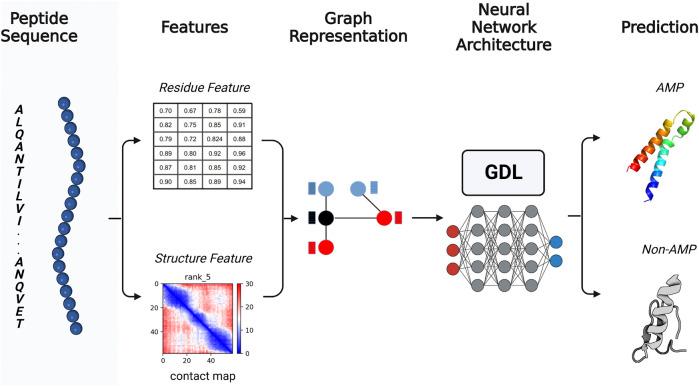
Antimicrobial peptides (AMPs) are components of natural immunity against invading pathogens. They are polymers that fold into a variety of three-dimensional structures, enabling their function, with an underlying sequence that is best represented in a non-flat space. The structural data of AMPs exhibits non-Euclidean characteristics, which means that certain properties, e.g., differential manifolds, common system of coordinates, vector space structure, or translation-equivariance, along with basic operations like convolution, in non-Euclidean space are not distinctly established. Geometric deep learning (GDL) refers to a category of machine learning methods that utilize deep neural models to process and analyze data in non-Euclidean settings, such as graphs and manifolds. This emerging field seeks to expand the use of structured models to these domains. This review provides a detailed summary of the latest developments in designing and predicting AMPs utilizing GDL techniques and also discusses both current research gaps and future directions in the field.
抗菌肽(AMPs)是抵抗入侵病原体的天然免疫的组成部分。它们是折叠成各种三维结构以实现其功能的聚合物,其基础序列在非平面空间中得到最佳体现。抗菌肽的结构数据具有非欧几里得特征,这意味着在非欧几里得空间中,某些属性,例如微分流形、通用坐标系、向量空间结构或平移不变性,以及诸如卷积等基本运算,并未明确确立。几何深度学习(GDL)是指一类利用深度神经模型在非欧几里得环境(如图和流形)中处理和分析数据的机器学习方法。这个新兴领域试图将结构化模型的应用扩展到这些领域。本综述详细总结了利用几何深度学习技术设计和预测抗菌肽的最新进展,并讨论了该领域当前的研究差距和未来方向。
 Zotero 插件