
自我报告的药物依从性工具及其在中低收入国家的适用性:范围综述。
Self-reported medication adherence instruments and their applicability in low-middle income countries: a scoping review.
机构信息
Department of Pharmacology and Clinical Pharmacy, Faculty of Pharmacy, Universitas Padjadjaran, Jatinangor, Indonesia.
Center of Excellence for Pharmaceutical Care Innovation, Faculty of Pharmacy, Universitas Padjadjaran, Jatinangor, Indonesia.
出版信息
Front Public Health. 2023 Jul 13;11:1104510. doi: 10.3389/fpubh.2023.1104510. eCollection 2023.
INTRODUCTION
Medication non-adherence is an important public health issue, associated with poor clinical and economic outcomes. Globally, self-reported instruments are the most widely used method to assess medication adherence. However, the majority of these were developed in high-income countries (HICs) with a well-established health care system. Their applicability in low- and middle-income countries (LMICs) remains unclear. The objective of this study is to systematically review the applicability of content and use of self-reported adherence instruments in LMICs.
METHOD
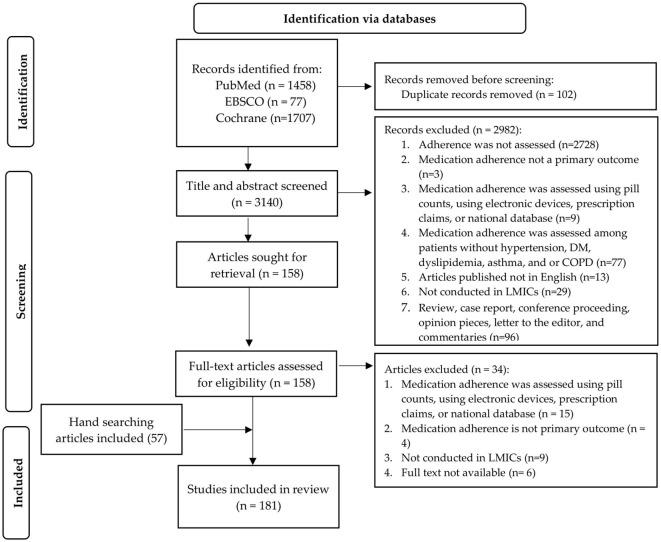
A scoping review informed by a literature search in Pubmed, EBSCO, and Cochrane databases was conducted to identify studies assessing medication adherence using self-reported instruments for patients with five common chronic diseases [hypertension, diabetes, dyslipidemia, asthma, or Chronic Obstructive Pulmonary Disease (COPD)] in LMICs up to January 2022 with no constraints on publication year. Two reviewers performed the study selection process, data extraction and outcomes assessment independently. Outcomes focused on LMIC applicability of the self-reported adherence instruments assessed by (i) containing LMIC relevant adherence content; (ii) methodological quality and (iii) fees for use.
FINDINGS
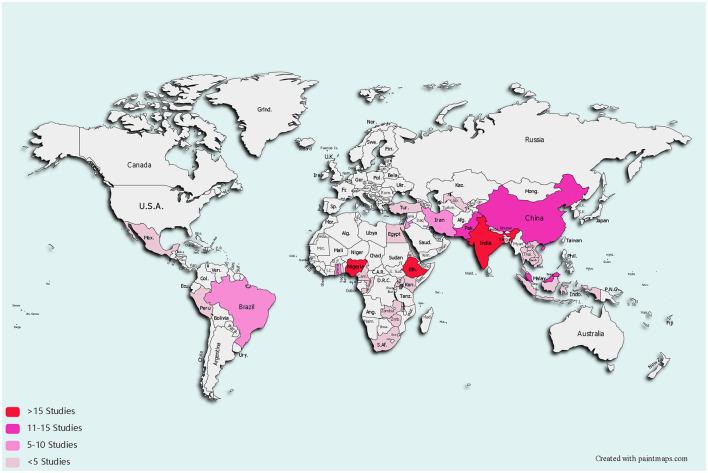
We identified 181 studies that used self-reported instruments for assessing medication adherence in LMICs. A total of 32 distinct types of self-reported instruments to assess medication adherence were identified. Of these, 14 self-reported instruments were developed in LMICs, while the remaining ones were adapted from self-reported instruments originally developed in HICs. All self-reported adherence instruments in studies included presented diverse potential challenges regarding their applicability in LMICs, included an underrepresentation of LMIC relevant non-adherence reasons, such as financial issues, use of traditional medicines, religious beliefs, lack of communication with healthcare provider, running out of medicine, and access to care. Almost half of included studies showed that the existing self-reported adherence instruments lack sufficient evidence regarding cross cultural validation and internal consistency. In 70% of the studies, fees applied for using the self-reported instruments in LMICs.
CONCLUSION
There seems insufficient emphasis on applicability and methodological rigor of self-reported medication adherence instruments used in LMICs. This presents an opportunity for developing a self-reported adherence instrument that is suitable to health systems and resources in LMICs.
SYSTEMATIC REVIEW REGISTRATION
https://www.crd.york.ac.uk/prospero/, identifier: CRD42022302215.
简介
药物依从性是一个重要的公共卫生问题,与临床和经济结果不佳有关。在全球范围内,自我报告工具是评估药物依从性最广泛使用的方法。然而,这些工具中的大多数都是在高收入国家(HIC)开发的,这些国家拥有完善的医疗保健系统。它们在中低收入国家(LMIC)的适用性尚不清楚。本研究的目的是系统地审查自我报告依从性工具在 LMIC 中的内容和使用的适用性。
方法
根据在 Pubmed、EBSCO 和 Cochrane 数据库中进行的文献检索,开展了一项范围界定综述,以确定评估五种常见慢性疾病(高血压、糖尿病、血脂异常、哮喘或慢性阻塞性肺疾病(COPD))患者药物依从性的研究使用自我报告仪器在 LMIC 中进行,截至 2022 年 1 月,对出版物年份没有限制。两名评审员独立进行了研究选择过程、数据提取和结果评估。结果侧重于自我报告依从性工具在 LMIC 中的适用性,评估方法包括(i)包含 LMIC 相关依从性内容;(ii)方法学质量和(iii)使用费用。
发现
我们确定了 181 项在 LMIC 中使用自我报告仪器评估药物依从性的研究。总共确定了 32 种不同类型的自我报告仪器来评估药物依从性。其中,14 种自我报告仪器是在 LMIC 中开发的,而其余仪器是从最初在 HIC 开发的自我报告仪器改编而来的。研究中包含的所有自我报告的依从性仪器都存在不同的潜在挑战,包括对 LMIC 相关不依从原因的代表性不足,例如经济问题、使用传统药物、宗教信仰、与医疗保健提供者缺乏沟通、药物用尽和获得医疗保健。在所包括的研究中,近一半的研究表明,现有的自我报告依从性仪器在跨文化验证和内部一致性方面缺乏足够的证据。在 70%的研究中,在 LMIC 中使用自我报告仪器需要支付费用。
结论
似乎对在 LMIC 中使用的自我报告药物依从性仪器的适用性和方法学严谨性重视不够。这为开发适合 LMIC 卫生系统和资源的自我报告依从性仪器提供了机会。
系统审查注册


 Zotero 插件