
光遗传脊髓刺激促进亚慢性颈脊髓损伤大鼠新轴突生长和熟练前肢恢复。
Optogenetic spinal stimulation promotes new axonal growth and skilled forelimb recovery in rats with sub-chronic cervical spinal cord injury.
机构信息
Department of Rehabilitation Medicine, University of Washington, Seattle, WA 98195, United States of America.
Center for Neurotechnology, Seattle, WA 98195, United States of America.
出版信息
J Neural Eng. 2023 Sep 12;20(5):056005. doi: 10.1088/1741-2552/acec13.
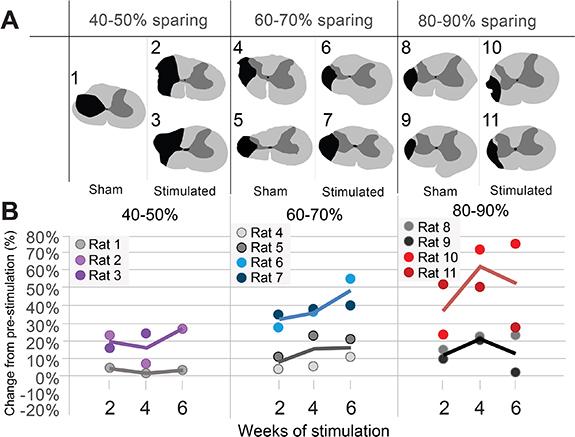
Spinal cord injury (SCI) leads to debilitating sensorimotor deficits that greatly limit quality of life. This work aims to develop a mechanistic understanding of how to best promote functional recovery following SCI. Electrical spinal stimulation is one promising approach that is effective in both animal models and humans with SCI. Optogenetic stimulation is an alternative method of stimulating the spinal cord that allows for cell-type-specific stimulation. The present work investigates the effects of preferentially stimulating neurons within the spinal cord and not glial cells, termed 'neuron-specific' optogenetic spinal stimulation. We examined forelimb recovery, axonal growth, and vasculature after optogenetic or sham stimulation in rats with cervical SCI.Adult female rats received a moderate cervical hemicontusion followed by the injection of a neuron-specific optogenetic viral vector ipsilateral and caudal to the lesion site. Animals then began rehabilitation on the skilled forelimb reaching task. At four weeks post-injury, rats received a micro-light emitting diode (µLED) implant to optogenetically stimulate the caudal spinal cord. Stimulation began at six weeks post-injury and occurred in conjunction with activities to promote use of the forelimbs. Following six weeks of stimulation, rats were perfused, and tissue stained for GAP-43, laminin, Nissl bodies and myelin. Location of viral transduction and transduced cell types were also assessed.Our results demonstrate that neuron-specific optogenetic spinal stimulation significantly enhances recovery of skilled forelimb reaching. We also found significantly more GAP-43 and laminin labeling in the optogenetically stimulated groups indicating stimulation promotes axonal growth and angiogenesis.These findings indicate that optogenetic stimulation is a robust neuromodulator that could enable future therapies and investigations into the role of specific cell types, pathways, and neuronal populations in supporting recovery after SCI.
脊髓损伤 (SCI) 导致使人衰弱的感觉运动功能缺陷,极大地限制了生活质量。这项工作旨在深入了解如何最好地促进 SCI 后的功能恢复。脊髓电刺激是一种很有前途的方法,在 SCI 的动物模型和人类中都有效。光遗传学刺激是一种替代的刺激脊髓的方法,它允许对特定细胞类型进行刺激。本研究探讨了优先刺激脊髓内神经元而不是神经胶质细胞的效果,称为“神经元特异性”光遗传学脊髓刺激。我们检查了光遗传学或假刺激后颈椎 SCI 大鼠的前肢恢复、轴突生长和血管生成。成年雌性大鼠接受中度颈椎半脱位,然后在损伤部位同侧和尾侧注射神经元特异性光遗传学病毒载体。动物随后开始在熟练的前肢抓握任务中进行康复。在损伤后四周,大鼠接受微发光二极管 (µLED) 植入物以光遗传学方式刺激尾部脊髓。刺激在损伤后六周开始,并与促进前肢使用的活动同时进行。刺激六周后,大鼠被灌注,组织用 GAP-43、层粘连蛋白、尼氏小体和髓鞘染色。还评估了病毒转导的位置和转导的细胞类型。我们的结果表明,神经元特异性光遗传学脊髓刺激可显著增强熟练的前肢抓握恢复。我们还发现光遗传学刺激组中 GAP-43 和层粘连蛋白标记明显增加,表明刺激促进了轴突生长和血管生成。这些发现表明光遗传学刺激是一种强大的神经调节剂,可用于未来的治疗方法和对特定细胞类型、途径和神经元群体在支持 SCI 后恢复中的作用的研究。




 Zotero 插件