
比较2种晶体结构以及12种由AlphaFold2预测的人类膜葡萄糖转运蛋白及其水溶性谷氨酰胺、苏氨酸和酪氨酸变体。
Comparing 2 crystal structures and 12 AlphaFold2-predicted human membrane glucose transporters and their water-soluble glutamine, threonine and tyrosine variants.
作者信息
Smorodina Eva, Tao Fei, Qing Rui, Jin David, Yang Steve, Zhang Shuguang
机构信息
Laboratory for Computational and Systems Immunology, Department of Immunology, University of Oslo, Oslo, Norway.
Laboratory of Food Microbial Technology, State Key Laboratory of Microbial Metabolism, School of Life Sciences and Biotechnology, Shanghai Jiaotong University, Shanghai 200240, China.
出版信息
QRB Discov. 2022 Jun 13;3:e5. doi: 10.1017/qrd.2022.6. eCollection 2022.
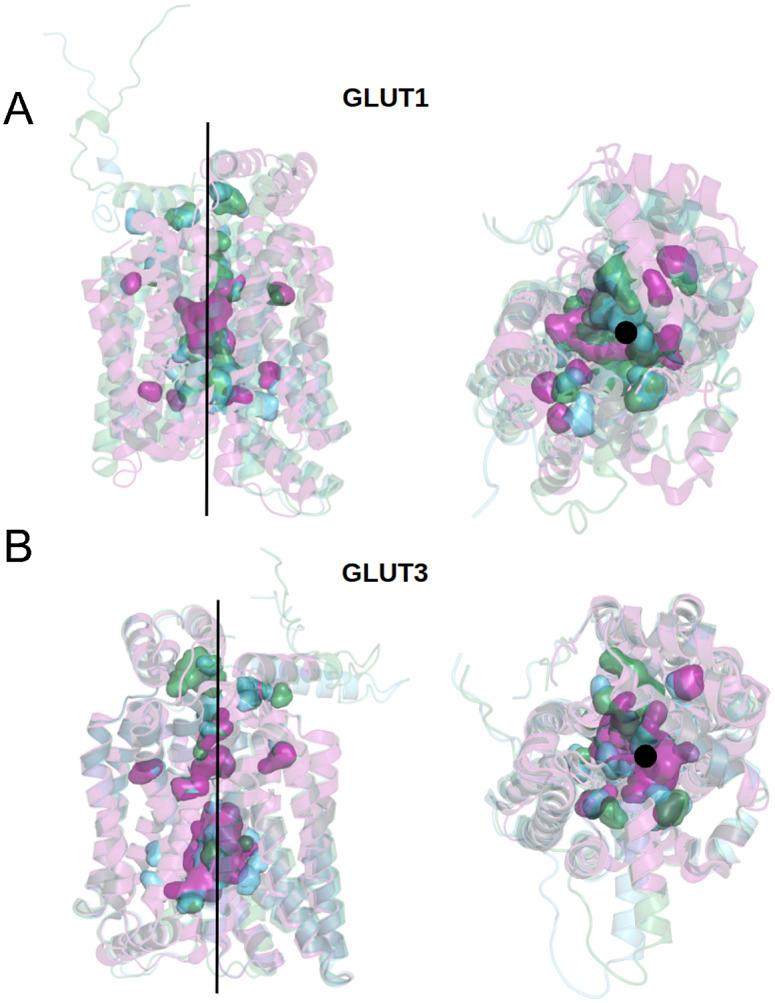
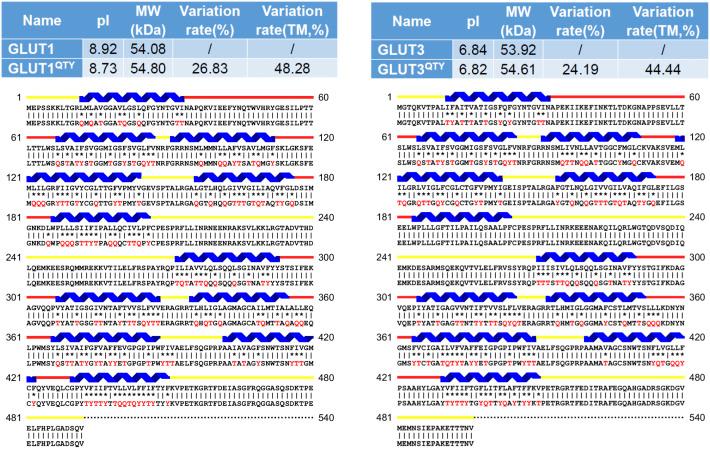
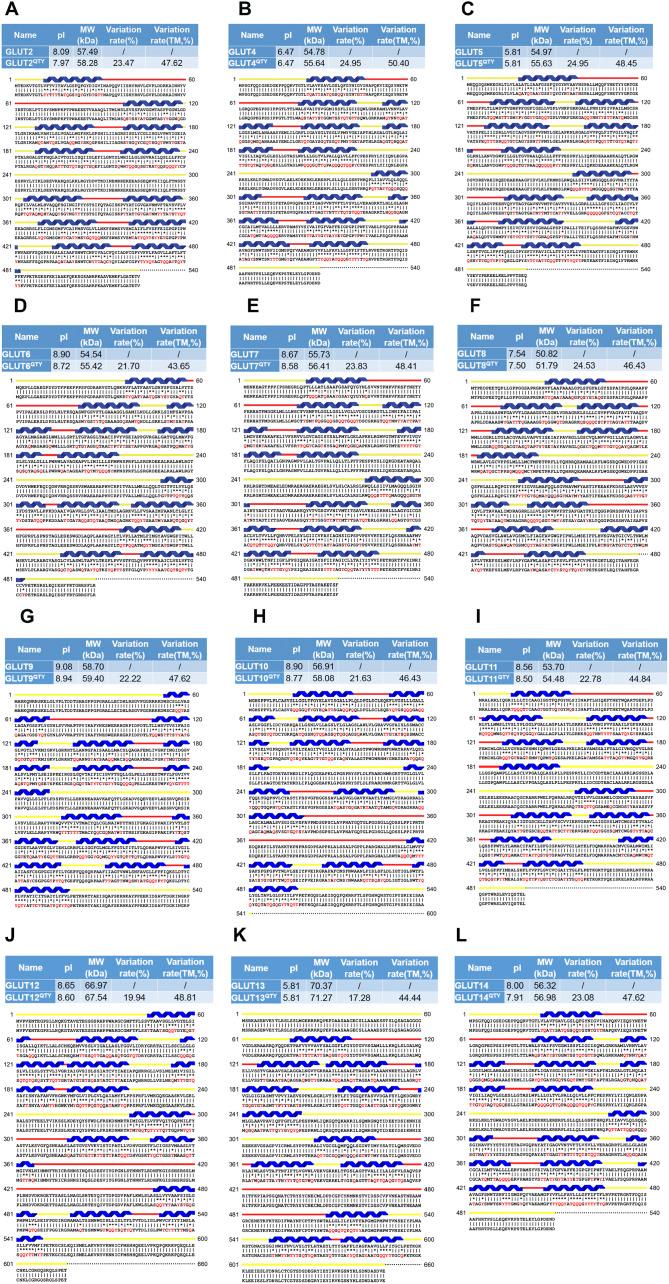
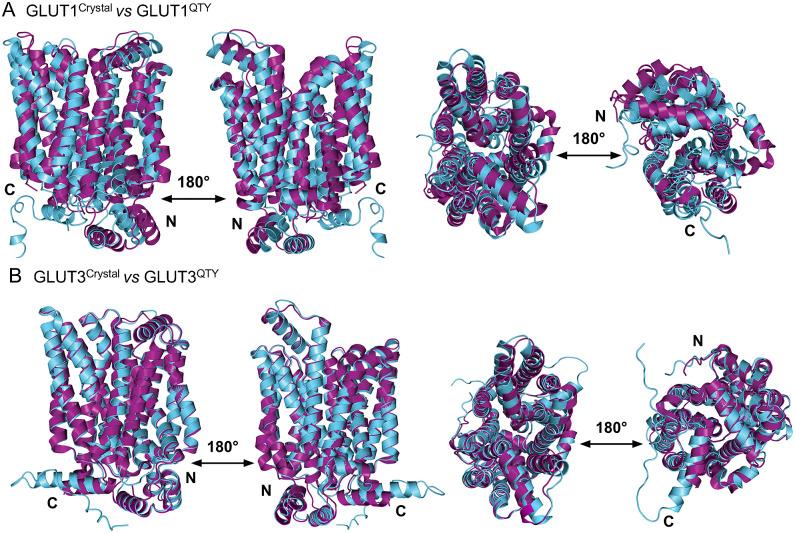
Membrane transporters including glucose transporters (GLUTs) are involved in cellular energy supplies, cell metabolism and other vital biological activities. They have also been implicated in cancer proliferation and metastasis, thus they represent an important target in combatting cancer. However, membrane transporters are very difficult to study due to their multispan transmembrane properties. The new computational tool, AlphaFold2, offers highly accurate predictions of three-dimensional protein structures. The glutamine, threonine and tyrosine (QTY) code provides a systematic method of rendering hydrophobic sequences into hydrophilic ones. Here, we present computational studies of native integral membrane GLUTs with 12 transmembrane helical segments determined by X-ray crystallography and CryoEM, comparing the AlphaFold2-predicted native structure to their water-soluble QTY variants predicted by AlphaFold2. In the native structures of the transmembrane helices, there are hydrophobic amino acids leucine (L), isoleucine (I), valine (V) and phenylalanine (F). Applying the QTY code, these hydrophobic amino acids are systematically replaced by hydrophilic amino acids, glutamine (Q), threonine (T) and tyrosine (Y) rendering them water-soluble. We present the superposed structures of native GLUTs and their water-soluble QTY variants. The superposed structures show remarkable similar residue mean square distance values between 0.47 and 3.6 Å (most about 1-2 Å) despite >44% transmembrane amino acid differences. We also show the differences of hydrophobicity patches between the native membrane transporters and their QTY variants. We explain the rationale why the membrane protein QTY variants become water-soluble. Our study provides insight into the differences between the hydrophobic helices and hydrophilic helices, and offers confirmation of the QTY method for studying multispan transmembrane proteins and other aggregated proteins through their water-soluble variants.
包括葡萄糖转运蛋白(GLUTs)在内的膜转运蛋白参与细胞能量供应、细胞代谢及其他重要的生物学活动。它们还与癌症的增殖和转移有关,因此是抗癌的重要靶点。然而,由于其多跨膜特性,膜转运蛋白很难进行研究。新的计算工具AlphaFold2能够对蛋白质的三维结构进行高精度预测。谷氨酰胺、苏氨酸和酪氨酸(QTY)编码提供了一种将疏水序列转化为亲水序列的系统方法。在此,我们对通过X射线晶体学和冷冻电镜确定的具有12个跨膜螺旋片段的天然整合膜GLUTs进行了计算研究,将AlphaFold2预测的天然结构与其预测的水溶性QTY变体进行了比较。在跨膜螺旋的天然结构中,存在疏水氨基酸亮氨酸(L)、异亮氨酸(I)、缬氨酸(V)和苯丙氨酸(F)。应用QTY编码,这些疏水氨基酸被亲水氨基酸谷氨酰胺(Q)、苏氨酸(T)和酪氨酸(Y)系统地取代,使其具有水溶性。我们展示了天然GLUTs及其水溶性QTY变体的叠加结构。尽管跨膜氨基酸差异超过44%,但叠加结构显示出显著相似的残基均方根距离值,介于0.47至3.6 Å之间(大多数约为1 - 2 Å)。我们还展示了天然膜转运蛋白与其QTY变体之间疏水性斑块的差异。我们解释了膜蛋白QTY变体变为水溶性的原理。我们的研究深入了解了疏水螺旋和亲水螺旋之间的差异,并证实了通过水溶性变体研究多跨膜蛋白和其他聚集蛋白的QTY方法。


 Zotero 插件