
阿齐沙坦对比坎地沙坦治疗左心室舒张功能障碍的疗效:J-TASTE 随机对照试验。
Efficacy of azilsartan on left ventricular diastolic dysfunction compared with candesartan: J-TASTE randomized controlled trial.
机构信息
Department of Cardiovascular Medicine, National Cerebral and Cardiovascular Center, Osaka, Japan.
Department of Clinical Medicine and Development, National Cerebral and Cardiovascular Center, Osaka, Japan.
出版信息
Sci Rep. 2023 Aug 2;13(1):12517. doi: 10.1038/s41598-023-39779-y.
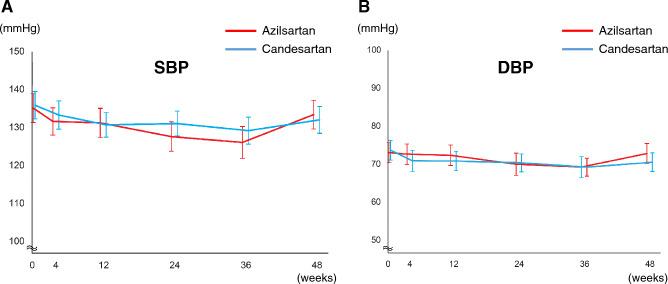
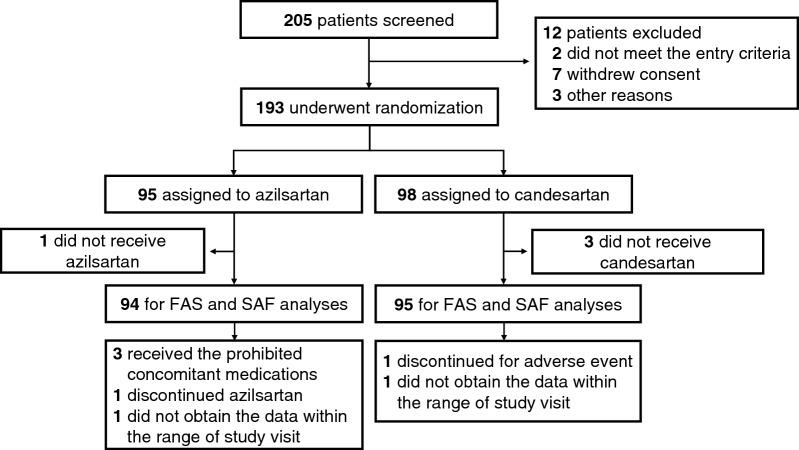
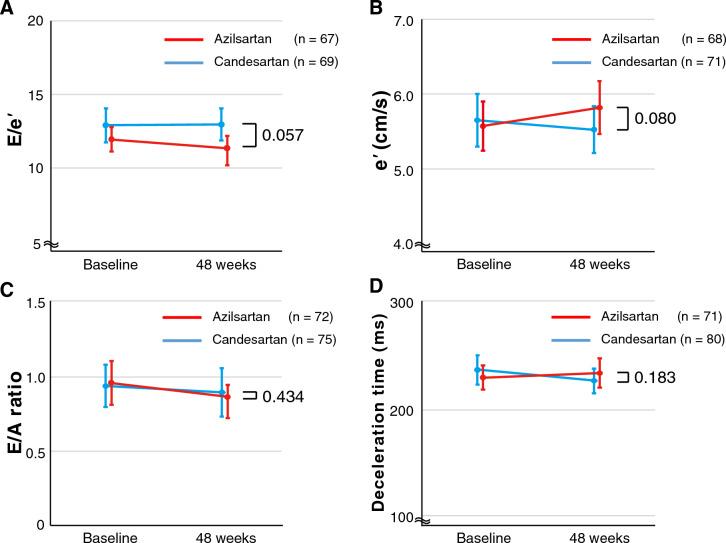
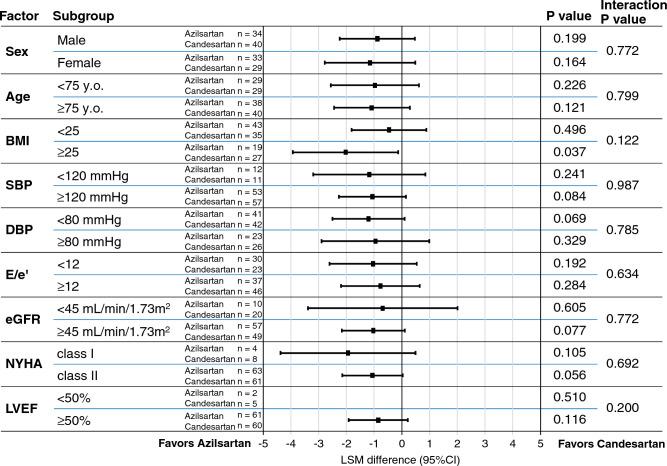
Characterized by ventricular and vascular stiffness, heart failure with preserved ejection fraction (HFpEF) has led to high morbidity and mortality. As azilsartan is an angiotensin receptor blocker with the highest myocardial and vascular affinities, azilsartan may improve the left ventricular (LV) diastolic function in patients with hypertension and either HFpEF or HF with mildly reduced ejection fraction (HFmrEF) more than candesartan. In this randomized, open-label trial, we randomly assigned 193 hypertensive patients with HF and LV ejection fraction ≥ 45% to 20 mg of azilsartan (n = 95) or 8 mg of candesartan (n = 98), once daily for 48 weeks. After the initiation of treatment, changes in the doses of the study drugs were permitted based on the patient's conditions, including blood pressure (median dose at 48 weeks: azilsartan 20.0 mg/day, candesartan 8.0 mg/day). The primary endpoint was the baseline-adjusted change in the ratio of peak early diastolic transmitral flow velocity (E) to early diastolic mitral annular velocity (e') (E/e'). Adjusted least-squares mean (LSM) change in E/e' was - 0.8 (95% confidence interval [CI] - 1.49 to - 0.04) in the azilsartan group and 0.2 (95% CI - 0.49 to 0.94) in the candesartan group, providing the LSM differences of - 1.0 (95% CI - 2.01 to 0.03, P = 0.057). The median change in left atrial volume index was - 2.7 mL/m with azilsartan vs 1.4 mL/m with candesartan (P = 0.091). The frequency of adverse events related to hypotension and hyperkalemia did not differ between the groups. The current study did not provide strong evidence that azilsartan improves LV diastolic dysfunction, and further confirmatory study is required.
以心室和血管僵硬为特征,射血分数保留的心力衰竭(HFpEF)导致高发病率和死亡率。由于阿齐沙坦是一种血管紧张素受体阻断剂,具有最高的心肌和血管亲和力,因此与坎地沙坦相比,阿齐沙坦可能会改善高血压合并 HFpEF 或射血分数轻度降低的心力衰竭(HFmrEF)患者的左心室(LV)舒张功能。在这项随机、开放标签试验中,我们将 193 名高血压合并 HF 和 LV 射血分数≥45%的患者随机分为阿齐沙坦 20 mg 组(n=95)或坎地沙坦 8 mg 组(n=98),每日一次,持续 48 周。在开始治疗后,根据患者的病情允许调整研究药物的剂量,包括血压(48 周时的中位数剂量:阿齐沙坦 20.0 mg/天,坎地沙坦 8.0 mg/天)。主要终点是基线校正后峰值早期舒张期二尖瓣血流速度(E)与早期舒张期二尖瓣环速度(e')的比值(E/e')的变化。阿齐沙坦组的 E/e'调整后最小二乘均数(LSM)变化为-0.8(95%置信区间[CI]为-1.49 至-0.04),坎地沙坦组为 0.2(95%CI 为-0.49 至 0.94),LSM 差异为-1.0(95%CI 为-2.01 至 0.03,P=0.057)。阿齐沙坦组左心房容积指数中位数变化为-2.7 mL/m,坎地沙坦组为 1.4 mL/m(P=0.091)。与低血压和高钾血症相关的不良事件发生率在两组之间没有差异。本研究没有提供阿齐沙坦改善 LV 舒张功能的有力证据,需要进一步的确认性研究。
 Zotero 插件