
基于 FDA 不良事件报告系统(FAERS)的 BCR::ABL1 抑制剂治疗患者的液体潴留相关不良事件:一项回顾性药物警戒研究。
Fluid retention-associated adverse events in patients treated with BCR::ABL1 inhibitors based on FDA Adverse Event Reporting System (FAERS): a retrospective pharmacovigilance study.
机构信息
Department of Pharmacy, The First Affiliated Hospital of Ningbo University, Ningbo, Zhejiang, China.
Department of Pharmacy, The First Affiliated Hospital of Ningbo University, Ningbo, Zhejiang, China
出版信息
BMJ Open. 2023 Aug 3;13(8):e071456. doi: 10.1136/bmjopen-2022-071456.
OBJECTIVES
This study aimed to conduct a thorough analysis of fluid retention-associated adverse events (AEs) associated with BCR::ABL inhibitors.
DESIGN
A retrospective pharmacovigilance study.
SETTING
Food and Drug Administration Adverse Event Reporting System (FAERS) database for BCR::ABL inhibitors was searched from 1 January 2004 to 30 September 2021.
MAIN OUTCOME MEASURES
Reporting OR (ROR) and 95% CI were used to detect the signals. ROR was calculated by dividing the odds of fluid retention event reporting for the target drug by the odds of fluid retention event reporting for all other drugs. The signal was considered positive if the lower limit of 95% CI of ROR was >1. The analysis was run only considering coupled fluid retention events/BCR::ABL inhibitors with at least three cases.
RESULTS
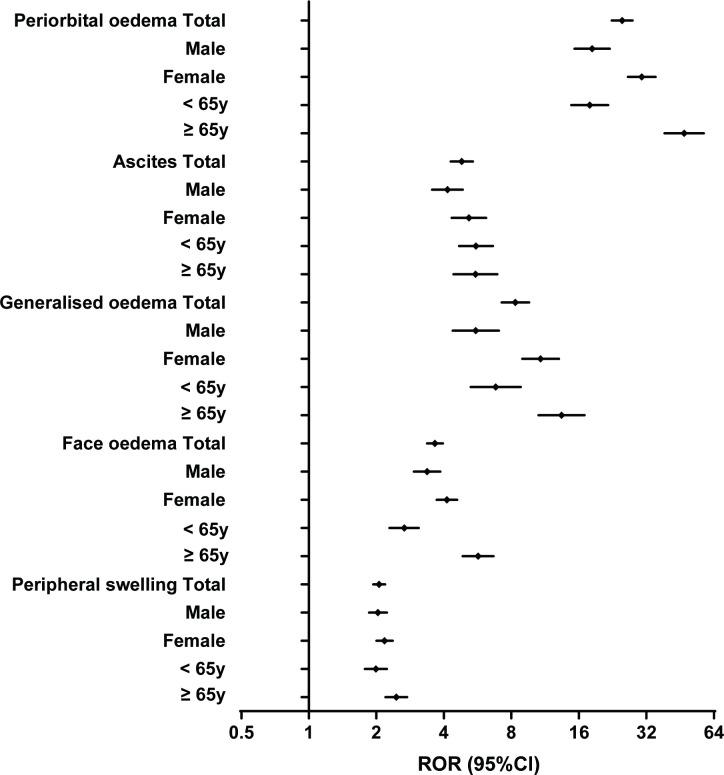
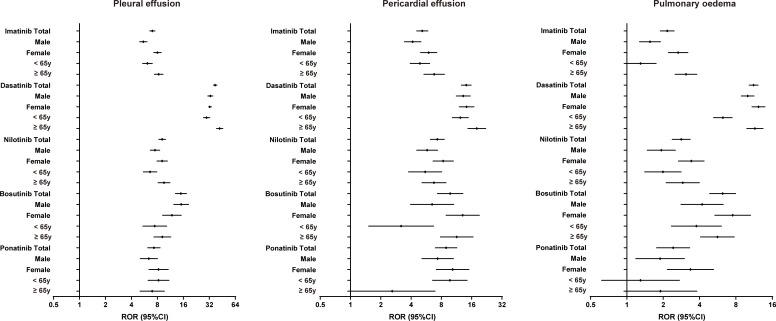
A total of 97 823 reports were identified in FAERS. Imatinib had the most fluid retention signals, followed by dasatinib and nilotinib, while bosutinib and ponatinib had fewer signals. Periorbital oedema (ROR=24.931, 95% CI 22.404 to 27.743), chylothorax (ROR=161.427, 95% CI 125.835 to 207.085), nipple swelling (ROR=48.796, 95% CI 26.270 to 90.636), chylothorax (ROR=35.798, 95% CI 14.791 to 86.642) and gallbladder oedema (ROR=77.996, 95% CI 38.286 to 158.893) were the strongest signals detected for imatinib, dasatinib, nilotinib, bosutinib and ponatinib, respectively. Pleural effusion, pericardial effusion and pulmonary oedema were detected for all BCR::ABL inhibitors, with dasatinib having the highest RORs for pleural effusion (ROR=37.424, 95% CI 35.715 to 39.216), pericardial effusion (ROR=14.146, 95% CI 12.649 to 15.819) and pulmonary oedema (ROR=11.217, 95% CI 10.303 to 12.213). Patients aged ≥65 years using dasatinib, imatinib, nilotinib or bosutinib had higher RORs for pleural effusion, pericardial effusion and pulmonary oedema. Patients aged ≥65 years and females using imatinib had higher RORs for periorbital oedema, generalised oedema and face oedema.
CONCLUSIONS
This pharmacovigilance study serves as a clinical reminder to physicians to be more vigilant for fluid retention-associated AEs with BCR::ABL inhibitors.
目的
本研究旨在对 BCR::ABL 抑制剂相关的液体潴留不良事件(AE)进行全面分析。
设计
回顾性药物警戒研究。
设置
从 2004 年 1 月 1 日至 2021 年 9 月 30 日,检索食品和药物管理局不良事件报告系统(FAERS)数据库中 BCR::ABL 抑制剂的相关数据。
主要结局测量
采用报告比值比(ROR)和 95%置信区间(CI)来检测信号。ROR 通过将目标药物液体潴留事件报告的比值与所有其他药物液体潴留事件报告的比值来计算。如果 ROR 的 95%CI 的下限>1,则认为信号为阳性。仅考虑至少有 3 例报告的与液体潴留相关的事件/BCR::ABL 抑制剂的偶发事件进行分析。
结果
在 FAERS 中共确定了 97823 例报告。伊马替尼的液体潴留信号最多,其次是达沙替尼和尼洛替尼,而博舒替尼和泊那替尼的信号较少。眶周水肿(ROR=24.931,95%CI 22.404 至 27.743)、乳糜胸(ROR=161.427,95%CI 125.835 至 207.085)、乳头肿胀(ROR=48.796,95%CI 26.270 至 90.636)、乳糜胸(ROR=35.798,95%CI 14.791 至 86.642)和胆囊水肿(ROR=77.996,95%CI 38.286 至 158.893)分别是伊马替尼、达沙替尼、尼洛替尼、博舒替尼和泊那替尼最强的信号。所有 BCR::ABL 抑制剂均检测到胸腔积液、心包积液和肺水肿,达沙替尼胸腔积液的 ROR 最高(ROR=37.424,95%CI 35.715 至 39.216)、心包积液(ROR=14.146,95%CI 12.649 至 15.819)和肺水肿(ROR=11.217,95%CI 10.303 至 12.213)。≥65 岁使用达沙替尼、伊马替尼、尼洛替尼或博舒替尼的患者胸腔积液、心包积液和肺水肿的 ROR 更高。≥65 岁和女性使用伊马替尼的患者眶周水肿、全身性水肿和面部水肿的 ROR 更高。
结论
本药物警戒研究提醒临床医生对 BCR::ABL 抑制剂相关的液体潴留相关 AE 保持警惕。
 Zotero 插件