
多发性硬化症患者的细胞特异性表观遗传年龄加速评估。
Evaluation of Cell-Specific Epigenetic Age Acceleration in People With Multiple Sclerosis.
机构信息
From the School of Medicine and Public Health (V.M., R.L., J.L.-S.), University of Newcastle, University Drive, Callaghan; Immune Health Program (V.M., A.X., J.L.-S.), Hunter Medical Research Institute; Department of Neurology (V.M., J.L.-S.), John Hunter Hospital, New Lambton Heights; School of Biomedical Sciences and Pharmacy (A.X.), University of Newcastle, University Drive, Callaghan, Australia; Department of Clinical Neuroscience (E.E., L.K., M.J.), Karolinska Institutet, Center for Molecular Medicine, Karolinska University Hospital, Stockholm, Sweden; Department of Neuroscience (M.-P.C., S.S., H.B., V.J.), Central Clinical School, Monash University, Victoria; Division of Molecular Genetics (R.J.S.), Pathology North, John Hunter Hospital, New Lambton Heights; MSBase Foundation (H.B.), Melbourne, Australia; Institute of Clinical Medicine (S.B.), University of Oslo,; Department of Neurology (S.B.), Oslo University Hospital, Norway; Flinders University (M.S.), Adelaide; Menzies Institute for Medical Research (I.A.M., B.V.T.), University of Tasmania, Hobart; Florey Institute of Neuroscience and Mental Health (A.-L.P.), The University of Melbourne; Centre of Epidemiology and Biostatistics (A.-L.P.), School of Population and Global Health, University of Melbourne; Murdoch Children's Research Institute (A.-L.P.), Royal Children's Hospital, Melbourne; and Centre for Genomics and Personalized Health (R.L.), School of Biomedical Science, Queensland University of Technology, Kelvin Grove, Australia.
出版信息
Neurology. 2023 Aug 15;101(7):e679-e689. doi: 10.1212/WNL.0000000000207489. Epub 2023 Aug 4.
BACKGROUND AND OBJECTIVES
In multiple sclerosis (MS), accelerated aging of the immune system (immunosenescence) may be associated with disease onset or drive progression. DNA methylation (DNAm) is an epigenetic factor that varies among lymphocyte subtypes, and cell-specific DNAm is associated with MS. DNAm varies across the life span and can be used to accurately estimate biological age acceleration, which has been linked to a range of morbidities. The objective of this study was to test for cell-specific epigenetic age acceleration (EAA) in people with MS.
METHODS
This was a case-control study of EAA using existing DNAm data from several independent previously published studies. Data were included if .idat files from Illumina 450K or EPIC arrays were available for both a case with MS and an age-matched and sex-matched control, from the same study. Multifactor statistical modeling was performed to assess the primary outcome of EAA. We explored the relationship of EAA and MS, including interaction terms to identify immune cell-specific effects. Cell-sorted DNA methylation data from 3 independent datasets were used to validate findings.
RESULTS
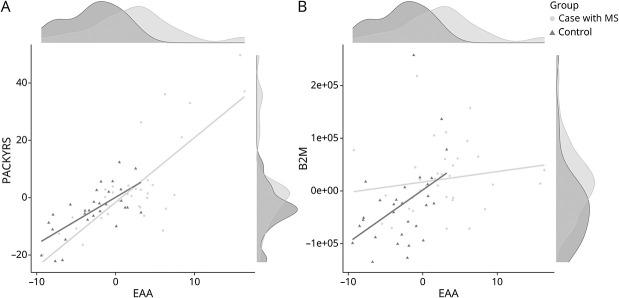
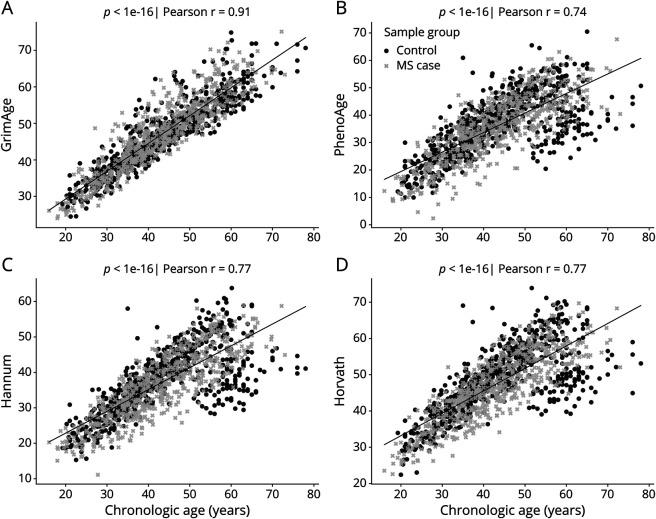
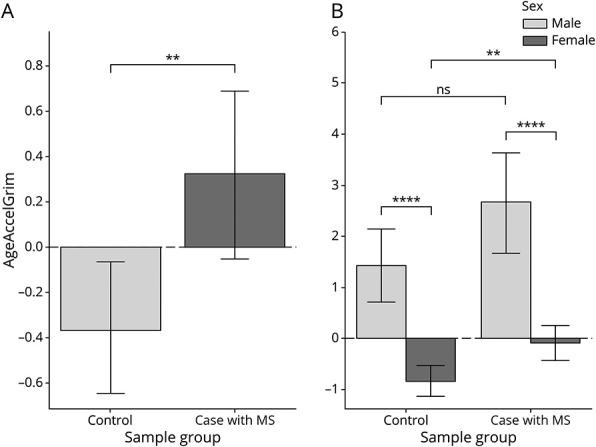
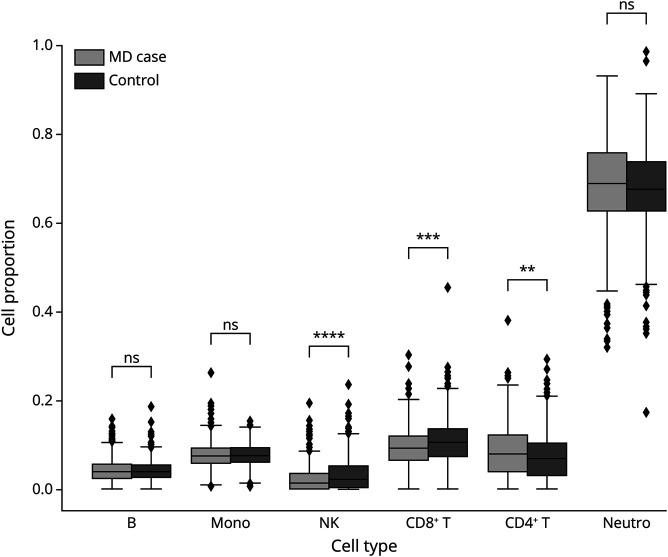
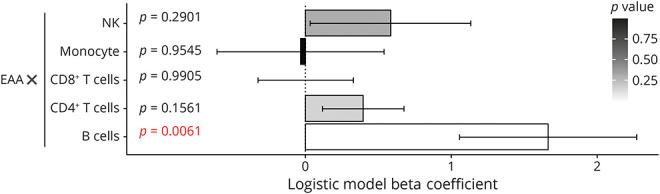
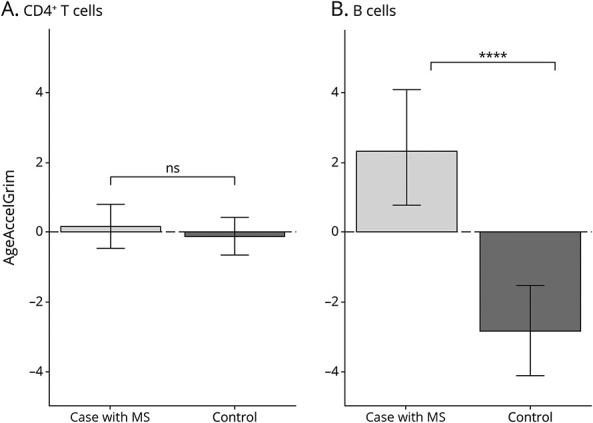
We used whole blood DNA methylation data from 583 cases with MS and 643 non-MS controls to calculate EAA using the GrimAge algorithm. The MS group exhibited an increased EAA compared with controls (approximately 9 mths, 95% CI 3.6-14.4), = 0.001). Statistical deconvolution showed that EAA is associated with MS in a B cell-dependent manner ( = 1.7, 95% CI 0.3-2.8), = 0.002), irrespective of B-cell proportions. Validation analysis using 3 independent datasets enriched for B cells showed an EAA increase of 5.1 years in cases with MS compared with that in controls (95% CI 2.8-7.4, = 5.5 × 10). By comparison, there was no EAA difference in MS in a T cell-enriched dataset. We found that EAA was attributed to the DNAm surrogates for Beta-2-microglobulin (difference = 47,546, 95% CI 10,067-85,026; = 7.2 × 10), and smoking pack-years (difference = 8.1, 95% CI 1.9-14.2, = 0.002).
DISCUSSION
This study provides compelling evidence that B cells exhibit marked EAA in MS and supports the hypothesis that premature B-cell immune senescence plays a role in MS. Future MS studies should focus on age-related molecular mechanisms in B cells.
背景与目的
在多发性硬化症(MS)中,免疫系统的加速衰老(免疫衰老)可能与疾病的发作或进展有关。DNA 甲基化(DNAm)是一种表遗传因素,在淋巴细胞亚型之间存在差异,且细胞特异性 DNAm 与 MS 相关。DNAm 随生命历程而变化,可用于准确估计生物年龄加速,这与多种发病率有关。本研究旨在检测 MS 患者的细胞特异性表观遗传年龄加速(EAA)。
方法
这是一项使用来自多个先前发表的独立研究的现有 DNAm 数据的病例对照研究,用于 EAA。如果从同一研究中获得了 MS 患者和年龄匹配、性别匹配的对照者的 Illumina 450K 或 EPIC 阵列的.idat 文件,则纳入数据。采用多因素统计模型评估 EAA 的主要结局。我们探讨了 EAA 和 MS 的关系,包括交互项以确定免疫细胞的特异性作用。使用 3 个独立数据集的细胞分选 DNA 甲基化数据来验证发现。
结果
我们使用来自 583 例 MS 患者和 643 例非 MS 对照者的全血 DNAm 数据,使用 GrimAge 算法计算 EAA。MS 组的 EAA 与对照组相比增加了约 9 个月(95%CI3.6-14.4),P=0.001)。统计去卷积表明,EAA 与 MS 呈 B 细胞依赖性相关(β=1.7,95%CI0.3-2.8),P=0.002),与 B 细胞比例无关。使用 3 个富含 B 细胞的独立数据集进行的验证分析显示,与对照组相比,MS 患者的 EAA 增加了 5.1 年(95%CI2.8-7.4,P=5.5×10)。相比之下,在 T 细胞富集的数据集的 MS 中没有 EAA 差异。我们发现,EAA 归因于β-2-微球蛋白的 DNAm 替代物(差异=47546,95%CI10067-85026;P=7.2×10)和吸烟包年数(差异=8.1,95%CI1.9-14.2,P=0.002)。
讨论
本研究提供了令人信服的证据,表明 MS 中的 B 细胞表现出明显的 EAA,并支持 B 细胞过早免疫衰老在 MS 中起作用的假说。未来的 MS 研究应关注 B 细胞中与年龄相关的分子机制。
 Zotero 插件