
长期暴露于空气污染物与心肺死亡率的个体及联合关联:中国北方一项为期22年的队列研究。
Individual and joint associations of long-term exposure to air pollutants and cardiopulmonary mortality: a 22-year cohort study in Northern China.
作者信息
Huang Wenzhong, Zhou Yang, Chen Xi, Zeng Xiaowen, Knibbs Luke D, Zhang Yunting, Jalaludin Bin, Dharmage Shyamali C, Morawska Lidia, Guo Yuming, Yang Xueli, Zhang Liwen, Shan Anqi, Chen Jie, Wang Tong, Heinrich Joachim, Gao Meng, Lin Lizi, Xiao Xiang, Zhou Peien, Yu Yunjiang, Tang Naijun, Dong Guanghui
机构信息
Guangdong Provincial Engineering Technology Research Center of Environmental Pollution and Health Risk Assessment, Department of Occupational and Environmental Health, School of Public Health, Sun Yat-sen University, Guangzhou 510080, China.
Climate, Air Quality Research Unit, School of Public Health and Preventive Medicine, Monash University, Melbourne, Australia.
出版信息
Lancet Reg Health West Pac. 2023 May 4;36:100776. doi: 10.1016/j.lanwpc.2023.100776. eCollection 2023 Jul.
BACKGROUND
Evidence on the associations between long-term exposure to multiple air pollutants and cardiopulmonary mortality is limited, especially for developing regions with higher pollutant levels. We aimed to characterise the individual and joint (multi-pollutant) associations of long-term exposure to air pollutants with cardiopulmonary mortality, and to identify air pollutant that primarily contributes to the mortality risk.
METHODS
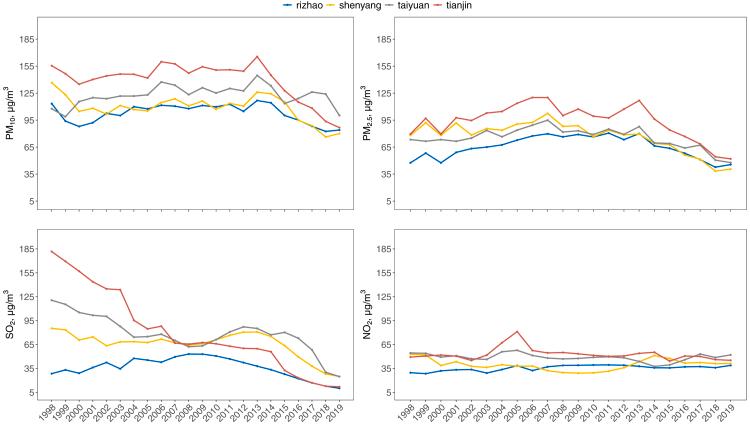
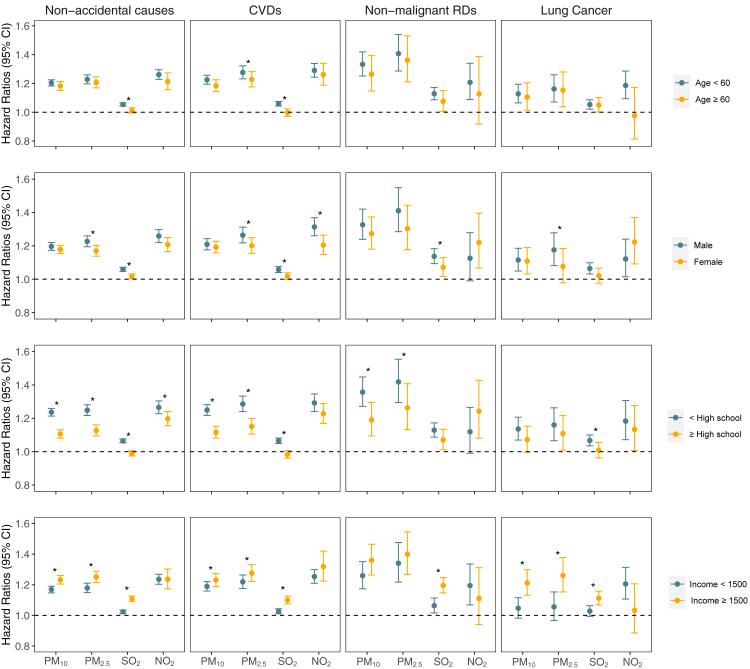
We followed 37,442 participants with a mean age of 43.5 years in four cities in northern China (Tianjin, Shenyang, Taiyuan, and Rizhao) from January 1998 to December 2019. Annual particulate matter (PM) with diameters ≤2.5 μm (PM), ≤10 μm (PM), sulfur dioxide (SO) and nitrogen dioxide (NO) were estimated using daily average values from satellite-derived machine learning models and monitoring stations. Time-varying Cox proportional hazards model was used to evaluate the individual association between air pollutants and mortality from non-accidental causes, cardiovascular diseases (CVDs), non-malignant respiratory diseases (RDs) and lung cancer, accounting for demographic and socioeconomic factors. Effect modifications by age, sex, income and education level were also examined. Quantile-based g-Computation integrated with time-to-event data was additionally applied to evaluate the co-effects and the relative weight of contributions for air pollutants.
FINDINGS
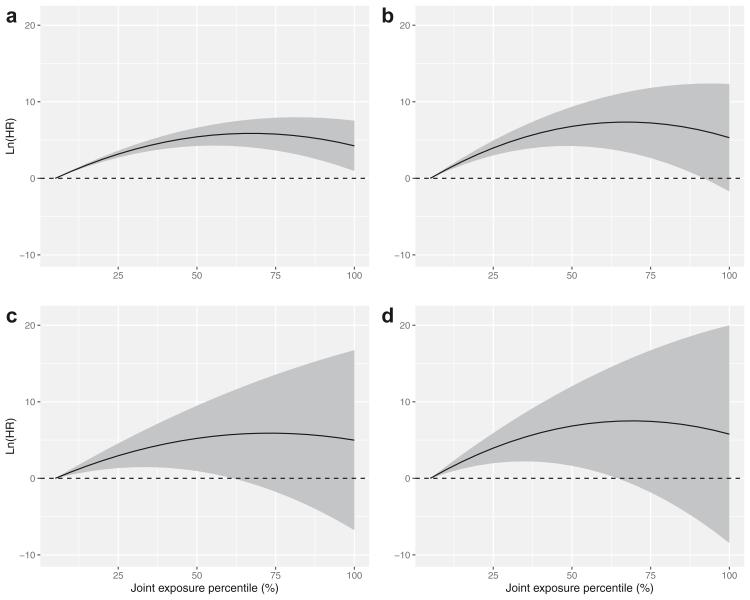
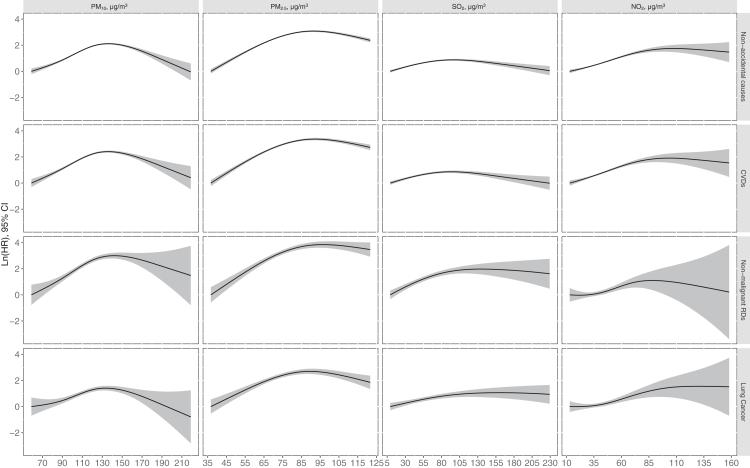
During 785,807 person-years of follow-up, 5812 (15.5%) died from non-accidental causes, among which 2932 (7.8%) were from all CVDs, 479 (1.3%) from non-malignant RDs, and 552 (1.4%) from lung cancer. Long-term exposure to PM (mean [baseline]: 136.5 μg/m), PM (mean [baseline]: 70.2 μg/m), SO (mean [baseline]: 113.0 μg/m) and NO (mean [baseline]: 39.2 μg/m) were adversely and consistently associated with all mortality outcomes. A 10 μg/m increase in PM was associated with higher mortality from non-accidental causes (hazard ratio 1.20; 95% confidence interval 1.17-1.23), CVDs (1.23; 1.19-1.28), non-malignant RDs (1.37; 1.25-1.49) and lung cancer (1.14; 1.05-1.23). A monotonically increasing curve with linear or supra-linear shape with no evidence of a threshold was observed for the exposure-response relationship of mortality with individual or joint exposure to air pollutants. PM consistently contributed most to the elevated mortality risks related to air pollutant mixture, followed by SO or PM.
INTERPRETATION
There was a strong and positive association of long-term individual and joint exposure to PM, PM, SO, and NO with mortalities from non-accidental causes, CVDs, non-malignant RDs and lung cancer in high-exposure settings, with PM potentially being the main contributor. The shapes of associations were consistent with a linear or supra-linear exposure-response relationship, with no lower threshold observed within the range of concentrations in this study.
FUNDING
National Key Research and Development Program of China, the China Scholarship Council, the National Natural Science Foundation of China, Natural Science Foundation of Guangdong Province.
背景
关于长期暴露于多种空气污染物与心肺死亡率之间关联的证据有限,特别是在污染物水平较高的发展中地区。我们旨在描述长期暴露于空气污染物与心肺死亡率之间的个体及联合(多污染物)关联,并确定主要导致死亡风险的空气污染物。
方法
1998年1月至2019年12月,我们对中国北方四个城市(天津、沈阳、太原和日照)的37442名平均年龄为43.5岁的参与者进行了随访。利用卫星衍生机器学习模型和监测站的日均值估算直径≤2.5μm(PM)、≤10μm(PM)的年颗粒物、二氧化硫(SO)和二氧化氮(NO)。采用时变Cox比例风险模型评估空气污染物与非意外原因、心血管疾病(CVD)、非恶性呼吸道疾病(RD)和肺癌死亡率之间的个体关联,并考虑人口统计学和社会经济因素。还研究了年龄、性别、收入和教育水平的效应修正。此外,应用基于分位数的g计算与时至事件数据相结合,评估空气污染物的协同效应和相对贡献权重。
结果
在785807人年的随访期间,5812人(15.5%)死于非意外原因,其中2932人(7.8%)死于所有心血管疾病,479人(1.3%)死于非恶性呼吸道疾病,552人(1.4%)死于肺癌。长期暴露于PM(平均[基线]:136.5μg/m)、PM(平均[基线]:70.2μg/m)、SO(平均[基线]:113.0μg/m)和NO(平均[基线]:39.2μg/m)与所有死亡结局均呈负相关且具有一致性。PM每增加10μg/m与非意外原因(风险比1.20;95%置信区间1.17 - 1.23)、心血管疾病(1.23;1.19 - 1.28)、非恶性呼吸道疾病(1.37;1.25 - 1.49)和肺癌(1.14;1.05 - 1.23)的死亡率升高相关。对于死亡率与个体或联合暴露于空气污染物的暴露 - 反应关系,观察到呈线性或超线性形状的单调递增曲线,且无阈值证据。PM始终对与空气污染物混合物相关的死亡率升高风险贡献最大,其次是SO或PM。
解读
在高暴露环境中,长期个体及联合暴露于PM、PM、SO和NO与非意外原因、心血管疾病、非恶性呼吸道疾病和肺癌的死亡率之间存在强烈的正相关,PM可能是主要贡献者。关联的形状与线性或超线性暴露 - 反应关系一致,在本研究的浓度范围内未观察到较低阈值。
资助
中国国家重点研发计划、中国留学基金委、中国国家自然科学基金、广东省自然科学基金。
 Zotero 插件