
心血管测量指标在涉及反复睡眠剥夺和恢复的长时间间隔内表现出强大的表型稳定性。
Cardiovascular measures display robust phenotypic stability across long-duration intervals involving repeated sleep deprivation and recovery.
作者信息
Pasetes Lauren N, Rosendahl-Garcia Kathleen M, Goel Namni
机构信息
Biological Rhythms Research Laboratory, Department of Psychiatry and Behavioral Sciences, Rush University Medical Center, Chicago, IL, United States.
Siemens Healthineers, Mountain View, CA, United States.
出版信息
Front Neurosci. 2023 Jul 20;17:1201637. doi: 10.3389/fnins.2023.1201637. eCollection 2023.
INTRODUCTION
We determined whether cardiovascular (CV) measures show trait-like responses after repeated total sleep deprivation (TSD), baseline (BL) and recovery (REC) exposures in two long-duration studies (total = 11 adults).
METHODS
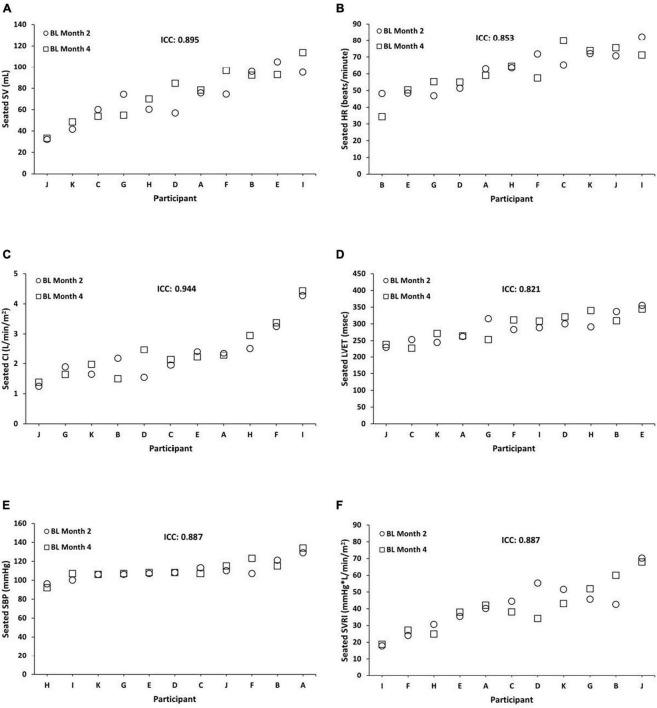
A 5-day experiment was conducted twice at months 2 and 4 in a 4-month study ( = 6 healthy adults; 3 females; mean age ± SD, 34.3 ± 5.7 years; mean BMI ± SD, 22.5 ± 3.2 kg/m), and three times at months 2, 4, and 8 in an 8-month study ( = 5 healthy adults; 2 females; mean age ± SD, 33.6 ± 5.17 years; mean BMI ± SD, 27.1 ± 4.9 kg/m). Participants were not shift workers or exposed to TSD in their professions. During each experiment, various seated and standing CV measures were collected via echocardiography [stroke volume (SV), heart rate (HR), cardiac index (CI), left ventricular ejection time (LVET), and systemic vascular resistance index (SVRI)] or blood pressure monitor [systolic blood pressure (SBP)] after (1) two BL 8h time in bed (TIB) nights; (2) an acute TSD night; and (3) two REC 8-10 h TIB nights. Intraclass correlation coefficients (ICCs) assessed CV measure stability during BL, TSD, and REC and for the BL and REC average (BL + REC) across months 2, 4, and 8; Spearman's rho assessed the relative rank of individuals' CV responses across measures.
RESULTS
Seated BL (0.693-0.944), TSD (0.643-0.962) and REC (0.735-0.960) CV ICCs showed substantial to almost perfect stability and seated BL + REC CV ICCs (0.552-0.965) showed moderate to almost perfect stability across months 2, 4, and 8. Individuals also exhibited significant, consistent responses within seated CV measures during BL, TSD, and REC. Standing CV measures showed similar ICCs for BL, TSD, and REC and similar response consistency.
DISCUSSION
This is the first demonstration of remarkably robust phenotypic stability of a number of CV measures in healthy adults during repeated TSD, BL and REC exposures across 2, 4, and 8 months, with significant consistency of responses within CV measures. The cardiovascular measures examined in our studies, including SV, HR, CI, LVET, SVRI, and SBP, are useful biomarkers that effectively track physiology consistently across long durations and repeated sleep deprivation and recovery.
引言
在两项长期研究(共11名成年人)中,我们确定了在反复进行完全睡眠剥夺(TSD)、基线(BL)和恢复(REC)暴露后,心血管(CV)指标是否呈现出类似特质的反应。
方法
在一项为期4个月的研究中,于第2个月和第4个月进行了两次为期5天的实验(n = 6名健康成年人;3名女性;平均年龄±标准差,34.3±5.7岁;平均BMI±标准差,22.5±3.2 kg/m²);在一项为期8个月的研究中,于第2个月、第4个月和第8个月进行了三次为期5天的实验(n = 5名健康成年人;2名女性;平均年龄±标准差,33.6±5.17岁;平均BMI±标准差,27.1±4.9 kg/m²)。参与者不是轮班工作者,其职业也未接触TSD。在每次实验中,在以下情况后通过超声心动图[每搏输出量(SV)、心率(HR)、心脏指数(CI)、左心室射血时间(LVET)和全身血管阻力指数(SVRI)]或血压监测仪[收缩压(SBP)]收集各种坐姿和站姿的CV指标:(1)两个BL期8小时卧床(TIB)夜晚;(2)一个急性TSD夜晚;(3)两个REC期8 - 10小时TIB夜晚。组内相关系数(ICC)评估了BL、TSD和REC期间以及第2、4和8个月BL和REC平均值(BL + REC)期间CV指标的稳定性;Spearman等级相关系数评估了个体在各项指标中CV反应的相对排名。
结果
坐姿BL(0.693 - 0.944)、TSD(0.643 - 0.962)和REC(0.735 - 0.960)的CV ICC显示出从实质到几乎完美的稳定性,坐姿BL + REC的CV ICC(0.552 - 0.965)在第2、4和8个月显示出从中度到几乎完美的稳定性。个体在BL、TSD和REC期间的坐姿CV指标内也表现出显著且一致的反应。站姿CV指标在BL、TSD和REC期间显示出类似的ICC以及类似的反应一致性。
讨论
这是首次证明在2、4和8个月期间反复进行TSD、BL和REC暴露时,健康成年人中许多CV指标具有显著强大的表型稳定性,且CV指标内反应具有显著一致性。我们研究中检查的心血管指标,包括SV、HR、CI、LVET、SVRI和SBP,是有效的生物标志物,可在长时间以及反复的睡眠剥夺和恢复过程中持续有效地追踪生理状态。


 Zotero 插件