
氧化还原酶 p66Shc 在肺部生物衰老中的作用。
The Role of the Redox Enzyme p66Shc in Biological Aging of the Lung.
机构信息
Excellence Cluster Cardio-Pulmonary Institute (CPI), Universities of Giessen and Marburg Lung Center (UGMLC), Member of the German Center for Lung Research (DZL), Justus- Liebig University of Giessen, Giessen, Germany.
Institute for Lung Health (ILH), Giessen, Germany.
出版信息
Aging Dis. 2024 Apr 1;15(2):911-926. doi: 10.14336/AD.2023.0715.
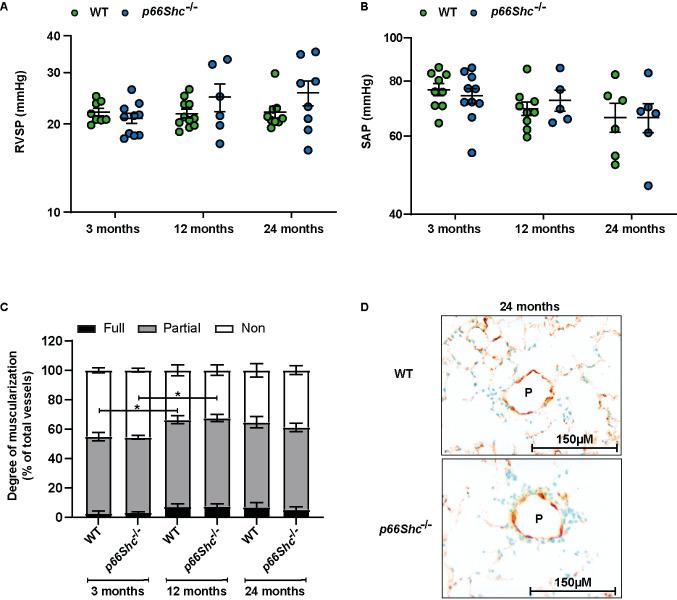
The mitochondrial adaptor protein p66Shc has been suggested to control life span in mice via the release of hydrogen peroxide. However, the role of p66Shc in lung aging remains unsolved. Thus, we investigated the effects of p66Shc on the aging of the lung and pulmonary circulation. In vivo lung and cardiac characteristics were investigated in p66Shc and wild type (WT) mice at 3, 12, and 24 months of age by lung function measurements, micro-computed tomography (µCT), and echocardiography. Alveolar number and muscularization of small pulmonary arteries were measured by stereology and vascular morphometry, respectively. Protein and mRNA levels of senescent markers were measured by western blot and PCR, respectively. Lung function declined similarly in WT and p66Shc mice during aging. However, µCT analyses and stereology showed slightly enhanced signs of aging-related parameters in p66Shc mice, such as a decline of alveolar density. Accordingly, p66Shc mice showed higher protein expression of the senescence marker p21 in lung homogenate compared to WT mice of the corresponding age. Pulmonary vascular remodeling was increased during aging, but aged p66Shc mice showed similar muscularization of pulmonary vessels and hemodynamics like WT mice. In the heart, p66Shc prevented the deterioration of right ventricular (RV) function but promoted the decline of left ventricular (LV) function during aging. p66Shc affects the aging process of the lung and the heart differently. While p66Shc slightly accelerates lung aging and deteriorates LV function in aged mice, it seems to exert protective effects on RV function during aging.
线粒体衔接蛋白 p66Shc 被认为通过释放过氧化氢来控制小鼠的寿命。然而,p66Shc 在肺部衰老中的作用仍未解决。因此,我们研究了 p66Shc 对肺部和肺循环衰老的影响。通过肺功能测量、微计算机断层扫描 (µCT) 和超声心动图,在 3、12 和 24 个月大时,研究了 p66Shc 和野生型 (WT) 小鼠体内的肺部和心脏特征。通过立体学测量肺泡数量和小肺动脉的肌化程度,分别测量血管形态计量学。通过 Western blot 和 PCR 分别测量衰老标志物的蛋白和 mRNA 水平。在衰老过程中,WT 和 p66Shc 小鼠的肺功能下降相似。然而,µCT 分析和立体学显示,p66Shc 小鼠与相应年龄的 WT 小鼠相比,与衰老相关的参数略有增强,例如肺泡密度下降。因此,p66Shc 小鼠的肺组织匀浆中衰老标志物 p21 的蛋白表达高于 WT 小鼠。肺血管重塑在衰老过程中增加,但衰老的 p66Shc 小鼠的肺血管肌化程度和血流动力学与 WT 小鼠相似。在心脏中,p66Shc 防止了右心室 (RV) 功能的恶化,但促进了左心室 (LV) 功能在衰老过程中的下降。p66Shc 对肺和心脏的衰老过程有不同的影响。虽然 p66Shc 略微加速了老年小鼠的肺部衰老并恶化了 LV 功能,但它似乎对衰老过程中的 RV 功能发挥了保护作用。


 Zotero 插件