
鉴定支架蛋白以改进细胞外囊泡的内源性工程。
Identification of scaffold proteins for improved endogenous engineering of extracellular vesicles.
机构信息
Division of Biomolecular and Cellular Medicine, Department of Laboratory Medicine, Karolinska Institutet, Huddinge, Sweden.
Institute of Technology, University of Tartu, Tartu, Estonia.
出版信息
Nat Commun. 2023 Aug 7;14(1):4734. doi: 10.1038/s41467-023-40453-0.
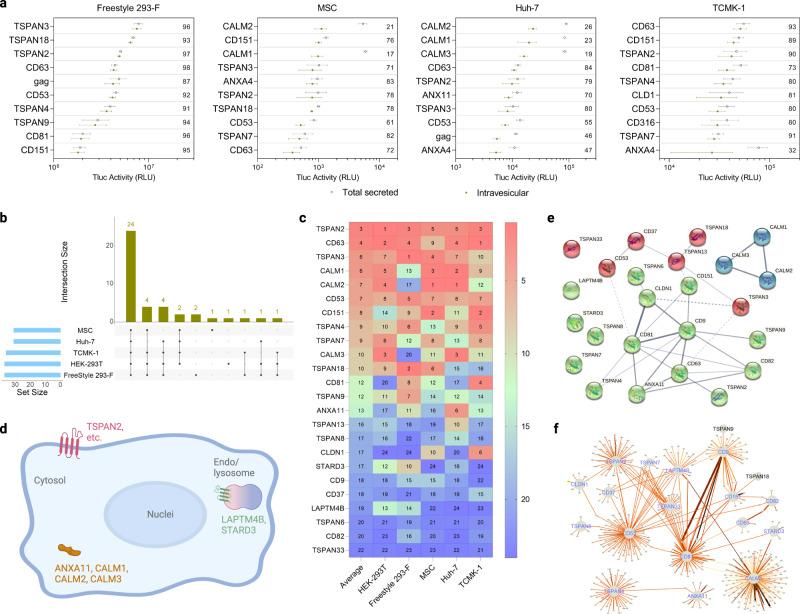
Extracellular vesicles (EVs) are gaining ground as next-generation drug delivery modalities. Genetic fusion of the protein of interest to a scaffold protein with high EV-sorting ability represents a robust cargo loading strategy. To address the paucity of such scaffold proteins, we leverage a simple and reliable assay that can distinguish intravesicular cargo proteins from surface- as well as non-vesicular proteins and compare the EV-sorting potential of 244 candidate proteins. We identify 24 proteins with conserved EV-sorting abilities across five types of producer cells. TSPAN2 and TSPAN3 emerge as lead candidates and outperform the well-studied CD63 scaffold. Importantly, these engineered EVs show promise as delivery vehicles in cell cultures and mice as demonstrated by efficient transfer of luminal cargo proteins as well as surface display of different functional entities. The discovery of these scaffolds provides a platform for EV-based engineering.
细胞外囊泡(EVs)作为下一代药物传递方式正在兴起。将感兴趣的蛋白质与具有高 EV 分拣能力的支架蛋白进行遗传融合是一种强大的货物加载策略。为了解决这种支架蛋白的缺乏问题,我们利用一种简单可靠的测定方法,可以区分囊泡内货物蛋白与表面和非囊泡蛋白,并比较 244 种候选蛋白的 EV 分拣潜力。我们在五种类型的产生细胞中鉴定出 24 种具有保守 EV 分拣能力的蛋白质。TSPAN2 和 TSPAN3 成为主要候选者,并优于研究充分的 CD63 支架。重要的是,这些工程化的 EV 作为递药载体在细胞培养物和小鼠中表现出良好的效果,如腔内货物蛋白的有效传递以及不同功能实体的表面展示。这些支架的发现为基于 EV 的工程提供了一个平台。




 Zotero 插件