
免疫检查点抑制剂在非小细胞肺癌中的再次治疗的疗效和安全性:系统评价和荟萃分析。
Efficacy and safety of immune checkpoint inhibitor rechallenge in non-small cell lung cancer: A systematic review and meta-analysis.
机构信息
Department of Medical Oncology, National Cancer Center/National Clinical Research Center for Cancer/Cancer Hospital, Chinese Academy of Medical Sciences & Peking Union Medical College, Beijing Key Laboratory of Clinical Study on Anticancer Molecular Targeted Drugs, Beijing, China.
Department of Medical Oncology, Beijing Tsinghua Changgung Hospital, School of Clinical Medicine, Tsinghua University, Beijing, China.
出版信息
Thorac Cancer. 2023 Sep;14(25):2536-2547. doi: 10.1111/1759-7714.15063. Epub 2023 Aug 8.
BACKGROUND
The aim of the study was to explore the efficacy and safety of immune checkpoint inhibitor (ICI) rechallenge in patients with non-small cell lung cancer (NSCLC).
METHODS
Studies that enrolled NSCLC patients treated with two lines of ICIs were included using four databases. The initial line (1L-) and subsequent lines (2L-) of ICIs were defined as 1L-ICI and 2L-ICI, respectively.
RESULTS
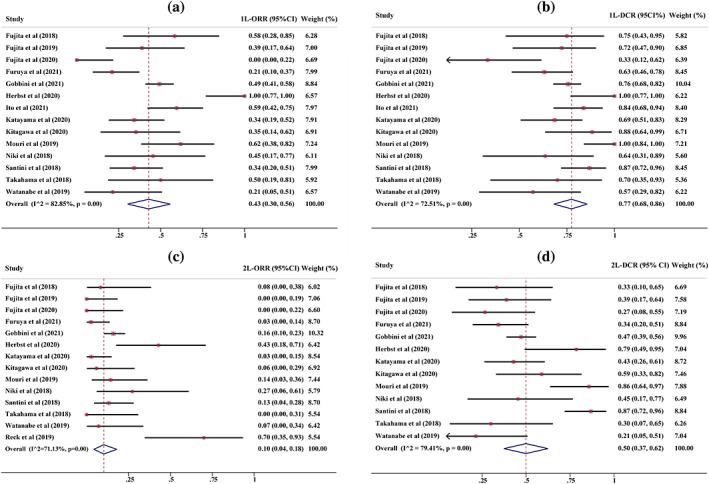
A total of 17 studies involving 2100 patients were included. The pooled objective response rate (ORR), disease control rate (DCR), median progression-free survival (mPFS), and median overall survival (mOS) for 2L-ICIs were 10%, 50%, 3.0 months, and 13.1 months, respectively. The 2L-ICI discontinuation rates caused by toxicities ranged from 0% to 23.5%. Original data were extracted from six studies, covering 89 patients. Patients in whom 1L-ICIs were discontinued following clinical decision (the mPFS of 2L-ICIs was not reach) achieved a more prolonged mPFS of 2L-ICIs than those due to toxicity (5.2 months) and progressive disease (2.1 months) (p < 0.0001). Patients' 1L-PFS for more than 2-years had preferable 2L-ORR (35.0% vs. 9.8%, p = 0.03), 2L-DCR (85.0% vs. 49.0%, p = 0.007), and 2L-mPFS (12.4 vs. 3.0 months, p < 0.0001) than those less than 1-year. Patients administered the same drugs achieved a significantly prolonged mPFS compared with the remaining patients (5.4 vs. 2.3 months, p = 0.0004), and those who did not accept antitumor treatments during the intervals of two lines of ICIs achieved a prolonged mPFS compared to those patients who did accept treatments (7.6 vs. 1.9 months, p < 0.0001).
CONCLUSIONS
ICI rechallenge is a useful therapeutic strategy for NSCLC patients, especially suitable for those who achieve long-term tumor remission for more than 2-years under 1L-ICIs.
背景
本研究旨在探讨免疫检查点抑制剂(ICI)在非小细胞肺癌(NSCLC)患者中的疗效和安全性。
方法
使用四个数据库纳入了接受两线 ICI 治疗的 NSCLC 患者的研究。一线(1L-)和二线(2L-)ICI 分别定义为 1L-ICI 和 2L-ICI。
结果
共纳入 17 项研究,涉及 2100 例患者。二线 ICI 的客观缓解率(ORR)、疾病控制率(DCR)、中位无进展生存期(mPFS)和中位总生存期(mOS)分别为 10%、50%、3.0 个月和 13.1 个月。二线 ICI 因毒性而停药的比例为 0%至 23.5%。六项研究中提取了原始数据,共涉及 89 例患者。与因毒性(5.2 个月)和疾病进展(2.1 个月)而停药的患者相比,因临床决策而停止使用 1L-ICI 的患者(二线 ICI 的 mPFS 尚未达到)的二线 ICI 具有更长的 mPFS(p<0.0001)。1L-PFS 超过 2 年的患者的二线 ORR(35.0% vs. 9.8%,p=0.03)、二线 DCR(85.0% vs. 49.0%,p=0.007)和二线 mPFS(12.4 个月 vs. 3.0 个月,p<0.0001)均优于 1 年以下的患者。接受相同药物治疗的患者的 mPFS 显著延长,而接受其他药物治疗的患者的 mPFS 缩短(5.4 个月 vs. 2.3 个月,p=0.0004),且二线 ICI 期间未接受抗肿瘤治疗的患者的 mPFS 延长,而接受治疗的患者的 mPFS 缩短(7.6 个月 vs. 1.9 个月,p<0.0001)。
结论
ICI 再挑战是 NSCLC 患者的一种有用的治疗策略,特别适用于在 1L-ICI 下实现长期肿瘤缓解超过 2 年的患者。



 Zotero 插件