
热量限制和有氧适能较低的大鼠中,情境诱导的肌肉产热减少,但单基因肥胖的大鼠并非如此。
Reduced contextually induced muscle thermogenesis in rats with calorie restriction and lower aerobic fitness but not monogenic obesity.
作者信息
Shemery Ashley M, Zendlo Meredith, Kowalski Jesse, Gorrell Erin, Everett Scott, Wagner Jacob G, Davis Ashley E, Koch Lauren G, Britton Steven L, Mul Joram D, Novak Colleen M
机构信息
School of Biomedical Sciences, Kent State University, Kent, OH, USA.
Department of Biological Sciences, Kent State University, Kent, OH, USA.
出版信息
Temperature (Austin). 2023 Feb 6;10(3):379-393. doi: 10.1080/23328940.2023.2171669. eCollection 2023.
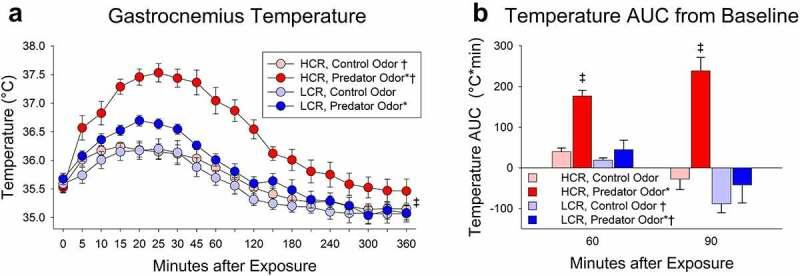
We have previously identified predator odor as a potent stimulus activating thermogenesis in skeletal muscle in rats. As this may prove relevant for energy balance and weight loss, the current study investigated whether skeletal muscle thermogenesis was altered with negative energy balance, obesity propensity seen in association with low intrinsic aerobic fitness, and monogenic obesity. First, weight loss subsequent to 3 wk of 50% calorie restriction suppressed the muscle thermogenic response to predator odor. Next, we compared rats bred based on artificial selection for intrinsic aerobic fitness - high- and low-capacity runners (HCR, LCR) - that display robust leanness and obesity propensity, respectively. Aerobically fit HCR showed enhanced predator odor-induced muscle thermogenesis relative to the less-fit LCR. This contrasted with the profound monogenic obesity displayed by rats homozygous for a loss of function mutation in ( rats), which showed no discernable deficit in thermogenesis. Taken together, these data imply that body size or obesity are not associated with deficient muscle thermogenesis. Rather, the physiological phenotype associated with polygenic obesity propensity may encompass pleiotropic mechanisms in the thermogenic pathway. Adaptive thermogenesis associated with weight loss also likely alters muscle thermogenic mechanisms.
我们之前已确定捕食者气味是一种能激活大鼠骨骼肌产热的有效刺激。鉴于这可能与能量平衡和体重减轻相关,当前研究调查了负能量平衡、与低内在有氧适能相关的肥胖倾向以及单基因肥胖是否会改变骨骼肌产热。首先,50%热量限制3周后的体重减轻抑制了肌肉对捕食者气味的产热反应。接下来,我们比较了基于内在有氧适能进行人工选择培育出的大鼠——高能力和低能力跑步者(HCR、LCR),它们分别表现出明显的瘦和肥胖倾向。有氧适能良好的HCR相对于适能较差的LCR,表现出更强的捕食者气味诱导的肌肉产热。这与因(大鼠)功能丧失突变纯合而表现出严重单基因肥胖的大鼠形成对比,这些大鼠在产热方面没有明显缺陷。综合来看,这些数据表明体型或肥胖与肌肉产热不足无关。相反,与多基因肥胖倾向相关的生理表型可能在产热途径中包含多效性机制。与体重减轻相关的适应性产热也可能改变肌肉产热机制。


 Zotero 插件