
人眼分泌物蛋白质组内的固有无序区。
Intrinsic Disorder in the Human Tear Proteome.
机构信息
Bascom Palmer Eye Institute, University of Miami, Miami, Florida, United States.
Department of Chemistry, University of South Florida, Tampa, Florida, United States.
出版信息
Invest Ophthalmol Vis Sci. 2023 Aug 1;64(11):14. doi: 10.1167/iovs.64.11.14.
PURPOSE
We aimed to characterize the proteome of human tears and assess for the presence of intrinsically disordered proteins (IDPs). IDPs, despite lacking a rigid three-dimensional structure, maintain biological functionality and could shed light on the molecular interactions within tears.
METHODS
We analyzed a dataset of 1475 proteins identified in the tear film of three healthy subjects. We employed several computational tools, including the Compositional Profiler, Rapid Intrinsic Disorder Analysis Online, Search Tool for the Retrieval of Interacting Genes, and Database of Disordered Protein Predictors to evaluate the intrinsic disorder, protein interactions, and functional characterization of the disordered regions within this proteome.
RESULTS
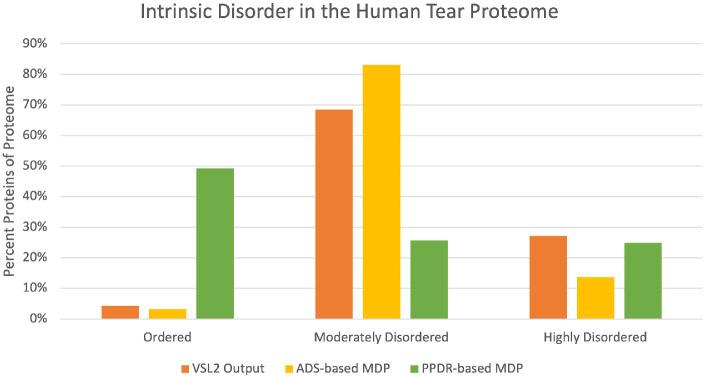
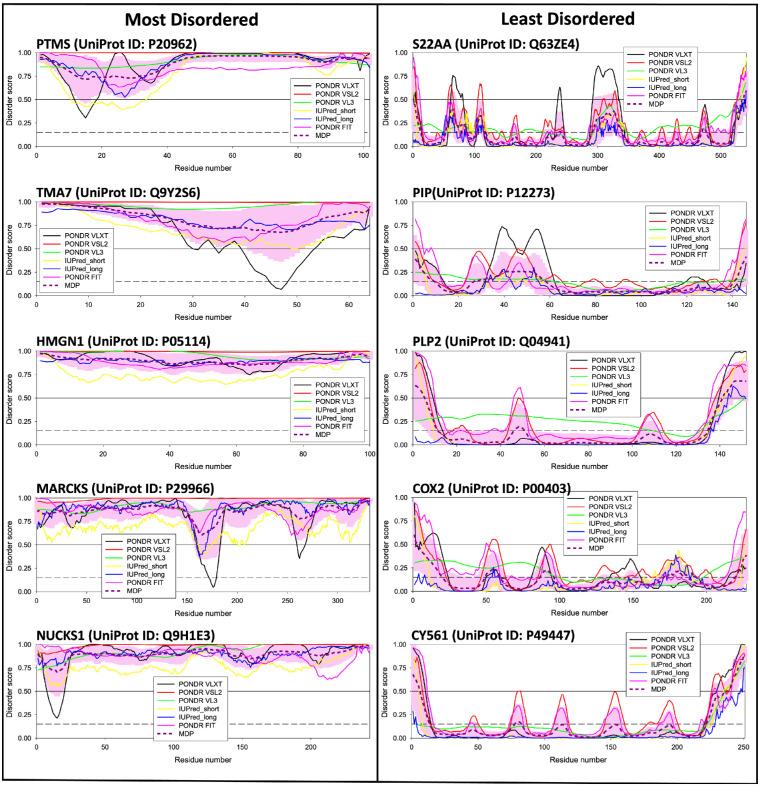
Our analysis showed a notable inclination toward intrinsic disorder. Two out of 10 order-promoting residues and five out of 10 disorder-promoting residues were found enriched. Using the Predictor of Natural Disordered Regions (PONDR) VSL2 output, 95% of these proteins were classified as highly or moderately disordered. We revealed an extensive protein-protein interaction network with significant interaction enrichment. The most disordered proteins exhibited higher disorder binding sites and diverse posttranslational modifications compared to the most ordered ones.
CONCLUSIONS
To the best of our knowledge, our study is the first comprehensive analysis of intrinsic disorder in the human tear film proteome, and it revealed an abundance of IDPs and their role in protein function and interaction networks. These findings suggest that variations in the intrinsic disorder of a tear film could be impacted by systemic and ocular conditions, offering promising avenues for disease biomarker identification and drug target development. Further research is needed to understand the implications of these findings in human health and disease.
目的
本研究旨在对人泪液的蛋白质组进行特征分析,并评估其中是否存在无规卷曲蛋白质(IDP)。尽管 IDP 缺乏刚性的三维结构,但它们仍具有生物功能,并可能揭示泪液中分子相互作用的机制。
方法
我们分析了三个健康受试者的泪膜中 1475 种蛋白质的数据集。我们使用了多种计算工具,包括 Compositional Profiler、Rapid Intrinsic Disorder Analysis Online、Search Tool for the Retrieval of Interacting Genes 和 Database of Disordered Protein Predictors,以评估该蛋白质组中无序区域的固有无序性、蛋白质相互作用和功能特征。
结果
我们的分析显示出明显的固有无序倾向。在 10 个促进有序的残基中有 2 个,在 10 个促进无序的残基中有 5 个被发现存在富集现象。使用 Predictor of Natural Disordered Regions(PONDR)VSL2 的输出结果,95%的这些蛋白质被归类为高度或中度无序。我们揭示了一个广泛的蛋白质-蛋白质相互作用网络,其中存在显著的相互作用富集现象。与最有序的蛋白质相比,最无序的蛋白质具有更高的无序结合位点和更多样的翻译后修饰。
结论
据我们所知,本研究是首次对人泪膜蛋白质组的固有无序性进行全面分析,揭示了大量 IDP 的存在及其在蛋白质功能和相互作用网络中的作用。这些发现表明,泪膜固有无序性的变化可能受到全身和眼部状况的影响,为疾病生物标志物的识别和药物靶点的开发提供了有前途的途径。需要进一步的研究来了解这些发现对人类健康和疾病的影响。





 Zotero 插件