
间充质基质细胞衍生的细胞外囊泡在软骨细胞炎症中的免疫调节潜力。
Immunomodulatory potential of mesenchymal stromal cell-derived extracellular vesicles in chondrocyte inflammation.
机构信息
Department of Orthopedics and Trauma Surgery, University Hospital Bonn, Bonn, Germany.
AO Research Institute Davos, Davos, Switzerland.
出版信息
Front Immunol. 2023 Jul 26;14:1198198. doi: 10.3389/fimmu.2023.1198198. eCollection 2023.
INTRODUCTION
Osteoarthritis (OA) affects a large percentage of the population worldwide. Current surgical and nonsurgical concepts for treating OA only result in symptom-modifying effects. However, there is no disease-modifying therapy available. Extracellular vesicles released by mesenchymal stem/stromal cells (MSC-EV) are promising agents to positively influence joint homeostasis in the osteoarthritic surroundings. This pilot study aimed to investigate the effect of characterized MSC-EVs on chondrogenesis in a 3D chondrocyte inflammation model with the pro-inflammatory cytokine TNFα.
METHODS
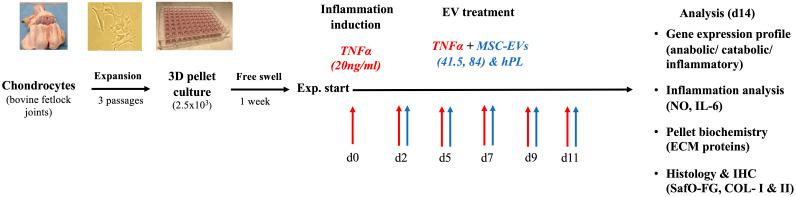
Bovine articular chondrocytes were expanded and transferred into pellet culture at passage 3. TNFα, human MSC-EV preparations (MSC-EV batches 41.5-EV and 84-EV), EVs from human platelet lysate (hPL-EV), or the combination of TNFα and EVs were supplemented. To assess the effect of MSC-EVs in the chondrocyte inflammation model after 14 days, DNA, glycosaminoglycan (GAG), total collagen, IL-6, and NO release were quantified, and gene expression of anabolic (COL-II, aggrecan, COMP, and PRG-4), catabolic (MMP-3, MMP-13, ADAMTS-4 and ADAMTS-5), dedifferentiation (COL-I), hypertrophy (COL-X, VEGF), and inflammatory (IL-8) markers were analyzed; histological evaluation was performed using safranin O/Fast Green staining and immunohistochemistry of COL I and II. For statistical evaluation, nonparametric tests were chosen with a significance level of p < 0.05.
RESULTS
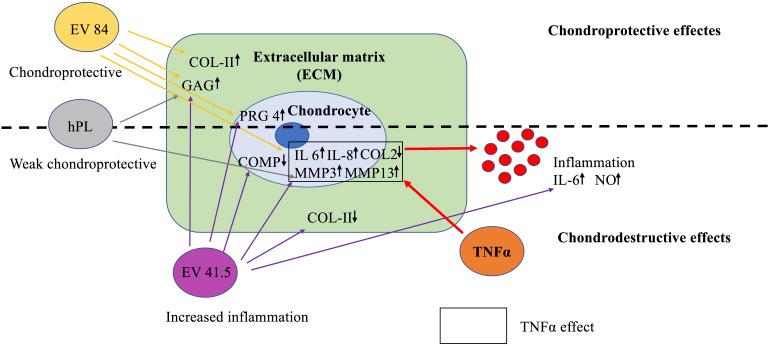
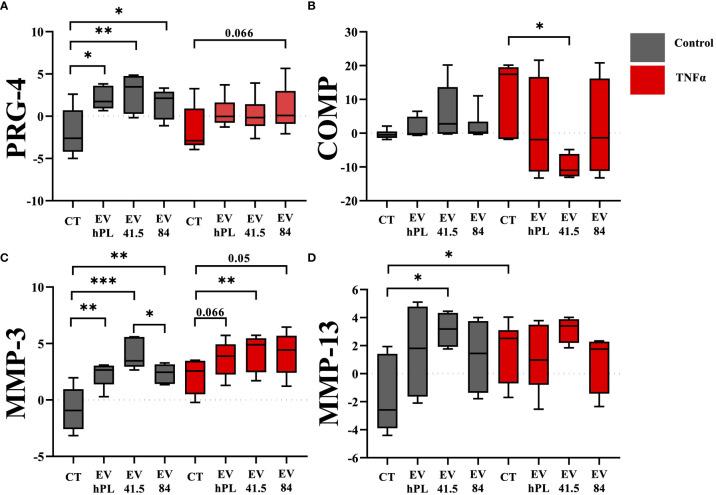
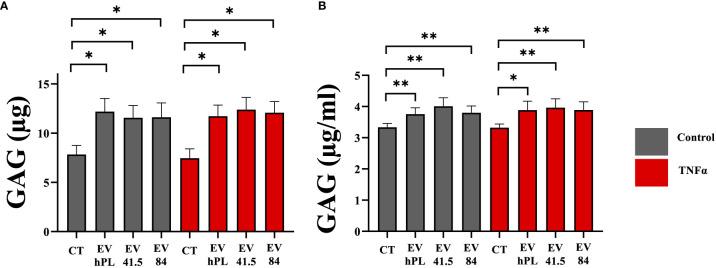
TNFα supplementation resulted in catabolic stimulation with increased levels of NO and IL-6, upregulation of catabolic gene expression, and downregulation of anabolic markers. These findings were supported by a decrease in matrix differentiation (COL-II). Supplementation of EVs resulted in an upregulation of the chondrogenic marker PRG-4. All MSC-EV preparations significantly increased GAG retention per pellet. In contrast, catabolic markers and IL-8 expression were upregulated by 41.5-EV. Regarding protein levels, IL-6 and NO release were increased by 41.5-EV. Histologic and immunohistochemical evaluations indicated a higher differentiation potential of chondrocytes treated with 84-EV.
DISCUSSION
MSC-EVs can positively influence chondrocyte matrix production in pro-inflammatory surroundings, but can also stimulate inflammation. In this study MSC-EV 41.5-EV supplementation increased chondrocyte inflammation, whereas MSC-84-EV supplementation resulted a higher chondrogenic potential of chondrocytes in 3D pellet culture. In summary, the selected MSC-EVs exhibited promising chondrogenic effects indicating their significant potential for the treatment of OA; however, the functional heterogeneity in MSC-EV preparations has to be solved.
简介
骨关节炎(OA)影响着全球很大一部分人群。目前针对 OA 的手术和非手术治疗理念仅能起到改善症状的作用。然而,目前还没有针对该病的治疗方法。间充质干细胞/基质细胞(MSC)释放的细胞外囊泡(MSC-EV)是一种很有前途的药物,可以积极影响 OA 环境中的关节稳态。本初步研究旨在通过添加促炎细胞因子 TNFα,探究经鉴定的 MSC-EV 对 3D 软骨细胞炎症模型中软骨生成的影响。
方法
牛关节软骨细胞在第 3 代时进行扩增并转移至微载体球培养。添加 TNFα、人 MSC-EV 制剂(MSC-EV 批次 41.5-EV 和 84-EV)、人血小板裂解物来源的 EV(hPL-EV)或 TNFα 与 EV 的混合物。14 天后,通过定量 DNA、糖胺聚糖(GAG)、总胶原、IL-6 和 NO 释放,分析 MSC-EV 在软骨细胞炎症模型中的作用,并检测合成代谢(COL-II、聚集蛋白聚糖、COMP、PRG-4)、分解代谢(MMP-3、MMP-13、ADAMTS-4 和 ADAMTS-5)、去分化(COL-I)、肥大(COL-X、VEGF)和炎症(IL-8)标志物的基因表达;采用番红 O/快绿染色和 COL I 和 II 的免疫组织化学染色进行组织学评估。统计分析采用非参数检验,p 值<0.05 为有统计学意义。
结果
TNFα 补充物导致软骨细胞代谢发生分解代谢刺激,NO 和 IL-6 水平升高,分解代谢基因表达上调,合成代谢标志物表达下调。COL-II 表达下调证实了基质分化减少。EV 补充物可上调软骨生成标志物 PRG-4。所有 MSC-EV 制剂均显著增加了每微载体球的 GAG 保留量。相比之下,41.5-EV 上调了分解代谢标志物和 IL-8 的表达。关于蛋白水平,41.5-EV 增加了 IL-6 和 NO 的释放。组织学和免疫组织化学评估表明,用 84-EV 处理的软骨细胞具有更高的分化潜能。
讨论
MSC-EV 可在促炎环境中积极影响软骨细胞基质生成,但也可刺激炎症。在这项研究中,MSC-EV 41.5-EV 补充物增加了软骨细胞炎症,而 MSC-84-EV 补充物增加了 3D 微载体球培养中的软骨细胞的软骨生成潜能。总之,所选的 MSC-EV 显示出有希望的软骨生成作用,表明它们对 OA 治疗具有重要的应用潜力;然而,MSC-EV 制剂的功能异质性仍需解决。


 Zotero 插件