
维奈托克联合低甲基化药物治疗的急性髓系白血病患者缓解后血细胞减少的管理:VIALE-A研究之前与之后——来自美国主要社区环境的真实世界经验
Post-remission cytopenia management in patients with AML treated with venetoclax in combination with hypomethylating agents: Pre- versus post-VIALE-A real-world experience from a predominantly US community setting.
作者信息
Vachhani Pankit, Ma Esprit, Xu Tao, Montez Melissa, Worth Sarah, Yellow-Duke Archibong, Cheng Wei-Han, Werner Michael E, Abbas Jonathan, Donnellan William
机构信息
O'Neal Comprehensive Cancer Center at the University of Alabama at Birmingham, Birmingham, Alabama, USA.
Genentech, Inc., South San Francisco, California, USA.
出版信息
Cancer Med. 2023 Sep;12(17):17914-17923. doi: 10.1002/cam4.6430. Epub 2023 Aug 11.
BACKGROUND
This retrospective cohort study used an electronic health record-derived, de-identified, US patient-level database to better understand the real-world treatment experience, in a predominantly community setting (80.3% of patients), of venetoclax+hypomethylating agents (HMAs) in routine clinical care, pre- and post-VIALE-A, to determine whether the post-remission cytopenia management insight from VIALE-A was reflected in real-world clinical practice.
METHODS
Patients with newly diagnosed acute myeloid leukemia (AML; N = 498), who initiated venetoclax+HMA ≤30 days from AML diagnosis from June 1, 2018, to March 31, 2021, were stratified into pre-(n = 330) and post-(n = 168) VIALE-A cohorts.
RESULTS
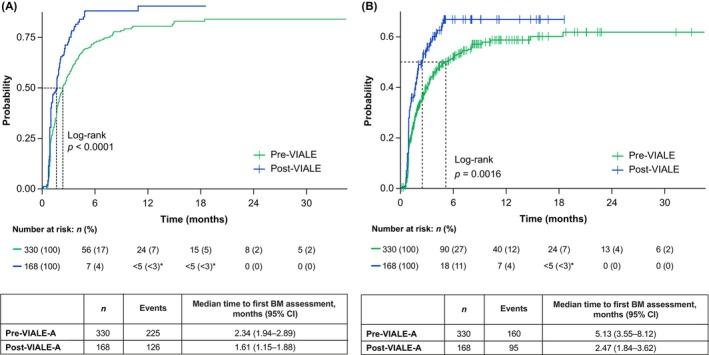
More patients in the post-(61%) versus pre-(45%) VIALE-A cohort had their first biopsy by 28 ± 14 days post-treatment initiation. Patients underwent bone marrow (BM) assessment earlier in the post- versus pre-VIALE-A cohort, and first identification of response was also earlier (2.5 vs 5.1 months, respectively). More venetoclax schedule modifications post-remission occurred among post-(82.1%) versus pre-(73.8%) VIALE-A responders; the most common reason for modification was treatment toxicities, specifically cytopenia. Treatment survival outcomes were comparable with or without venetoclax schedule modifications.
CONCLUSIONS
Findings suggest that venetoclax schedule modifications can be used to manage cytopenia events without adversely affecting outcomes. Opportunities remain to improve earlier BM assessment to determine venetoclax schedule modifications, providing the best chance for optimal treatment outcomes.
背景
这项回顾性队列研究使用了一个源自电子健康记录、去识别化的美国患者层面数据库,以更好地了解在主要为社区环境(80.3%的患者)中,维奈克拉联合低甲基化药物(HMAs)在VIALE-A研究之前和之后的常规临床护理中的真实世界治疗体验,以确定VIALE-A研究中缓解后血细胞减少管理的见解是否反映在真实世界的临床实践中。
方法
2018年6月1日至2021年3月31日期间,新诊断为急性髓系白血病(AML;N = 498)且在AML诊断后≤30天开始使用维奈克拉+HMA的患者被分为VIALE-A研究之前(n = 330)和之后(n = 168)的队列。
结果
与VIALE-A研究之前的队列(45%)相比,VIALE-A研究之后的队列中更多患者(61%)在治疗开始后28±14天进行了首次活检。与VIALE-A研究之前的队列相比,患者在VIALE-A研究之后更早接受骨髓(BM)评估,首次确定缓解也更早(分别为2.5个月和5.1个月)。在VIALE-A研究之后的缓解后维奈克拉治疗方案调整发生率高于之前(82.1%对73.8%);调整的最常见原因是治疗毒性,特别是血细胞减少。无论维奈克拉治疗方案是否调整,治疗生存结果相当。
结论
研究结果表明,维奈克拉治疗方案调整可用于管理血细胞减少事件,而不会对结果产生不利影响。仍有机会改善早期BM评估以确定维奈克拉治疗方案调整,为实现最佳治疗结果提供最佳机会。

 Zotero 插件