
使用层状双氢氧化物催化剂对聚对苯二甲酸乙二酯进行化学回收:合成方法和镁铁生物相容性金属的影响
Chemical Recycling of PET Using Catalysts from Layered Double Hydroxides: Effect of Synthesis Method and Mg-Fe Biocompatible Metals.
作者信息
Arcanjo Ana P, Liborio Denisson O, Arias Santiago, Carvalho Florival R, Silva Josivan P, Ribeiro Bernardo D, Dias Marcos L, Castro Aline M, Fréty Roger, Barbosa Celmy M B M, Pacheco Jose Geraldo A
机构信息
Laboratory of Refining and Cleaner Technology (LabRefino-Lateclim), Department of Chemical Engineering, Institute for Petroleum and Energy Research (i-LITPEG), Federal University of Pernambuco, Recife 50740-550, PE, Brazil.
Fuel Laboratory, Department of Chemical Engineering, Institute for Petroleum and Energy Research (i-LITPEG), Federal University of Pernambuco, Recife 50740-550, PE, Brazil.
出版信息
Polymers (Basel). 2023 Aug 2;15(15):3274. doi: 10.3390/polym15153274.
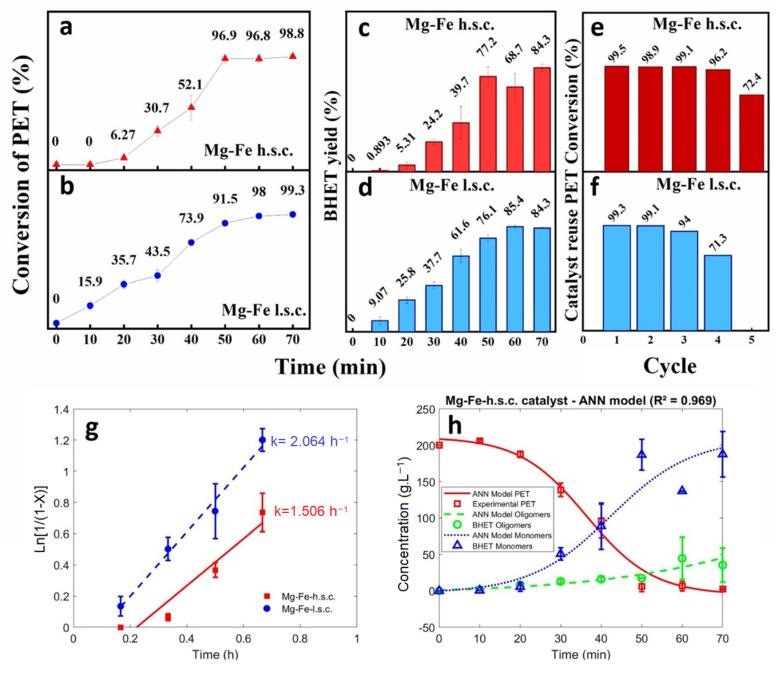
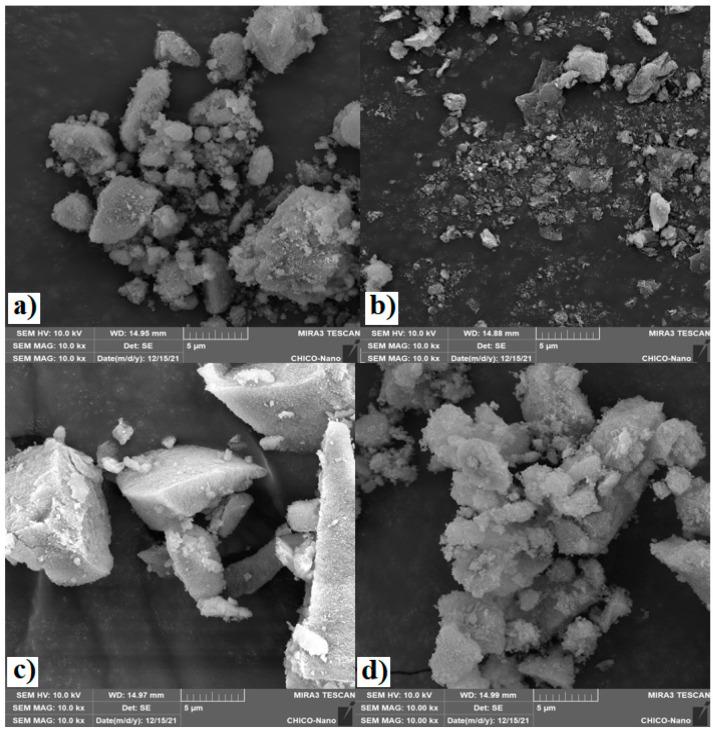
The chemical recycling of poly(ethylene terephthalate) (PET) residues was performed via glycolysis with ethylene glycol (EG) over Mg-Fe and Mg-Al oxide catalysts derived from layered double hydroxides. Catalysts prepared using the high supersaturation method (h.s.c.) presented a higher surface area and larger particles, but this represented less PET conversion than those prepared by the low supersaturation method (l.s.c.). This difference was attributed to the smaller mass transfer limitations inside the (l.s.c.) catalysts. An artificial neural network model well fitted the PET conversion and bis(2-hydroxyethyl) terephthalate (BHET) yield. The influence of Fe in place of Al resulted in a higher PET conversion of the Mg-Fe-h.s.c. catalyst (95.8%) than of Mg-Al-h.s.c. (63%). Mg-Fe catalysts could be reused four to five times with final conversions of up to 97% with reaction conditions of EG: PET = 5:1 and catalyst: PET = 0.5%. These results confirm the Mg-Fe oxides as a biocompatible novel catalyst for the chemical recycling of PET residues to obtain non-toxic BHET for further polymerization, and use in food and beverage packaging.
通过在由层状双氢氧化物衍生的Mg-Fe和Mg-Al氧化物催化剂上,用乙二醇(EG)对聚对苯二甲酸乙二酯(PET)残渣进行化学循环利用。采用高过饱和度法(h.s.c.)制备的催化剂具有更高的表面积和更大的颗粒,但与采用低过饱和度法(l.s.c.)制备的催化剂相比,其PET转化率较低。这种差异归因于(l.s.c.)催化剂内部较小的传质限制。人工神经网络模型很好地拟合了PET转化率和对苯二甲酸双(2-羟乙基)酯(BHET)产率。用Fe代替Al导致Mg-Fe-h.s.c.催化剂的PET转化率(约95.8%)高于Mg-Al-h.s.c.催化剂(约63%)。在EG:PET = 5:1和催化剂:PET = 0.5%的反应条件下,Mg-Fe催化剂可以重复使用四到五次,最终转化率高达97%。这些结果证实了Mg-Fe氧化物是一种生物相容性新型催化剂,可用于PET残渣的化学循环利用,以获得无毒的BHET用于进一步聚合,并用于食品和饮料包装。

 Zotero 插件