
具有微血管侵犯的肝细胞癌中生物标志物的作用及分子机制:综述
Roles and Molecular Mechanisms of Biomarkers in Hepatocellular Carcinoma with Microvascular Invasion: A Review.
作者信息
Zhao Xudong, Wang Yudan, Xia Haoming, Liu Shuqiang, Huang Ziyue, He Risheng, Yu Liang, Meng Nanfeng, Wang Hang, You Junqi, Li Jinglin, Yam Judy Wai Ping, Xu Yi, Cui Yunfu
机构信息
Department of Hepatopancreatobiliary Surgery, Second Affiliated Hospital of Harbin Medical University, Harbin, Heilongjiang, China.
Department of Pathology, School of Clinical Medicine, Li Ka Shing Faculty of Medicine, The University of Hong Kong, Hong Kong, China.
出版信息
J Clin Transl Hepatol. 2023 Oct 28;11(5):1170-1183. doi: 10.14218/JCTH.2022.00013S. Epub 2023 May 4.
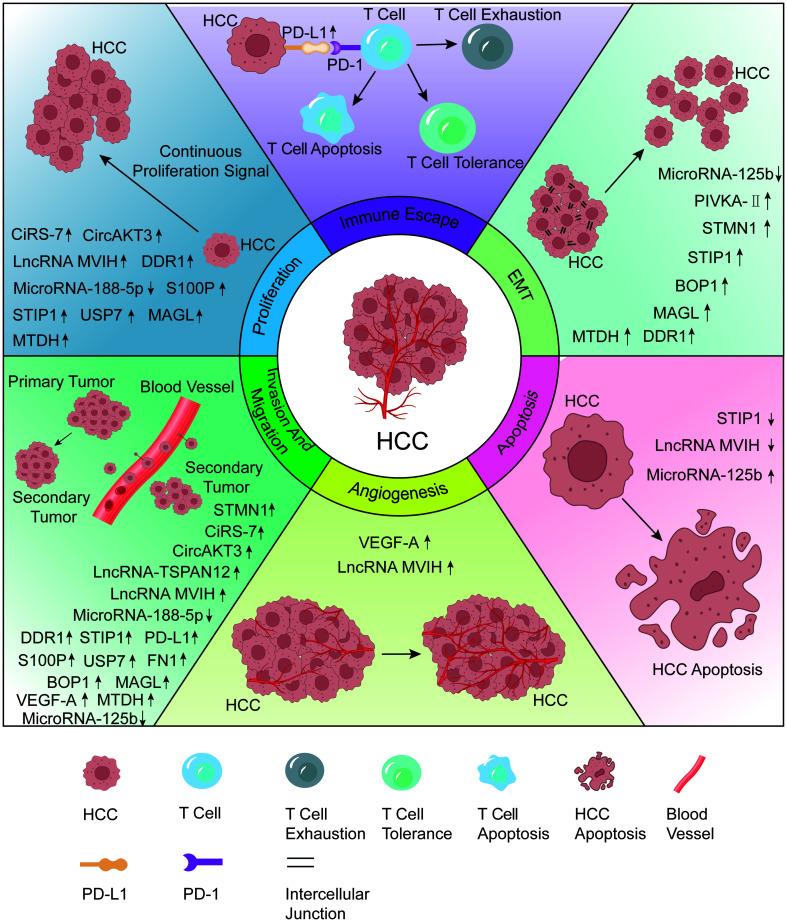
Hepatocellular carcinoma (HCC) being a leading cause of cancer-related death, has high associated mortality and recurrence rates. It has been of great necessity and urgency to find effective HCC diagnosis and treatment measures. Studies have shown that microvascular invasion (MVI) is an independent risk factor for poor prognosis after hepatectomy. The abnormal expression of biomacromolecules such as circ-RNAs, lncRNAs, STIP1, and PD-L1 in HCC patients is strongly correlated with MVI. Deregulation of several markers mentioned in this review affects the proliferation, invasion, metastasis, EMT, and anti-apoptotic processes of HCC cells through multiple complex mechanisms. Therefore, these biomarkers may have an important clinical role and serve as promising interventional targets for HCC. In this review, we provide a comprehensive overview on the functions and regulatory mechanisms of MVI-related biomarkers in HCC.
肝细胞癌(HCC)是癌症相关死亡的主要原因,具有较高的死亡率和复发率。寻找有效的HCC诊断和治疗措施具有极大的必要性和紧迫性。研究表明,微血管侵犯(MVI)是肝切除术后预后不良的独立危险因素。HCC患者中circ-RNAs、lncRNAs、STIP1和PD-L1等生物大分子的异常表达与MVI密切相关。本综述中提到的几种标志物的失调通过多种复杂机制影响HCC细胞的增殖、侵袭、转移、上皮-间质转化(EMT)和抗凋亡过程。因此,这些生物标志物可能具有重要的临床作用,并有望成为HCC的干预靶点。在本综述中,我们全面概述了HCC中MVI相关生物标志物的功能和调控机制。

 Zotero 插件