
孕期早期金属和微量元素混合物与儿童早期和中期认知:来自 Viva 项目队列的研究结果。
Mixtures of Metals and Micronutrients in Early Pregnancy and Cognition in Early and Mid-Childhood: Findings from the Project Viva Cohort.
机构信息
Division of Epidemiology, School of Public Health, University of California, Berkeley, Berkeley, California, USA.
Division of Chronic Disease Research Across the Lifecourse, Department of Population Medicine, Harvard Medical School and Harvard Pilgrim Health Care Institute, Boston, Massachusetts, USA.
出版信息
Environ Health Perspect. 2023 Aug;131(8):87008. doi: 10.1289/EHP12016. Epub 2023 Aug 16.
BACKGROUND
The developing fetal brain is sensitive to many environmental exposures. However, the independent and joint effects of prenatal exposure to metals and micronutrients on child cognition are not well understood.
OBJECTIVES
Our aim was to evaluate associations of first-trimester ( wk) maternal erythrocyte concentrations of mixtures of nonessential and essential metals and micronutrients with early ( y) and mid-childhood ( y) cognitive test scores in Project Viva, a prebirth cohort in Boston, Massachusetts, USA.
METHODS
We measured concentrations of five essential metals (Cu, Mg, Mn, Se, Zn) and two micronutrients (vitamin B12 and folate), together termed the "nutrient mixture," as well as six nonessential metals (As, Ba, Cd, Cs, Hg, Pb), together termed the "neurotoxic mixture," in first-trimester ( wk) maternal erythrocytes (metals) or plasma (micronutrients). We assessed visual-motor function and receptive vocabulary in early childhood ( y), and visual-motor function, visual memory, and fluid and crystallized intelligence in mid-childhood ( y). We employed adjusted quantile g-computation and linear regression to estimate mixture and individual component associations, respectively.
RESULTS
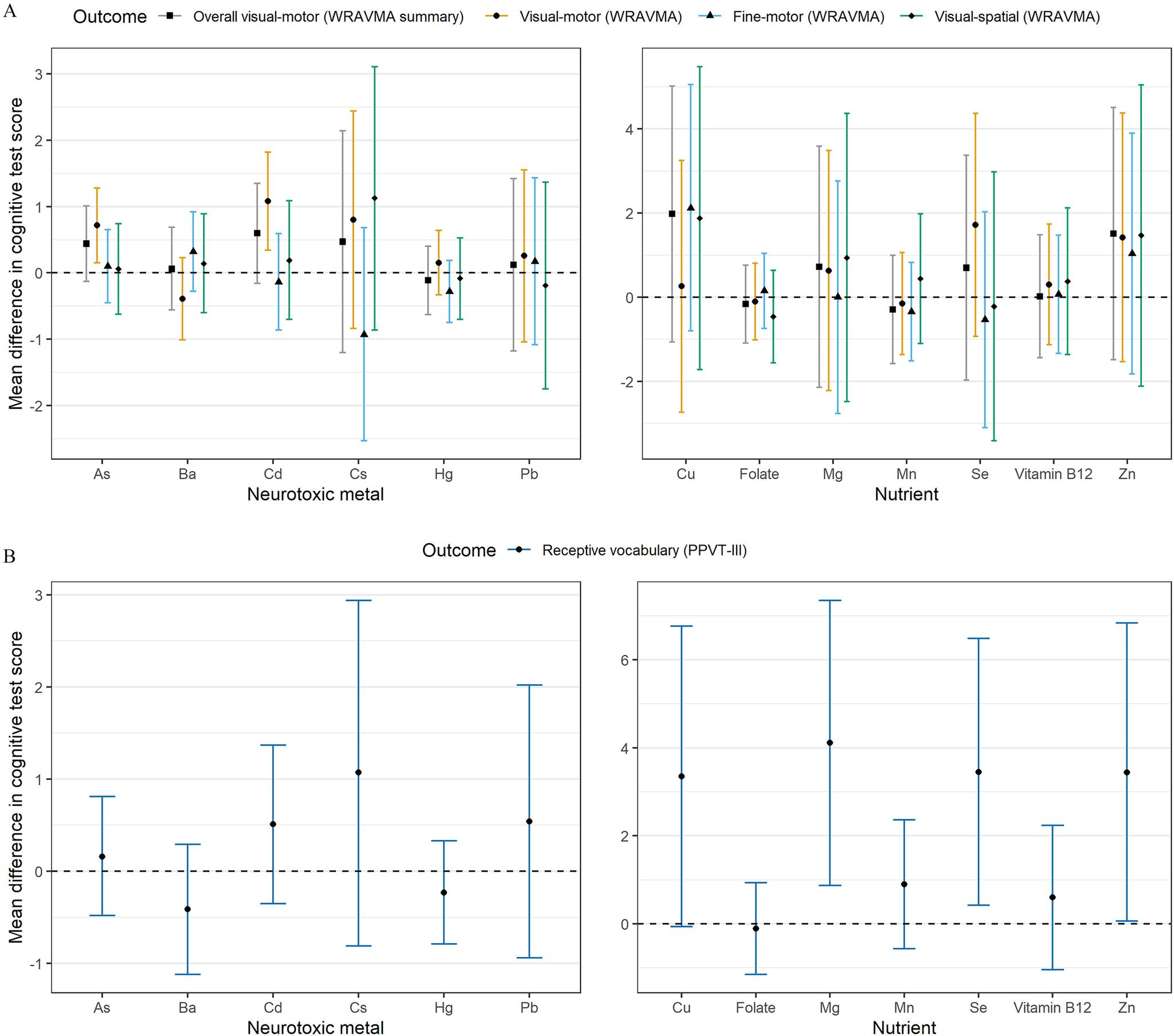
Analyses included 900 mother-child pairs (74% college graduates; 52% male children). In mixture analyses, a quartile increase in the nutrient mixture was associated with a mean difference in early childhood receptive vocabulary score of 1.58 points [95% confidence interval (CI): 0.06, 3.10], driven by Zn and Se. A quartile increase in the neurotoxic mixture was associated with a mean difference in mid-childhood visual-motor score of points (95% CI: , ), driven by Ba and Cs. Linear regressions supported quantile g-computation findings for mixture component contributions.
DISCUSSION
Maternal circulating concentrations of several essential (Zn and Se) and nonessential (Ba and Cs) metals were associated with some domains of child cognition. In this folate-replete cohort, first-trimester circulating concentrations of known neurotoxic metals, such as Pb, were not associated with child cognition. https://doi.org/10.1289/EHP12016.
背景
发育中的胎儿大脑对外界环境的许多因素都很敏感。然而,产前暴露于金属和微量营养素对儿童认知的独立和联合影响尚不清楚。
目的
我们旨在评估美国马萨诸塞州波士顿一项产前队列项目(Viva 项目)中,妊娠早期(第 5 周)母亲红细胞中混合非必需和必需金属及微量营养素浓度与儿童早期(1 岁)和中期(3 岁)认知测试分数之间的关联。
方法
我们测量了妊娠早期(第 5 周)母亲红细胞(金属)或血浆(微量营养素)中五种必需金属(铜、镁、锰、硒、锌)和两种微量营养素(维生素 B12 和叶酸)组成的“营养混合物”,以及六种非必需金属(砷、钡、镉、铯、汞、铅)组成的“神经毒性混合物”的浓度。我们评估了儿童早期(1 岁)的视觉运动功能和接受性词汇,以及儿童中期(3 岁)的视觉运动功能、视觉记忆、流体智力和晶体智力。我们分别采用校正分位数 g 计算和线性回归来估计混合物和个别成分的关联。
结果
分析纳入了 900 对母婴(74%为大学毕业生;52%为男童)。在混合物分析中,营养混合物的四分位距增加 1 个单位与儿童早期接受性词汇评分的平均差异为 1.58 分[95%置信区间(CI):0.06,3.10],这主要由锌和硒推动。神经毒性混合物的四分位距增加 1 个单位与儿童中期视觉运动评分的平均差异为 1.58 分[95%置信区间(CI):0.06,3.10],这主要由钡和铯推动。线性回归支持分位数 g 计算得出的混合物成分贡献的发现。
讨论
母亲循环中的几种必需(锌和硒)和非必需(钡和铯)金属浓度与儿童认知的某些领域有关。在这个叶酸充足的队列中,妊娠早期循环中已知的神经毒性金属(如铅)浓度与儿童认知无关。

 Zotero 插件