
用于预测膀胱尿路上皮癌预后和免疫治疗反应的G蛋白偶联受体相关基因特征。
The G protein-coupled receptor-related gene signatures for predicting prognosis and immunotherapy response in bladder urothelial carcinoma.
作者信息
Wan Zhengqiang, Wang Yinglei, Li Cheng, Zheng Dongbing
机构信息
Department of Thoracic Surgery, The First People's Hospital of Suining, Suining, Sichuan, China.
Department of Urology, Yantai Affiliated Hospital of Binzhou Medical University, Yantai, Shandong, China.
出版信息
Open Life Sci. 2023 Aug 10;18(1):20220682. doi: 10.1515/biol-2022-0682. eCollection 2023.
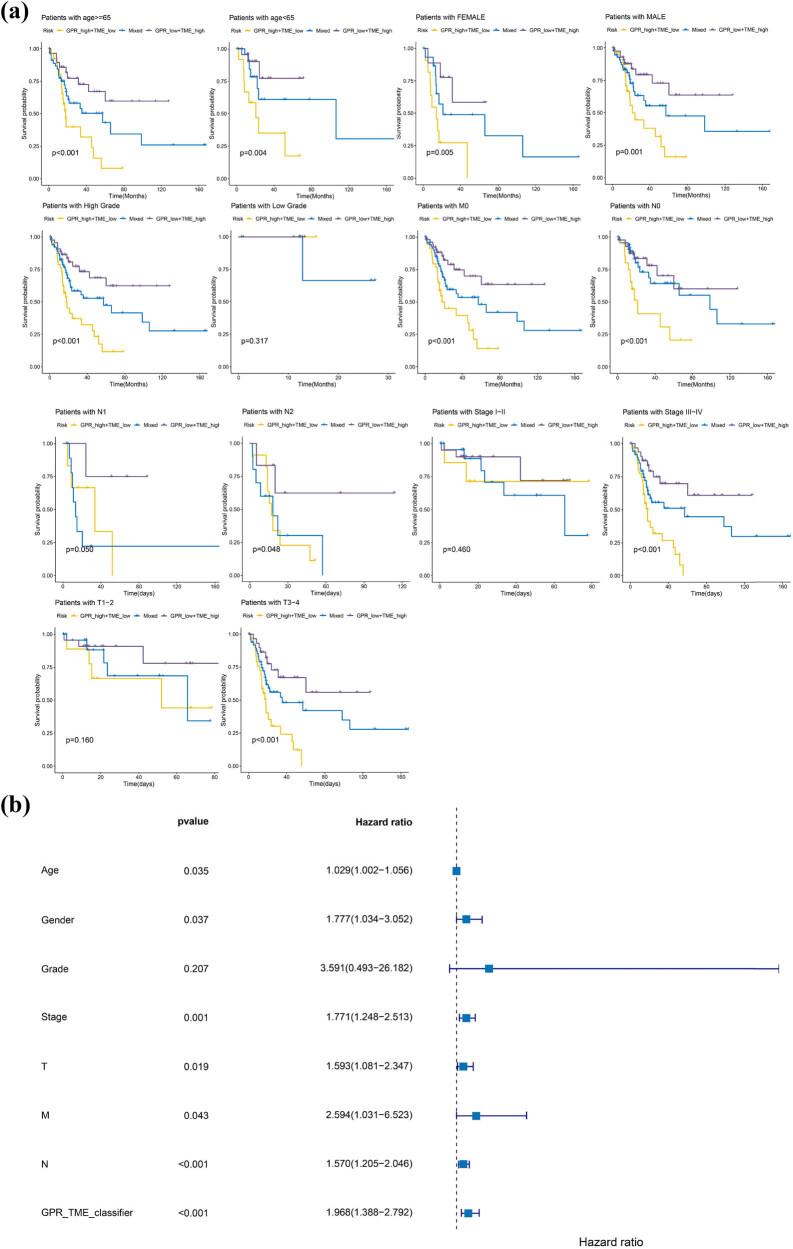
Bladder urothelial carcinoma (BLCA) is the most common malignant tumor of the urinary tract with a high lethality rate, and its immunotherapy resistance and tumor recurrence have become a major challenge in its clinical treatment. G Protein-Coupled Receptors (GPRs) are the largest family of receptors on the cell membrane surface, involved in multiple signaling pathways, and are excellent targets for oncology drug action. The transcriptome profile, single cell transcriptome profile, and clinical data of BLCA were extracted and integrated from TCGA and GEO databases, respectively. The GPR-related genes were obtained from GSEA-MSigDB database. The GPR-related gene signatures of 15 genes were constructed by using the methods of least absolute shrinkage and selection operator regression, multifactor Cox model. At the same time, tumor microenvironment (TME)-score signatures were constructed based on the immune microenvironment of BLCA, and GPR-TME-score signature was further constructed. The stability of this model was verified by using the external dataset GSE160693. We constructed risk groups by combining BLCA patient prognostic information, and with the help of BLCA scRNA transcriptome profiling, we explored differences in prognosis, immune scores, cell-cell interactions, tumor mutational burden, immune checkpoints, and response to immunotherapy in each risk group. We found that the GPR-TME-score signature was an independent prognostic factor for BLCA patients. the TME-score was a protective factor for the prognosis of BLCA patients. Among BLCA patients, GPR-high + TME-low risk group had the worst prognosis, while GPR-high + TME-high risk group had the best prognosis, and the latter had better immune score and immunotherapy response. The above differences in immune response among the subgroups may be related to the higher immune cell infiltration in the GPR-high + TME-high group. GPR-related gene signatures and TME are closely related to BLCA prognosis and immunotherapy, and GPR-related gene signature can be a useful tool to assess BLCA prognosis and immunotherapy response.
膀胱尿路上皮癌(BLCA)是最常见的泌尿系统恶性肿瘤,致死率高,其免疫治疗耐药性和肿瘤复发已成为临床治疗中的重大挑战。G蛋白偶联受体(GPRs)是细胞膜表面最大的受体家族,参与多种信号通路,是肿瘤药物作用的优良靶点。分别从TCGA和GEO数据库中提取并整合了BLCA的转录组图谱、单细胞转录组图谱和临床数据。GPR相关基因从GSEA-MSigDB数据库中获取。采用最小绝对收缩和选择算子回归、多因素Cox模型构建了15个基因的GPR相关基因特征。同时,基于BLCA的免疫微环境构建肿瘤微环境(TME)评分特征,并进一步构建GPR-TME评分特征。利用外部数据集GSE160693验证了该模型的稳定性。我们结合BLCA患者的预后信息构建风险组,并借助BLCA的scRNA转录组图谱,探讨各风险组在预后、免疫评分、细胞间相互作用、肿瘤突变负荷、免疫检查点及免疫治疗反应方面的差异。我们发现GPR-TME评分特征是BLCA患者的独立预后因素。TME评分是BLCA患者预后的保护因素。在BLCA患者中,GPR高+TME低风险组预后最差,而GPR高+TME高风险组预后最好,且后者具有更好的免疫评分和免疫治疗反应。亚组间上述免疫反应差异可能与GPR高+TME高组中较高的免疫细胞浸润有关。GPR相关基因特征和TME与BLCA预后及免疫治疗密切相关,GPR相关基因特征可作为评估BLCA预后和免疫治疗反应的有用工具。



 Zotero 插件