
巴西面对新冠疫情时与状态及自我感知心理健康变化相关的因素。
Factors associated with status and self-perceived mental health changes in the face of the COVID-19 pandemic in Brazil.
作者信息
Rosa Rander Junior, Araújo Juliana Soares Tenório de, Berra Thaís Zamboni, Ramos Antônio Carlos Vieira, Moura Heriederson Sávio Dias, Nascimento Murilo César do, Tártaro Ariela Fehr, Silva Ruan Victor Dos Santos, Delpino Felipe Mendes, Fiorati Regina Célia, Teibo Titilade Kehinde Ayandeyi, Alves Yan Mathias, Paiva Juliana Queiroz Rocha de, Arcoverde Marcos Augusto Moraes, Scholze Alessandro Rolim, Arcêncio Ricardo Alexandre
机构信息
Department of Maternal-Infant Nursing and Public Health, University of São Paulo at Ribeirão Preto College of Nursing, Ribeirão Preto, São Paulo, Brazil.
Department of Neurosciences and Behavioral Sciences, Ribeirão Preto Medical School of the University of São Paulo, Ribeirão Preto, São Paulo, Brazil.
出版信息
PLOS Glob Public Health. 2023 Aug 18;3(8):e0001636. doi: 10.1371/journal.pgph.0001636. eCollection 2023.
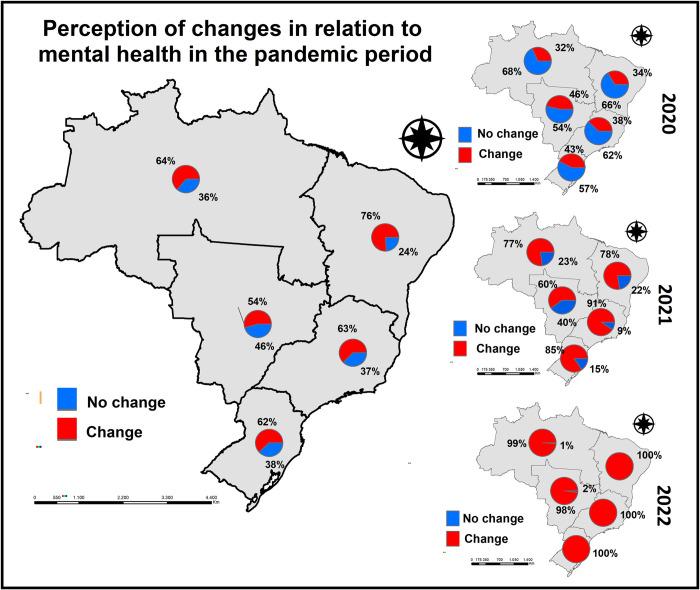
The SARS-CoV-2-triggered Public Health Emergency of International Importance has significantly contributed to emotional and mental health issues. The aim of this study was to identify factors associated with self-perceived mental health changes while facing the COVID-19 pandemic in Brazil. This was a cross-sectional, descriptive, and analytical study that collected data via a web survey using a validated instrument. The study included individuals over 18 years old residing in the 26 federal units and the Federal District from August 2020 to November 2022. The sample was recruited using the snowball technique. Two logistic regression analyses were conducted to identify factors associated with the outcomes of interest. The first analysis considered individuals who rated their mental health condition as poor as the dependent variable, while the second analysis considered individuals who reported changes in their mental health during the pandemic as the dependent variable. The study found that individuals with complete college education and those using tranquilizers or antidepressants were more likely to perceive their mental health as poor (1.97 and 2.04 times higher likelihood, respectively). Increased consumption of ultra-processed foods during the pandemic was associated with a 2.49 higher likelihood of reporting mental health changes. Participants also reported more difficulty sleeping. The negative self-perception of mental health varied across Brazil's regions and changed over time, with different patterns observed before and after the vaccination period. In 2022, most regions of Brazil classified their mental health as "poor." The study highlights the impact of the COVID-19 pandemic on mental health, with increased prevalence of mental disorders and emotional problems among the population. The results highlight the presence of mental disorders and increased reporting of emotional problems among the population due to the impact of the COVID-19 pandemic.
由严重急性呼吸综合征冠状病毒2(SARS-CoV-2)引发的“国际关注的突发公共卫生事件”对情绪和心理健康问题产生了重大影响。本研究的目的是确定在巴西面对2019冠状病毒病疫情时与自我感知的心理健康变化相关的因素。这是一项横断面、描述性和分析性研究,通过使用经过验证的工具进行网络调查来收集数据。该研究纳入了2020年8月至2022年11月居住在26个联邦单位和联邦区的18岁以上个体。样本采用滚雪球技术招募。进行了两项逻辑回归分析以确定与感兴趣的结果相关的因素。第一次分析将心理健康状况评为差的个体作为因变量,而第二次分析将报告在疫情期间心理健康有变化的个体作为因变量。研究发现,拥有完整大学学历的个体以及使用镇静剂或抗抑郁药的个体更有可能认为自己的心理健康状况差(可能性分别高出1.97倍和2.04倍)。疫情期间超加工食品消费的增加与报告心理健康变化的可能性高出2.49倍相关。参与者还报告睡眠困难更多。心理健康的负面自我认知在巴西各地区有所不同,并且随时间变化,在疫苗接种期之前和之后观察到不同的模式。2022年,巴西大部分地区将其心理健康状况归类为“差”。该研究强调了2019冠状病毒病疫情对心理健康的影响,人群中精神障碍和情绪问题的患病率增加。结果强调了由于2019冠状病毒病疫情的影响,人群中存在精神障碍且情绪问题的报告增多。

 Zotero 插件