
神经系统疾病中的肠道微生物群-脑轴
The gut microbiota-brain axis in neurological disorder.
作者信息
Ullah Hanif, Arbab Safia, Tian Yali, Liu Chang-Qing, Chen Yuwen, Qijie Li, Khan Muhammad Inayat Ullah, Hassan Inam Ul, Li Ka
机构信息
Department of Nursing, West China Hospital, West China School of Nursing, Sichuan University, Chengdu, China.
Key Laboratory of Veterinary Pharmaceutical Development, Ministry of Agriculture, Lanzhou, China.
出版信息
Front Neurosci. 2023 Aug 4;17:1225875. doi: 10.3389/fnins.2023.1225875. eCollection 2023.
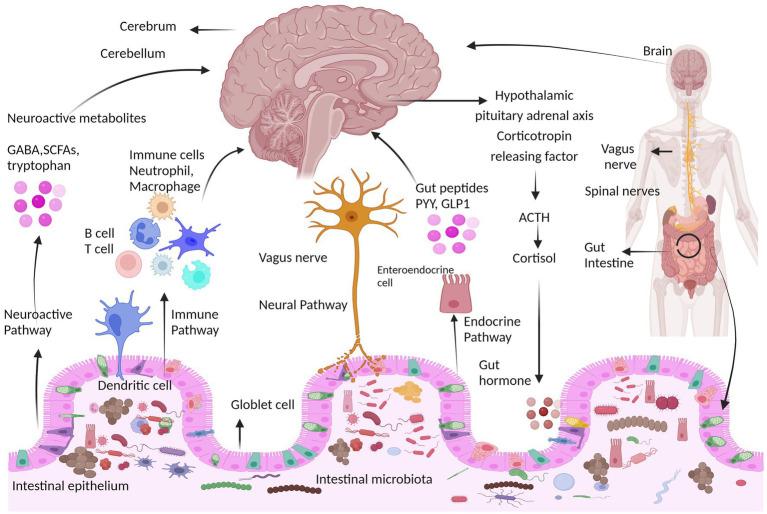
The gut microbiota (GM) plays an important role in the physiology and pathology of the host. Microbiota communicate with different organs of the organism by synthesizing hormones and regulating body activity. The interaction of the central nervous system (CNS) and gut signaling pathways includes chemical, neural immune and endocrine routes. Alteration or dysbiosis in the gut microbiota leads to different gastrointestinal tract disorders that ultimately impact host physiology because of the abnormal microbial metabolites that stimulate and trigger different physiologic reactions in the host body. Intestinal dysbiosis leads to a change in the bidirectional relationship between the CNS and GM, which is linked to the pathogenesis of neurodevelopmental and neurological disorders. Increasing preclinical and clinical studies/evidence indicate that gut microbes are a possible susceptibility factor for the progression of neurological disorders, including Alzheimer's disease (AD), Parkinson's disease (PD), multiple sclerosis (MS) and autism spectrum disorder (ASD). In this review, we discuss the crucial connection between the gut microbiota and the central nervous system, the signaling pathways of multiple biological systems and the contribution of gut microbiota-related neurological disorders.
肠道微生物群(GM)在宿主的生理和病理过程中发挥着重要作用。微生物群通过合成激素和调节身体活动与机体的不同器官进行交流。中枢神经系统(CNS)与肠道信号通路的相互作用包括化学、神经免疫和内分泌途径。肠道微生物群的改变或失调会导致不同的胃肠道疾病,由于异常的微生物代谢产物刺激并引发宿主体内不同的生理反应,最终影响宿主的生理机能。肠道菌群失调会导致中枢神经系统与肠道微生物群之间的双向关系发生变化,这与神经发育和神经疾病的发病机制有关。越来越多的临床前和临床研究/证据表明,肠道微生物是包括阿尔茨海默病(AD)、帕金森病(PD)、多发性硬化症(MS)和自闭症谱系障碍(ASD)在内的神经疾病进展的一个可能的易感因素。在这篇综述中,我们讨论了肠道微生物群与中枢神经系统之间的关键联系、多个生物系统的信号通路以及肠道微生物群相关神经疾病的作用。

 Zotero 插件