
部分基因抑制可改善 CRISPR-Cas9 基因敲除泛致死时癌症脆弱性鉴定。
Partial gene suppression improves identification of cancer vulnerabilities when CRISPR-Cas9 knockout is pan-lethal.
机构信息
Broad Institute of Harvard and MIT, Cambridge, MA, USA.
Dana-Farber Cancer Institute, Boston, MA, USA.
出版信息
Genome Biol. 2023 Aug 23;24(1):192. doi: 10.1186/s13059-023-03020-w.
BACKGROUND
Hundreds of functional genomic screens have been performed across a diverse set of cancer contexts, as part of efforts such as the Cancer Dependency Map, to identify gene dependencies-genes whose loss of function reduces cell viability or fitness. Recently, large-scale screening efforts have shifted from RNAi to CRISPR-Cas9, due to superior efficacy and specificity. However, many effective oncology drugs only partially inhibit their protein targets, leading us to question whether partial suppression of genes using RNAi could reveal cancer vulnerabilities that are missed by complete knockout using CRISPR-Cas9. Here, we compare CRISPR-Cas9 and RNAi dependency profiles of genes across approximately 400 matched cancer cell lines.
RESULTS
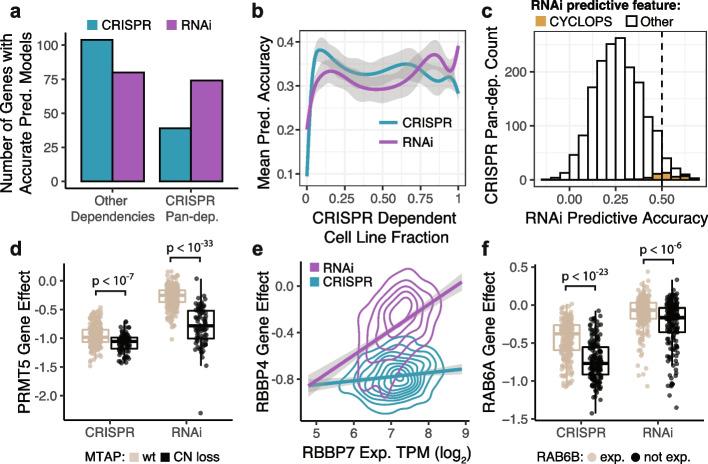
We find that CRISPR screens accurately identify more gene dependencies per cell line, but the majority of each cell line's dependencies are part of a set of 1867 genes that are shared dependencies across the entire collection (pan-lethals). While RNAi knockdown of about 30% of these genes is also pan-lethal, approximately 50% have selective dependency patterns across cell lines, suggesting they could still be cancer vulnerabilities. The accuracy of the unique RNAi selectivity is supported by associations to multi-omics profiles, drug sensitivity, and other expected co-dependencies.
CONCLUSIONS
Incorporating RNAi data for genes that are pan-lethal knockouts facilitates the discovery of a wider range of gene targets than could be detected using the CRISPR dataset alone. This can aid in the interpretation of contrasting results obtained from CRISPR and RNAi screens and reinforce the importance of partial gene suppression methods in building a cancer dependency map.
背景
作为癌症依赖性图谱等努力的一部分,已经在各种癌症环境中进行了数百项功能基因组筛选,以确定基因依赖性 - 这些基因的功能丧失会降低细胞活力或适应性。最近,由于效果更好和特异性更高,大规模筛选工作已从 RNAi 转移到 CRISPR-Cas9。然而,许多有效的肿瘤药物仅部分抑制其蛋白质靶标,这使我们质疑使用 RNAi 部分抑制基因是否可以揭示 CRISPR-Cas9 完全敲除所错过的癌症脆弱性。在这里,我们比较了大约 400 对匹配癌细胞系中 CRISPR-Cas9 和 RNAi 依赖性谱。
结果
我们发现 CRISPR 筛选更准确地鉴定了每个细胞系中的更多基因依赖性,但每个细胞系的大部分依赖性都是跨越整个集合(泛致死性)的 1867 个基因的共同依赖性的一部分。虽然这些基因的约 30%的 RNAi 敲低也是泛致死性的,但大约 50%的基因在细胞系之间具有选择性依赖性模式,这表明它们仍然可能是癌症脆弱性。独特的 RNAi 选择性的准确性得到了与多组学谱、药物敏感性和其他预期的共依赖性的关联的支持。
结论
对于泛致死性敲除的基因,纳入 RNAi 数据有助于发现比仅使用 CRISPR 数据集更广泛的基因靶标。这可以帮助解释 CRISPR 和 RNAi 筛选获得的对比结果,并加强部分基因抑制方法在构建癌症依赖性图谱中的重要性。



 Zotero 插件