
多模态成像技术在非人灵长类动物离子通道型化学遗传学中的验证和优化
Multimodal Imaging for Validation and Optimization of Ion Channel-Based Chemogenetics in Nonhuman Primates.
机构信息
Department of Functional Brain Imaging, National Institutes for Quantum Science and Technology, Chiba 263-8555, Japan.
Department of Functional Brain Imaging, National Institutes for Quantum Science and Technology, Chiba 263-8555, Japan
出版信息
J Neurosci. 2023 Sep 27;43(39):6619-6627. doi: 10.1523/JNEUROSCI.0625-23.2023. Epub 2023 Aug 24.
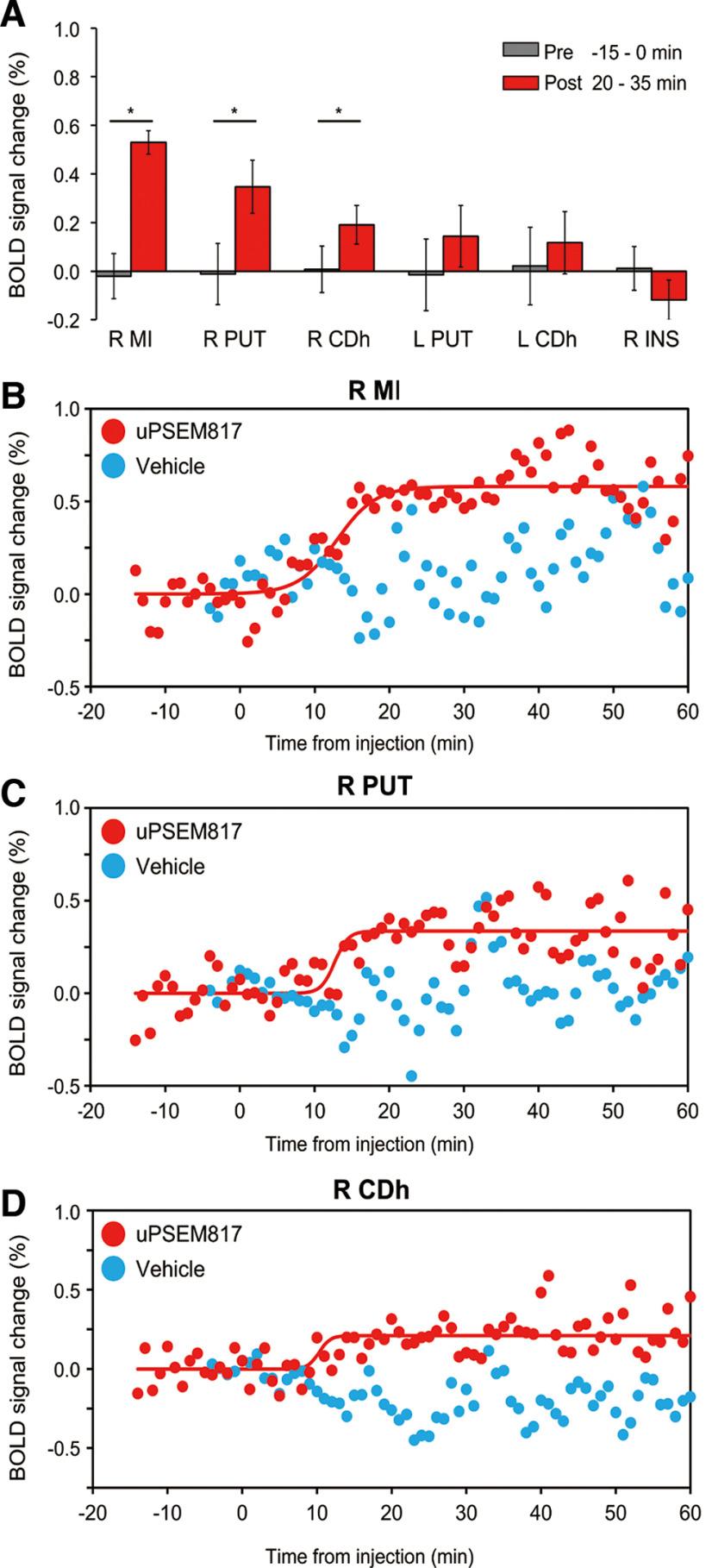
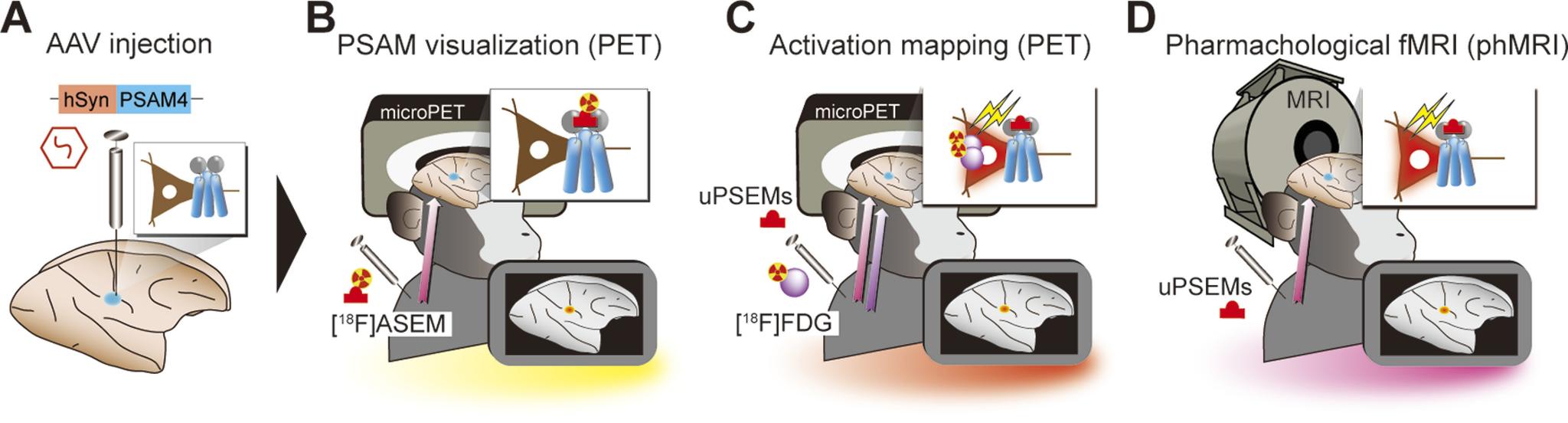
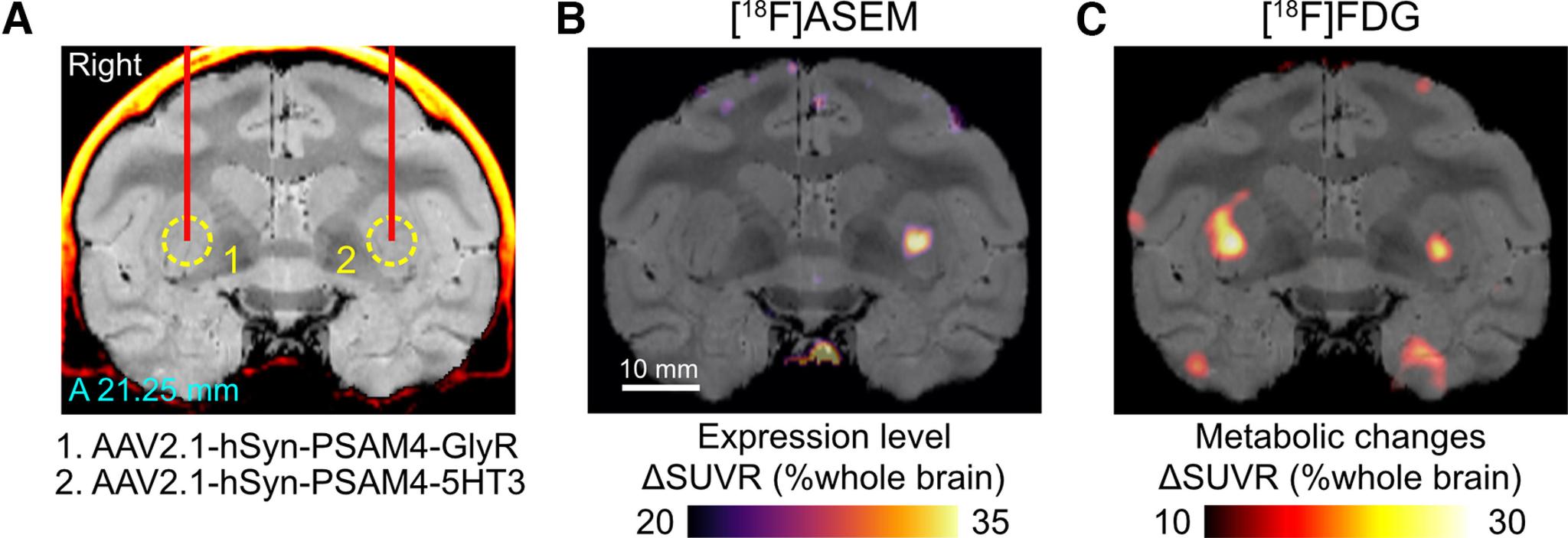
Chemogenetic tools provide an opportunity to manipulate neuronal activity and behavior selectively and repeatedly in nonhuman primates (NHPs) with minimal invasiveness. Designer Receptors Exclusively Activated by Designer Drugs (DREADDs) are one example that is based on mutated muscarinic acetylcholine receptors. Another channel-based chemogenetic system available for neuronal modulation in NHPs uses pharmacologically selective actuator modules (PSAMs), which are selectively activated by pharmacologically selective effector molecules (PSEMs). To facilitate the use of the PSAM/PSEM system, the selection and dosage of PSEMs should be validated and optimized for NHPs. To this end, we used a multimodal imaging approach. We virally expressed excitatory PSAM (PSAM4-5HT3) in the striatum and the primary motor cortex (M1) of two male macaque monkeys, and visualized its location through positron emission tomography (PET) with the reporter ligand [F]ASEM. Chemogenetic excitability of neurons triggered by two PSEMs (uPSEM817 and uPSEM792) was evaluated using [F]fluorodeoxyglucose-PET imaging, with uPSEM817 being more efficient than uPSEM792. Pharmacological magnetic resonance imaging (phMRI) showed that increased brain activity in the PSAM4-expressing region began ∼13 min after uPSEM817 administration and continued for at least 60 min. Our multimodal imaging data provide valuable information regarding the manipulation of neuronal activity using the PSAM/PSEM system in NHPs, facilitating future applications. Like other chemogenetic tools, the ion channel-based system called pharmacologically selective actuator module/pharmacologically selective effector molecule (PSAM/PSEM) allows remote manipulation of neuronal activity and behavior in living animals. Nevertheless, its application in nonhuman primates (NHPs) is still limited. Here, we used multitracer positron emission tomography (PET) imaging and pharmacological magnetic resonance imaging (phMRI) to visualize an excitatory chemogenetic ion channel (PSAM4-5HT3) and validate its chemometric function in macaque monkeys. Our results provide the optimal agonist, dose, and timing for chemogenetic neuronal manipulation, facilitating the use of the PSAM/PSEM system and expanding the flexibility and reliability of circuit manipulation in NHPs in a variety of situations.
化学遗传工具为在非人类灵长类动物(NHP)中选择性和重复地进行最小侵入性的神经元活动和行为操纵提供了机会。基于突变毒蕈碱乙酰胆碱受体的 Designer Receptors Exclusively Activated by Designer Drugs(DREADD)是一个例子。另一种可用于 NHP 神经元调节的基于通道的化学遗传系统使用药理学选择性激活模块(PSAM),其被药理学选择性效应分子(PSEM)选择性激活。为了促进 PSAM/PSEM 系统的使用,应该对 PSEM 的选择和剂量进行验证和优化,以适应 NHP。为此,我们使用了多模态成像方法。我们在两只雄性猕猴的纹状体和初级运动皮层(M1)中病毒表达兴奋性 PSAM(PSAM4-5HT3),并通过正电子发射断层扫描(PET)用报告配体[F]ASEM 可视化其位置。使用[F]氟脱氧葡萄糖-PET 成像评估两种 PSEM(uPSEM817 和 uPSEM792)触发的神经元化学遗传兴奋性,uPSEM817 比 uPSEM792 更有效。药理学磁共振成像(phMRI)显示,PSAM4 表达区域的脑活动增加在 uPSEM817 给药后约 13 分钟开始,并持续至少 60 分钟。我们的多模态成像数据提供了关于使用 PSAM/PSEM 系统在 NHP 中操纵神经元活动的有价值的信息,为未来的应用提供了便利。与其他化学遗传工具一样,基于离子通道的系统称为药理学选择性激活模块/药理学选择性效应分子(PSAM/PSEM)允许在活体动物中远程操纵神经元活动和行为。然而,其在非人类灵长类动物(NHP)中的应用仍然有限。在这里,我们使用多示踪剂正电子发射断层扫描(PET)成像和药理学磁共振成像(phMRI)来可视化兴奋性化学遗传离子通道(PSAM4-5HT3),并验证其在猕猴中的化学计量功能。我们的结果提供了化学遗传神经元操纵的最佳激动剂、剂量和时间,为 PSAM/PSEM 系统的使用提供了便利,并在各种情况下扩展了 NHP 中电路操纵的灵活性和可靠性。


 Zotero 插件