
谷胱甘肽循环的组成部分作为生物学年龄的标志物:一种衰老临床应用的方法
Components of the Glutathione Cycle as Markers of Biological Age: An Approach to Clinical Application in Aging.
作者信息
Diaz-Del Cerro Estefania, Martinez de Toda Irene, Félix Judith, Baca Adriana, De la Fuente Monica
机构信息
Unit of Animal Physiology, Department of Genetics, Physiology, and Microbiology, Faculty of Biological Sciences, Complutense University of Madrid, José Antonio Novais, 12, 28040 Madrid, Spain.
Institute of Investigation Hospital 12 Octubre (imas12), 28041 Madrid, Spain.
出版信息
Antioxidants (Basel). 2023 Jul 30;12(8):1529. doi: 10.3390/antiox12081529.
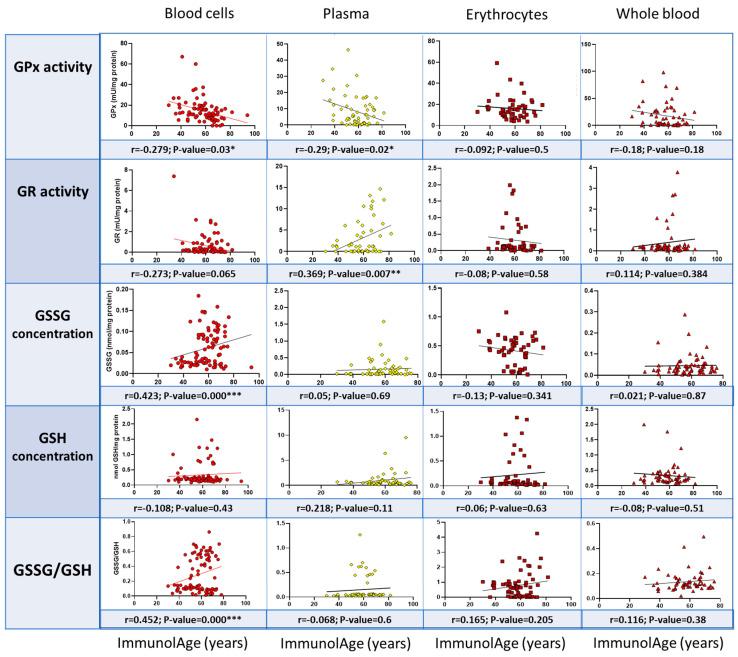
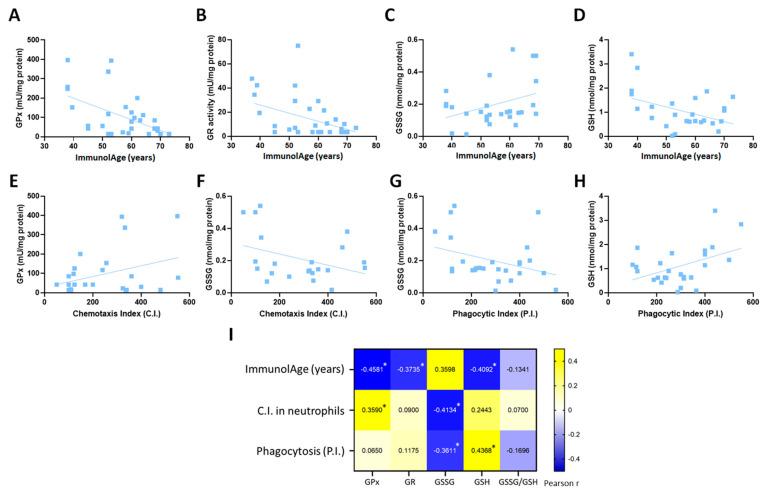
The oxidative-inflammatory theory of aging states that aging is the result of the establishment of a chronic oxidative-inflammatory stress situation in which the immune system is implicated. Among the redox parameters, those involved in the glutathione cycle have been suggested as essential in aging. Thus, the first objective of this study was to determine if several components of the glutathione cycle (glutathione reductase (GR) and glutathione peroxidase (GPx) activities, and concentrations of oxidized glutathione (GSSG) and reduced glutathione (GSH)) in leukocytes) are associated with the biological age (ImmunolAge) estimated using the Immunity Clock in 190 men and women. The second objective was to identify the best blood fraction (whole blood, blood cells, erythrocytes, or plasma) to quantify these components and correlate them with the estimated ImmunolAge. The results show that the oxidative state of peripheral leukocytes correlates with their functionality, supporting the idea that this is the basis of immunosenescence. In blood, the correlations are more significant in the fraction of blood cells with respect to ImmunolAge (positive correlations with GSSG concentration and the GSSG/GSH ratio, and negative correlations with GPx and GR activities). Therefore, blood cells are proposed as the most effective sample to estimate the biological age of individuals in clinical settings.
衰老的氧化-炎症理论认为,衰老是免疫系统参与其中的慢性氧化-炎症应激状态确立的结果。在氧化还原参数中,那些参与谷胱甘肽循环的参数被认为在衰老过程中至关重要。因此,本研究的首要目标是确定190名男性和女性白细胞中谷胱甘肽循环的几个组成部分(谷胱甘肽还原酶(GR)和谷胱甘肽过氧化物酶(GPx)活性、氧化型谷胱甘肽(GSSG)和还原型谷胱甘肽(GSH)的浓度)是否与使用免疫时钟估算的生物学年龄(免疫衰老年龄)相关。第二个目标是确定用于量化这些组成部分并将它们与估算的免疫衰老年龄相关联的最佳血液成分(全血、血细胞、红细胞或血浆)。结果表明,外周白细胞的氧化状态与其功能相关,支持了这是免疫衰老基础的观点。在血液中,血细胞部分与免疫衰老年龄的相关性更为显著(与GSSG浓度和GSSG/GSH比值呈正相关,与GPx和GR活性呈负相关)。因此,血细胞被认为是临床环境中估算个体生物学年龄的最有效样本。


 Zotero 插件