
全球范围内一剂与两剂人乳头瘤病毒疫苗接种方案的影响和成本效益比较:建模分析。
Global impact and cost-effectiveness of one-dose versus two-dose human papillomavirus vaccination schedules: a comparative modelling analysis.
机构信息
Department of Infectious Disease Epidemiology, Faculty of Epidemiology and Population Health, London School of Hygiene & Tropical Medicine, London, UK.
Saw Swee Hock School of Public Health, National University of Singapore and National University Health System, Singapore, Singapore.
出版信息
BMC Med. 2023 Aug 28;21(1):313. doi: 10.1186/s12916-023-02988-3.
BACKGROUND
To eliminate cervical cancer as a public health problem, the World Health Organization had recommended routine vaccination of adolescent girls with two doses of the human papillomavirus (HPV) vaccine before sexual initiation. However, many countries have yet to implement HPV vaccination because of financial or logistical barriers to delivering two doses outside the infant immunisation programme.
METHODS
Using three independent HPV transmission models, we estimated the long-term health benefits and cost-effectiveness of one-dose versus two-dose HPV vaccination, in 188 countries, under scenarios in which one dose of the vaccine gives either a shorter duration of full protection (20 or 30 years) or lifelong protection but lower vaccine efficacy (e.g. 80%) compared to two doses. We simulated routine vaccination with the 9-valent HPV vaccine in 10-year-old girls at 80% coverage for the years 2021-2120, with a 1-year catch-up campaign up to age 14 at 80% coverage in the first year of the programme.
RESULTS
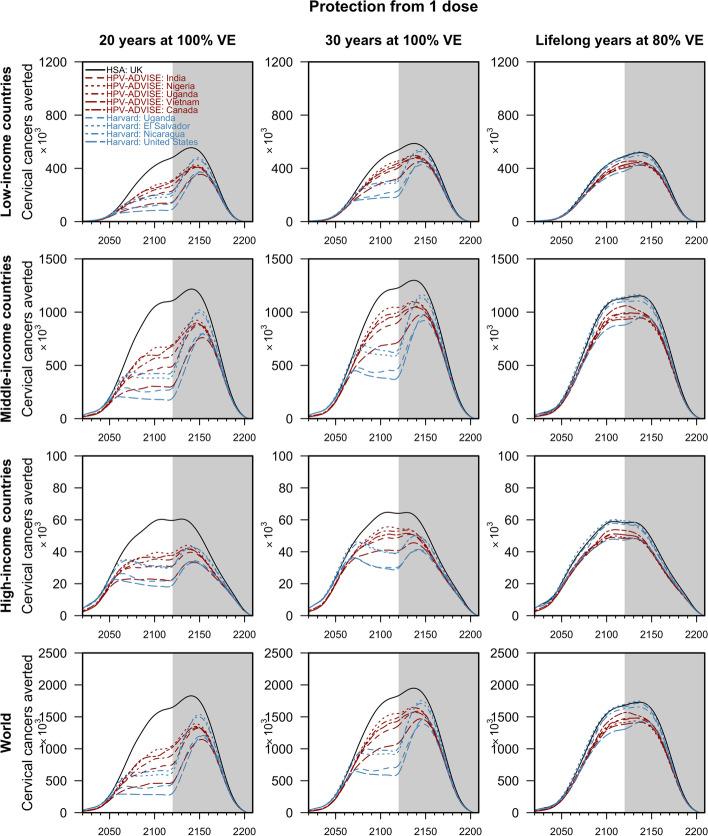
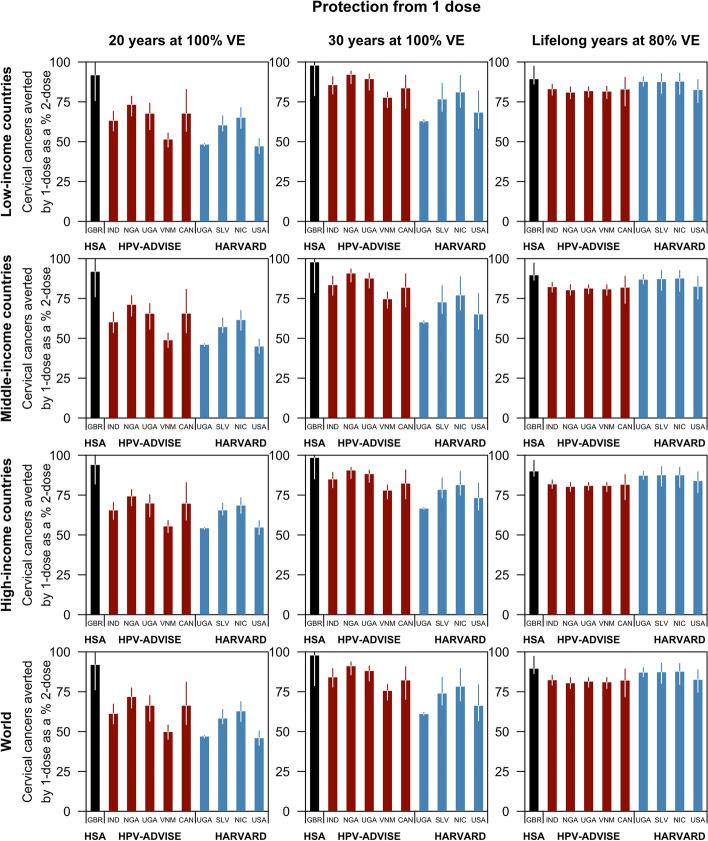
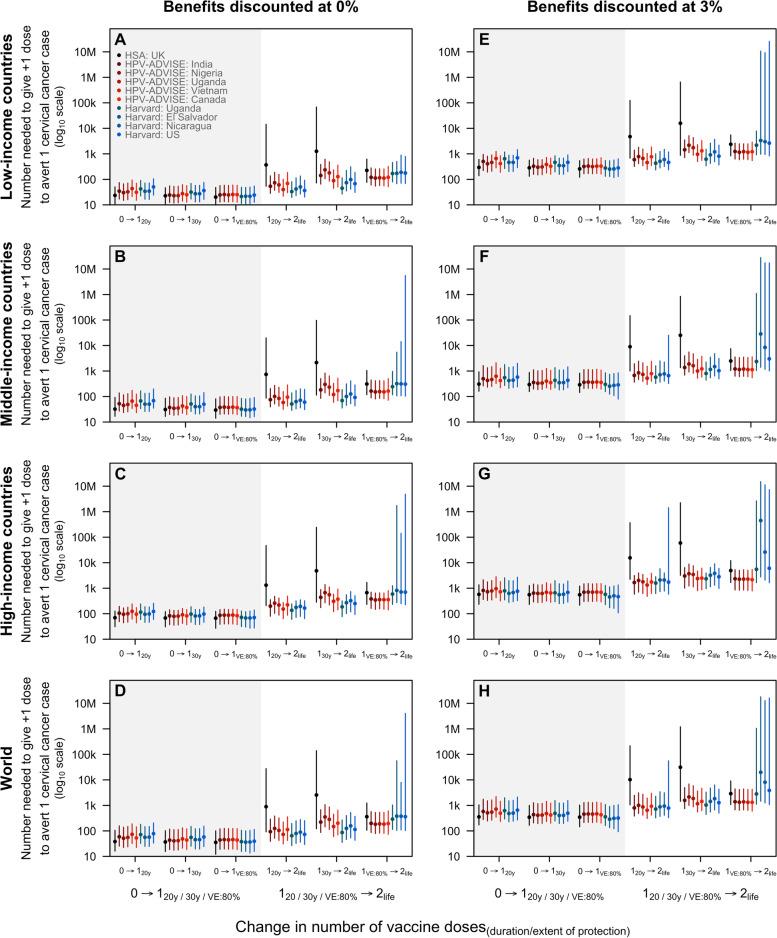
Over the years 2021-2120, one-dose vaccination at 80% coverage was projected to avert 115.2 million (range of medians: 85.1-130.4) and 146.8 million (114.1-161.6) cervical cancers assuming one dose of the vaccine confers 20 and 30 years of protection, respectively. Should one dose of the vaccine provide lifelong protection at 80% vaccine efficacy, 147.8 million (140.6-169.7) cervical cancer cases could be prevented. If protection wanes after 20 years, 65 to 889 additional girls would need to be vaccinated with the second dose to prevent one cervical cancer, depending on the epidemiological profiles of the country. Across all income groups, the threshold cost for the second dose was low: from 1.59 (0.14-3.82) USD in low-income countries to 44.83 (3.75-85.64) USD in high-income countries, assuming one dose confers 30-year protection.
CONCLUSIONS
Results were consistent across the three independent models and suggest that one-dose vaccination has similar health benefits to a two-dose programme while simplifying vaccine delivery, reducing costs, and alleviating vaccine supply constraints. The second dose may become cost-effective if there is a shorter duration of protection from one dose, cheaper vaccine and vaccination delivery strategies, and high burden of cervical cancer.
背景
为了消除宫颈癌这一公共卫生问题,世界卫生组织曾建议在少女初次性行为之前,接种两剂人乳头瘤病毒(HPV)疫苗。然而,许多国家尚未实施 HPV 疫苗接种,因为在婴儿免疫计划之外提供两剂疫苗存在财务或后勤方面的障碍。
方法
我们使用三种独立的 HPV 传播模型,估计了在以下情况下,一剂 HPV 疫苗与两剂 HPV 疫苗相比的长期健康效益和成本效益:在疫苗提供的完全保护持续时间较短(20 年或 30 年)或终身保护但疫苗效力较低(例如 80%)的情况下,在 188 个国家中,对九价 HPV 疫苗进行常规接种,在 2021 年至 2120 年期间,以 80%的覆盖率对 10 岁女孩进行接种,在计划实施的第一年,以 80%的覆盖率对 14 岁以下女孩进行为期一年的补种。
结果
在 2021 年至 2120 年期间,假设一剂疫苗分别提供 20 年和 30 年的保护,80%的覆盖率预计可预防 11520 万(中位数范围:8510 万至 13040 万)和 14680 万(11410 万至 16160 万)例宫颈癌。如果一剂疫苗能提供 80%疫苗效力的终身保护,那么 14780 万(14060 万至 16970 万)例宫颈癌病例可被预防。如果 20 年后保护作用减弱,根据国家的流行病学特征,需要额外接种 65 至 889 剂第二剂疫苗以预防一例宫颈癌。在所有收入组中,第二剂疫苗的门槛成本都很低:从低收入国家的 1.59 美元(0.14 美元至 3.82 美元)到高收入国家的 448.3 美元(3.75 美元至 85.64 美元),假设一剂疫苗提供 30 年的保护。
结论
三种独立模型的结果一致,表明一剂 HPV 疫苗接种具有与两剂方案相似的健康效益,同时简化了疫苗接种,降低了成本,并缓解了疫苗供应的限制。如果一剂疫苗的保护持续时间较短、疫苗更便宜、接种和疫苗输送策略更优,且宫颈癌负担较高,那么第二剂疫苗可能具有成本效益。


 Zotero 插件