
灭活 COVID-19 疫苗对女性卵巢储备的影响:一项倾向评分匹配的回顾性队列研究。
Impact of inactivated COVID-19 vaccination on female ovarian reserve: a propensity score-matched retrospective cohort study.
机构信息
Center for Reproductive Medicine, Jiangxi Maternal and Child Health Hospital, Jiangxi Branch of National Clinical Research Center for Obstetrics and Gynecology, Nanchang Medical College, Nanchang, China.
Department of Clinical Medicine, School of Queen Mary, Nanchang University, Nanchang, China.
出版信息
Front Immunol. 2023 Aug 11;14:1198051. doi: 10.3389/fimmu.2023.1198051. eCollection 2023.
PURPOSE
To explore the impact of inactivated COVID-19 vaccination on ovarian reserve as assessed by serum anti-Müllerian hormone (AMH) concentration.
METHODS
A total of 3160 women were included in this single-center retrospective cohort study between June 2021 and October 2022. Vaccination information were collected from official immunization records available in personal mobile apps. Serum AMH was qualified by electrochemiluminescence immunoassay and compared with previous measurement data within three years. Women were categorized to the vaccinated group if they received two doses of inactivated COVID-19 vaccines (Sinopharm or Sinovac) between AMH tests ( = 488), and to the control group if not vaccinated ( = 2672). Propensity score matching and multivariate linear regression were performed to control for potential confounders. The main outcome measures were the numeric AMH change and percentage AMH change between the two tests.
RESULTS
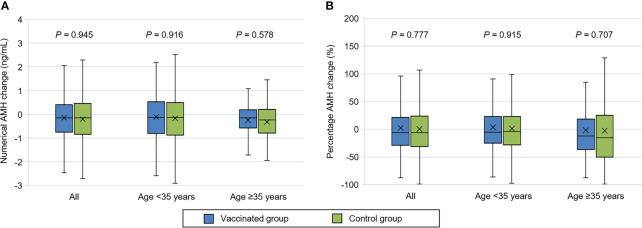
There were 474 women left in each group after matching all baseline characteristics. The mean interval from the first to second AMH measurement was 508.0 ± 250.2 and 507.5 ± 253.6 days for vaccinated and unvaccinated women, respectively ( = 0.680). Both groups had a significant AMH decrease in the second test compared with the first test ( = 0.001). However, the second AMH level remained comparable between groups (3.26 ± 2.80 3.24 ± 2.61 ng/mL, = 0.757). Similarly, no significant differences were observed in numerical (-0.14 ± 1.32 -0.20 ± 1.56 ng/mL, = 0.945) and percentage (2.33 ± 58.65 0.35 ± 48.42%, = 0.777) AMH changes. The results were consistent in sub-analyses for women aged <35 and ≥35 years. There were also no significant differences when vaccinated women were divided according to the time interval after vaccination: ≤30, 31-60, 61-90, and ≥91 days.
CONCLUSION
Our study provides the first evidence that inactivated COVID-19 vaccination has no measurable detrimental effect on ovarian reserve, regardless of female age and vaccination interval. This reassuring finding adds to the safety evidence of COVID-19 vaccine in fertility, and should be useful to promote vaccine acceptance. Multicenter prospective cohort studies are needed to validate our conclusion.
目的
探讨血清抗苗勒管激素(AMH)浓度评估的灭活 COVID-19 疫苗接种对卵巢储备的影响。
方法
本单中心回顾性队列研究于 2021 年 6 月至 2022 年 10 月期间纳入了 3160 名女性。疫苗接种信息来自个人移动应用程序中可用的官方免疫记录。采用电化学发光免疫分析法对血清 AMH 进行定性,并与三年内的既往测量数据进行比较。如果女性在 AMH 检测之间(n=488)接受了两剂灭活的 COVID-19 疫苗(国药或科兴),则将其归入接种组,如果未接种疫苗,则归入对照组(n=2672)。采用倾向评分匹配和多变量线性回归来控制潜在的混杂因素。主要结局指标为两次检测之间 AMH 的数值变化和百分比变化。
结果
匹配所有基线特征后,每组各有 474 名女性。接种组和未接种组第一次和第二次 AMH 测量的平均间隔分别为 508.0±250.2 天和 507.5±253.6 天(=0.680)。与第一次检测相比,两组第二次检测的 AMH 均显著下降(=0.001)。然而,两组间第二次 AMH 水平仍无显著差异(3.26±2.80ng/mL 和 3.24±2.61ng/mL,=0.757)。同样,数值变化(-0.14±1.32ng/mL 和-0.20±1.56ng/mL,=0.945)和百分比变化(2.33±58.65%和 0.35±48.42%,=0.777)也无显著差异。在年龄<35 岁和≥35 岁的女性亚分析中,结果一致。根据接种后时间间隔(≤30、31-60、61-90 和≥91 天)将接种疫苗的女性分组时,也无显著差异。
结论
本研究首次提供了证据,表明灭活 COVID-19 疫苗接种对卵巢储备没有可衡量的不良影响,无论女性年龄和接种间隔如何。这一令人安心的发现增加了 COVID-19 疫苗在生育力方面的安全性证据,这对于促进疫苗接种接受度应该是有用的。需要多中心前瞻性队列研究来验证我们的结论。
 Zotero 插件