
超越 αβ T 细胞:白血病患者中的 NK、iNKT 和 γδT 细胞生物学,以及 AML 现货过继细胞疗法的潜力。
Beyond αβ T cells: NK, iNKT, and γδT cell biology in leukemic patients and potential for off-the-shelf adoptive cell therapies for AML.
机构信息
Division of Medical Oncology, Department of Medicine, University of Colorado, Aurora, CO, United States.
Human Immunology and Immunotherapy Initiative, University of Colorado, Aurora, CO, United States.
出版信息
Front Immunol. 2023 Aug 15;14:1202950. doi: 10.3389/fimmu.2023.1202950. eCollection 2023.
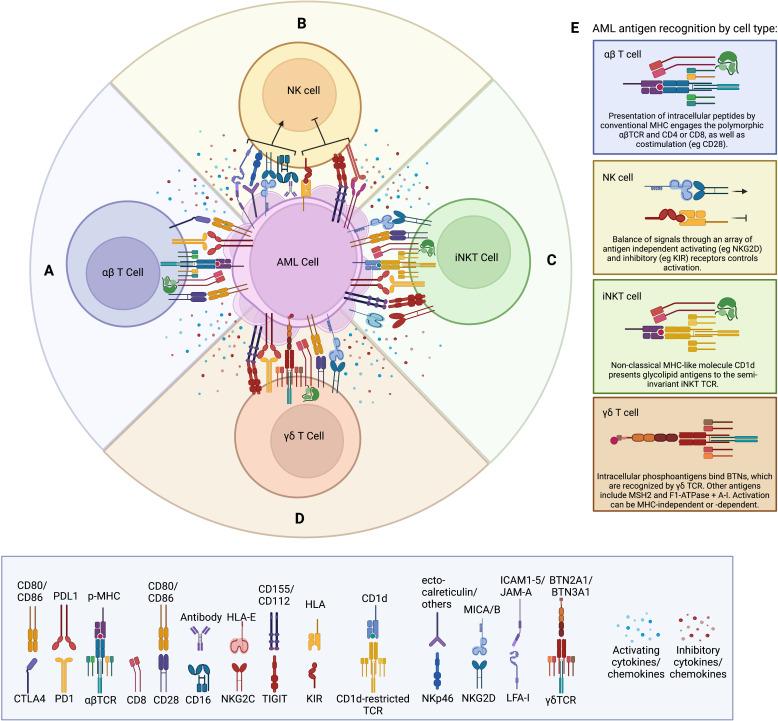
Acute myeloid leukemia (AML) remains an elusive disease to treat, let alone cure, even after highly intensive therapies such as stem cell transplants. Adoptive cell therapeutic strategies based on conventional alpha beta (αβ)T cells are an active area of research in myeloid neoplasms given their remarkable success in other hematologic malignancies, particularly B-cell-derived acute lymphoid leukemia, myeloma, and lymphomas. Several limitations have hindered clinical application of adoptive cell therapies in AML including lack of leukemia-specific antigens, on-target-off-leukemic toxicity, immunosuppressive microenvironments, and leukemic stem cell populations elusive to immune recognition and destruction. While there are promising T cell-based therapies including chimeric antigen receptor (CAR)-T designs under development, other cytotoxic lymphocyte cell subsets have unique phenotypes and capabilities that might be of additional benefit in AML treatment. Of particular interest are the natural killer (NK) and unconventional T cells known as invariant natural killer T (iNKT) and gamma delta (γδ) T cells. NK, iNKT, and γδT cells exhibit intrinsic anti-malignant properties, potential for alloreactivity, and human leukocyte-antigen (HLA)-independent function. Here we review the biology of each of these unconventional cytotoxic lymphocyte cell types and compare and contrast their strengths and limitations as the basis for adoptive cell therapies for AML.
急性髓系白血病 (AML) 即使在高强度治疗如干细胞移植后,仍然难以治疗,更遑论治愈。基于常规αβ (αβ) T 细胞的过继细胞治疗策略是髓系肿瘤的一个活跃研究领域,因为它们在其他血液恶性肿瘤中取得了显著成功,特别是 B 细胞来源的急性淋巴细胞白血病、骨髓瘤和淋巴瘤。在 AML 中,过继细胞治疗的临床应用受到多种限制,包括缺乏白血病特异性抗原、针对目标而非白血病的毒性、免疫抑制微环境和白血病干细胞逃避免疫识别和破坏。虽然有许多有前途的基于 T 细胞的疗法正在开发中,包括嵌合抗原受体 (CAR)-T 设计,但其他细胞毒性淋巴细胞亚群具有独特的表型和功能,可能对 AML 治疗有额外的益处。特别值得关注的是自然杀伤 (NK) 和非常规 T 细胞,即不变自然杀伤 T (iNKT) 和γδ (γδ) T 细胞。NK、iNKT 和 γδT 细胞具有内在的抗恶性特性、潜在的同种异体反应性和 HLA 非依赖性功能。在这里,我们将回顾这些非常规细胞毒性淋巴细胞类型的生物学,并比较和对比它们作为 AML 过继细胞治疗的基础的优势和局限性。

 Zotero 插件