
阐明培养基中的氮在促进白腐真菌产生木质素解聚酶方面的作用。
Elucidating the role of media nitrogen in augmenting the production of lignin-depolymerizing enzymes by white-rot fungi.
作者信息
Pradeep Kumar Vidya, Sridhar Manpal, Ashis Kumar Samanta, Bhatta Raghavendra
机构信息
National Institute of Animal Nutrition and Physiology, Adugodi , Bangalore, Karnataka, India.
出版信息
Microbiol Spectr. 2023 Sep 1;11(5):e0141923. doi: 10.1128/spectrum.01419-23.
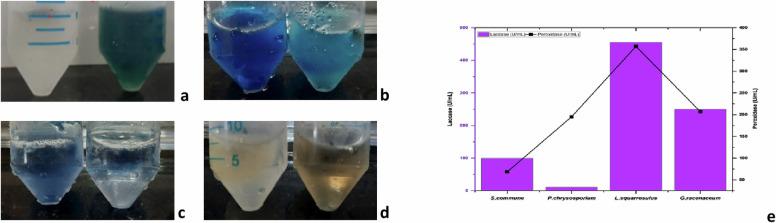
Indigenous white-rot fungal isolates , , , and , demonstrating the ability to depolymerize lignin of the crop residues, were studied for their potential to produce ligninolytic enzymes using modified production media under conditions of limiting and excess nitrogen for higher enzymatic expressions. Secretome-rich media on the investigation confirmed the successful production of lignin-depolymerizing enzymes, . laccase, lignin peroxidase, manganese peroxidase, and versatile peroxidase. Production of laccases and peroxidases was statistically significant in nitrogen-limiting media with and without the substrate, across all white-rot fungal cultures at 95% confidence interval. Nitrogen-limiting media with the substrate on analysis extracellularly expressed 99.27 U of laccase and 68.48 U of manganese peroxidase in , while 195.14 U of lignin peroxidase was produced by expressed 455.34 U of laccase and 357.13 U of versatile peroxidase with 250.09 U of laccase and 206.95 U of manganese peroxidase produced by for every milliliter of the media used. Nitrogen-limiting media triggered the production of laccase during the initial stages of growth while the expression of peroxidases was predominant at a later stage. Also, this media evinced increased enzymatic yields with low biomass content compared to nitrogen-excess conditions. The extant study confirmed the positive influence of nitrogen-limiting media in the efficient production of ligninolytic enzymes and their suggestive degradation potential for environmental pollutants, making these enzymes a safe, clean alternative to the use of chemicals and the media to be effective for large-scale production of ligninolytic enzymes. IMPORTANCE Lignin on account of its high abundance, complex polymeric structure, and biochemical properties is identified as a promising candidate in renewable energy and bioproduct manufacturing. However, depolymerization of lignin remains a major challenge in lignin utilization, entailing the employment of harsh treatments representing not only an environmental concern but also a waste of economic potential. Developing an alternative green technology to minimize this impact is imperative. Methods using enzymes to depolymerize lignin are the focus of recent studies. Current research work emphasized the efficient expression of the major lignin-depolymerizing enzymes: laccases, lignin peroxidases, manganese peroxidases, and versatile peroxidases from native isolates of white-rot fungus for several biotechnological applications as well as treatment of crop residues for use as ruminant feed in improving productivity. The importance of nitrogen in augmenting the expression of lignin-depolymerizing enzymes and providing a media recipe for the cost-effective production of ligninolytic enzymes is highlighted.
研究了本地白腐真菌分离株、、、和,它们具有解聚作物残渣木质素的能力,在氮含量有限和过量的条件下,使用改良的生产培养基研究它们产生木质素分解酶的潜力,以实现更高的酶表达。富含分泌蛋白组的培养基研究证实成功产生了木质素解聚酶,即漆酶、木质素过氧化物酶、锰过氧化物酶和多功能过氧化物酶。在95%置信区间内,在所有白腐真菌培养物中,无论有无底物,在氮限制培养基中漆酶和过氧化物酶的产生具有统计学意义。分析含有底物的氮限制培养基时,胞外表达漆酶99.27 U和锰过氧化物酶68.48 U,而表达漆酶195.14 U,每毫升培养基产生漆酶455.34 U和多功能过氧化物酶357.13 U,产生漆酶250.09 U和锰过氧化物酶206.95 U。氮限制培养基在生长初期触发漆酶的产生,而过氧化物酶的表达在后期占主导地位。此外,与氮过量条件相比,这种培养基在生物量含量较低的情况下酶产量增加。现有研究证实了氮限制培养基对高效生产木质素分解酶的积极影响及其对环境污染物的潜在降解能力,使这些酶成为一种安全、清洁的替代化学品的选择,并且该培养基对大规模生产木质素分解酶有效。重要性由于木质素含量高、聚合物结构复杂和生化特性,它被认为是可再生能源和生物产品制造中有前景的候选物。然而,木质素的解聚仍然是木质素利用中的一个主要挑战,需要采用苛刻的处理方法,这不仅涉及环境问题,还浪费经济潜力。开发一种替代绿色技术以最小化这种影响势在必行。使用酶解聚木质素的方法是近期研究的重点。当前的研究工作强调从白腐真菌的天然分离株高效表达主要的木质素解聚酶:漆酶、木质素过氧化物酶、锰过氧化物酶和多功能过氧化物酶,用于多种生物技术应用以及处理作物残渣用作反刍动物饲料以提高生产力。强调了氮在增强木质素解聚酶表达和提供一种具有成本效益的生产木质素分解酶的培养基配方方面的重要性。


 Zotero 插件