
宏基因组下一代测序在儿童痰和支气管肺泡灌洗液样本中检测下呼吸道感染。
Metagenomic next-generation sequencing for detecting lower respiratory tract infections in sputum and bronchoalveolar lavage fluid samples from children.
机构信息
Division of Pulmonology, Department of Pediatrics, Third Affiliated Hospital of Zhengzhou University, Zhengzhou, China.
Henan Pediatric Clinical Research Center and Key Laboratory of Child Brain Injury, Third Affiliated Hospital and Institute of Neuroscience of Zhengzhou University, Zhengzhou, China.
出版信息
Front Cell Infect Microbiol. 2023 Aug 17;13:1228631. doi: 10.3389/fcimb.2023.1228631. eCollection 2023.
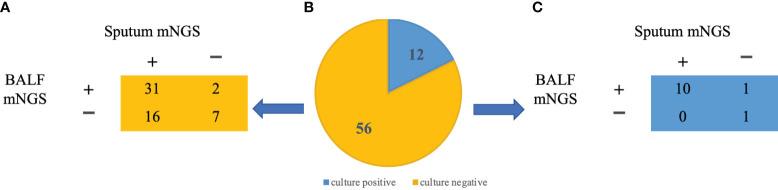
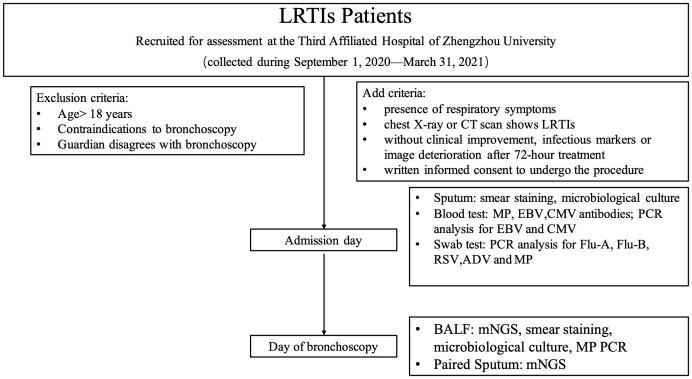
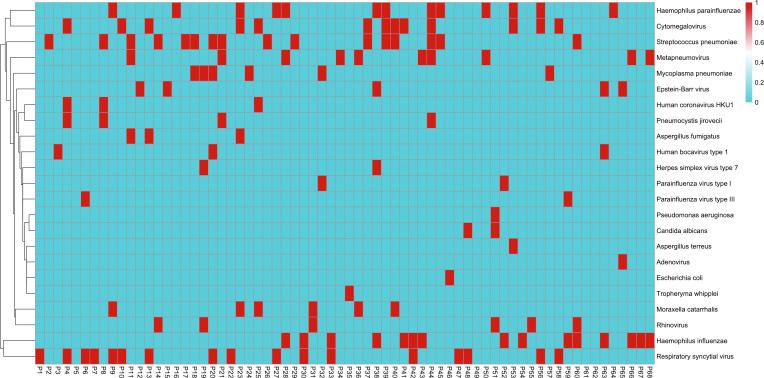
Lower respiratory tract infections are common in children. Bronchoalveolar lavage fluid has long been established as the best biological sample for detecting respiratory tract infections; however, it is not easily collected in children. Sputum may be used as an alternative yet its diagnostic accuracy remains controversial. Therefore, this study sought to evaluate the diagnostic accuracy of sputum for detecting lower respiratory tract infections using metagenomic next-generation sequencing. Paired sputum and bronchoalveolar lavage fluid samples were obtained from 68 patients; pathogens were detected in 67 sputum samples and 64 bronchoalveolar lavage fluid samples by metagenomic next-generation sequencing, respectively. The combined pathogen-detection rates in the sputum and bronchoalveolar lavage fluid samples were 80.90% and 66.2%, respectively. For sputum, the positive predictive values (PPVs) and negative predictive values (NPVs) for detecting bacteria were 0.72 and 0.73, respectively, with poor Kappa agreement (0.30; 95% confidence interval: 0.218-0.578, < 0.001). However, viral detection in sputum had good sensitivity (0.87), fair specificity (0.57), and moderate Kappa agreement (0.46; 95% confidence interval: 0.231-0.693, < 0.001). The PPVs and NPVs for viral detection in sputum were 0.82 and 0.67, respectively. The consistency between the sputum and bronchoalveolar lavage fluid was poor for bacterial detection yet moderate for viral detection. Thus, clinicians should be cautious when interpreting the results of sputum in suspected cases of lower respiratory tract infections, particularly with regards to bacterial detection in sputum. Viral detection in sputum appears to be more reliable; however, clinicians must still use comprehensive clinical judgment.
下呼吸道感染在儿童中很常见。支气管肺泡灌洗液长期以来一直被确立为检测呼吸道感染的最佳生物样本;然而,在儿童中不易采集。痰可以作为替代物,但它的诊断准确性仍存在争议。因此,本研究旨在评估宏基因组下一代测序技术检测下呼吸道感染时痰的诊断准确性。从 68 例患者中获得配对的痰和支气管肺泡灌洗液样本;通过宏基因组下一代测序,分别在 67 例痰样本和 64 例支气管肺泡灌洗液样本中检测到病原体。痰和支气管肺泡灌洗液样本的联合病原体检出率分别为 80.90%和 66.2%。对于痰,检测细菌的阳性预测值(PPV)和阴性预测值(NPV)分别为 0.72 和 0.73,kappa 一致性差(0.30;95%置信区间:0.218-0.578, < 0.001)。然而,痰中病毒检测的敏感性(0.87)较好,特异性(0.57)一般,kappa 一致性(0.46;95%置信区间:0.231-0.693, < 0.001)中等。痰中病毒检测的 PPV 和 NPV 分别为 0.82 和 0.67。痰中细菌检测的一致性较差,病毒检测的一致性较好。因此,临床医生在疑似下呼吸道感染病例中解释痰结果时应谨慎,特别是痰中细菌检测。痰中病毒检测似乎更可靠;然而,临床医生仍需综合临床判断。
 Zotero 插件