
马拉维开放性胫骨骨折 1 年后的功能结局和生活质量:一项多中心前瞻性队列研究。
Functional outcomes and quality of life at 1-year follow-up after an open tibia fracture in Malawi: a multicentre, prospective cohort study.
机构信息
Malawi-Liverpool-Wellcome Trust, Blantyre, Malawi; Liverpool School of Tropical Medicine, Liverpool, UK; Queen Elizabeth Central Hospital, Blantyre, Malawi.
Kamuzu University of Health Sciences, Blantyre, Malawi.
出版信息
Lancet Glob Health. 2023 Oct;11(10):e1609-e1618. doi: 10.1016/S2214-109X(23)00346-7. Epub 2023 Sep 1.
BACKGROUND
Injuries are a major cause of disability globally and injury incidence is rapidly increasing, largely due to road traffic injuries in low-income and middle-income countries. Current estimates of the scale and consequences of disability from injury are largely based on modelling studies, with a scarcity of empirical evidence from severe injuries in low-income countries. We aimed to better understand the outcomes for individuals with open tibia fractures in Malawi.
METHODS
In this multicentre, prospective cohort study, adults (aged ≥18 years) with open tibia fractures were systematically recruited at six hospitals in Malawi (two tertiary hospitals and four district hospitals). Follow-up lasted at least 1 year, during which in-person follow-up reviews were done at 6 weeks, 3 months, 6 months, and 1 year post-injury. The primary outcome was function at 1 year post-injury, measured by the Short Musculoskeletal Functional Assessment (SMFA) score. Secondary outcomes included quality-adjusted life-years (QALYs; as determined via the European Quality of Life 5-Dimensions 3-Levels [EQ-5D-3L] survey) and fracture-related infection at 1 year post-injury. Multilevel regression models investigated associations between SMFA score, EQ-5D-3L, baseline factors, and orthopaedic management.
FINDINGS
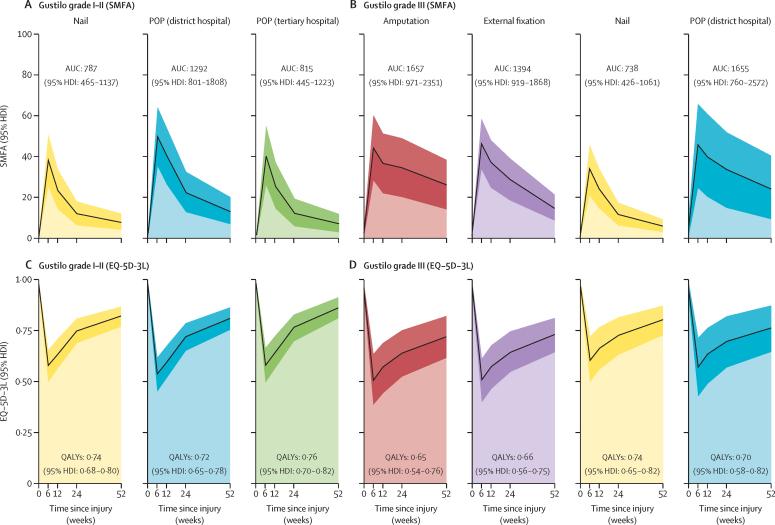
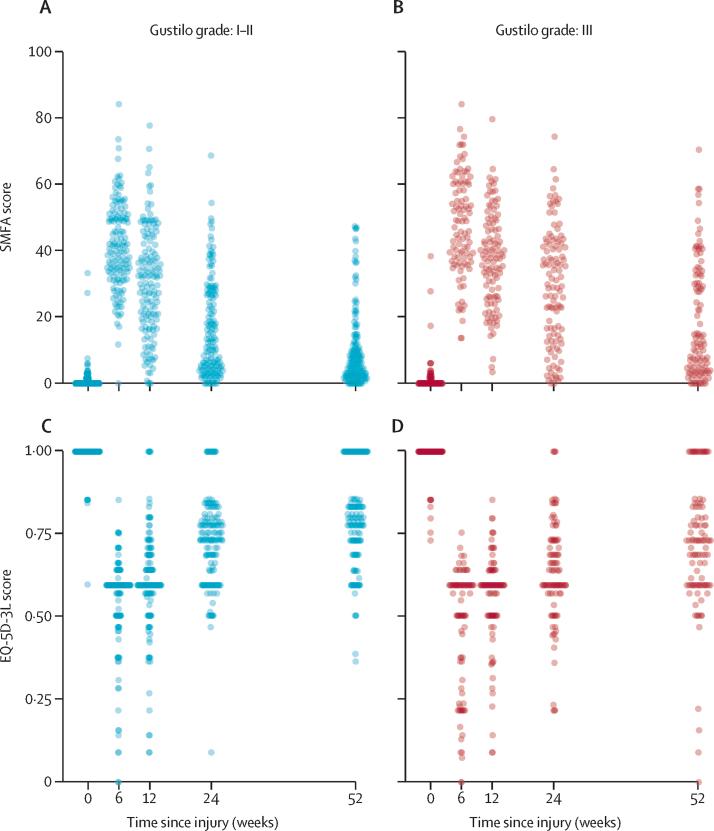
Between Feb 12, 2021, and March 14, 2022, 287 participants were enrolled (median age 34 years [IQR 25-44]; 84% male). The most common mode of injury was road traffic injuries (194 [68%] of 287). Overall, 268 (93%) participants had debridement; of the 63 participants who were debrided in district hospitals, 47 (75%) had the procedure under local or no anaesthesia. Following substantial declines by 6 weeks after injury, function and quality of life had not recovered by 1 year post-injury for participants with Gustilo grade I-II fractures (posterior mean SMFA at 1 year: 10·5, 95% highest density interval [HDI]: 9·5-11·6; QALYs: 0·73, 95% HDI: 0·66-0·80) nor Gustilo grade III fractures (posterior mean SMFA at 1 year: 14·9, 95% HDI: 13·4-16·6; QALYs: 0·67, 95% HDI: 0·59-0·75). For all fracture grades, intramedullary nailing substantially improved function and quality of life at 1 year post-injury. Delayed definitive fixation after 5 days had 5-times greater odds of infection compared with early management within 2 days (adjusted odds ratio: 5·1, 95% CI 1·8-16·1; p=0·02).
INTERPRETATION
Adults with open tibia fractures in Malawi have poor function and quality of life in the 1 year following injury. Centralised orthopaedic surgical management, including early definitive fixation and intramedullary nailing for more severe injuries, might improve outcomes.
FUNDING
Wellcome Trust.
TRANSLATION
For the Chichewa translation of the abstract see Supplementary Materials section.
背景
在全球范围内,伤害是导致残疾的主要原因,而且伤害发生率正在迅速上升,这主要是由于低收入和中等收入国家的道路交通伤害。目前对伤害导致残疾的规模和后果的估计主要基于建模研究,而来自低收入国家严重伤害的经验证据却很少。我们旨在更好地了解马拉维开放性胫骨骨折患者的结局。
方法
在这项多中心、前瞻性队列研究中,我们在马拉维的六家医院(两家三级医院和四家区医院)系统招募了成年人(年龄≥18 岁)开放性胫骨骨折患者。随访时间至少为 1 年,在受伤后 6 周、3 个月、6 个月和 1 年进行了面对面的随访复查。主要结局是受伤后 1 年的功能,通过短肌肉骨骼功能评估(SMFA)评分来衡量。次要结局包括质量调整生命年(QALYs;通过欧洲健康相关生活质量 5 维 3 级(EQ-5D-3L)调查确定)和受伤后 1 年的骨折相关感染。多水平回归模型调查了 SMFA 评分、EQ-5D-3L、基线因素和骨科管理之间的关联。
结果
在 2021 年 2 月 12 日至 2022 年 3 月 14 日期间,共纳入 287 名参与者(中位数年龄 34 岁[IQR 25-44];84%为男性)。最常见的损伤方式是道路交通伤害(287 名参与者中的 194 名[68%])。总体而言,268(93%)名参与者接受了清创术;在 63 名在区医院进行清创术的参与者中,47 名(75%)在局部麻醉或无麻醉下进行了该手术。受伤后 6 周功能和生活质量大幅下降后,Gustilo Ⅰ-Ⅱ级骨折患者(1 年后后肢 SMFA 中位数:10.5,95%最高密度区间[HDI]:9.5-11.6;QALYs:0.73,95%HDI:0.66-0.80)和 Gustilo Ⅲ级骨折患者(1 年后后肢 SMFA 中位数:14.9,95%HDI:13.4-16.6;QALYs:0.67,95%HDI:0.59-0.75)在受伤后 1 年时功能和生活质量均未恢复。与早期 2 天内管理相比,伤后 5 天以后进行确定性固定的感染风险增加了 5 倍(调整比值比:5.1,95%CI 1.8-16.1;p=0.02)。
结论
马拉维开放性胫骨骨折患者在受伤后 1 年内功能和生活质量较差。集中的骨科手术管理,包括早期确定性固定和对更严重损伤进行髓内钉固定,可能会改善结局。
资助
惠康信托基金会。

 Zotero 插件