
基因预测的循环微量营养素水平与肾结石疾病风险的因果关系:一项孟德尔随机化研究
Causal relationship of genetically predicted circulating micronutrients levels with the risk of kidney stone disease: a Mendelian randomization study.
作者信息
Yang Junyi, Wu Weisong, Amier Yirixiatijiang, Li Xianmiao, Wan Wenlong, Yu Xiao
机构信息
Department of Urology, Institute of Urology, Tongji Hospital, Tongji Medical College, Huazhong University of Science and Technology, Wuhan, China.
出版信息
Front Nutr. 2023 Aug 21;10:1132597. doi: 10.3389/fnut.2023.1132597. eCollection 2023.
BACKGROUND
Current studies have reported conflicting associations between circulating micronutrient levels and kidney stone disease (KSD). We aimed to elucidate the causal relationship between circulating micronutrient levels and KSD by a two-sample Mendelian randomization (MR) analysis.
METHODS
Total of 36 single nucleotide polymorphisms (SNPs) from published genome-wide association studies (GWAS) significantly associated with eight micronutrients (vitamin B12, folic acid, magnesium, iron, phosphorus, copper, zinc, and selenium) were used as instrumental variables. The GWAS summary data associated with KSD (8,060 cases and 301,094 controls) were obtained from the FinnGen consortium. Inverse variance weighted was the main MR analysis method. MR-Pleiotropy RESidual Sum and Outlier (MR-PRESSO), weighted median and MR-Egger were used to assess pleiotropy and heterogeneity.
RESULTS
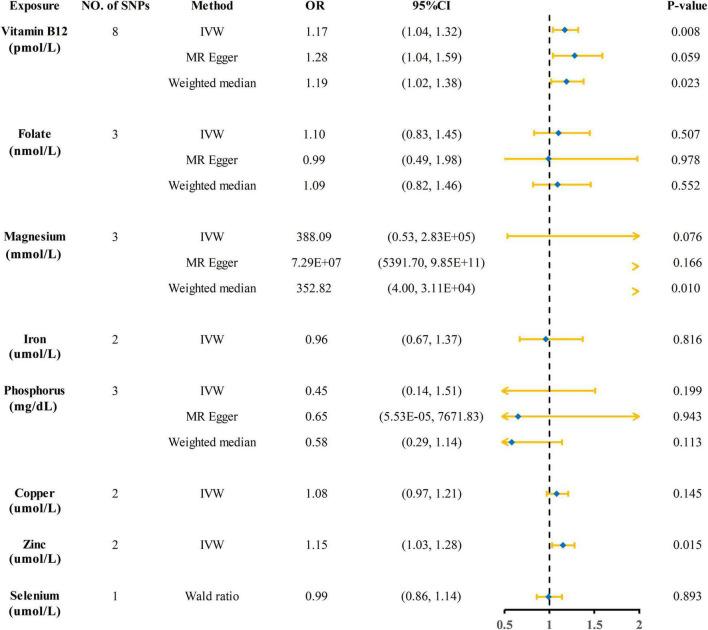
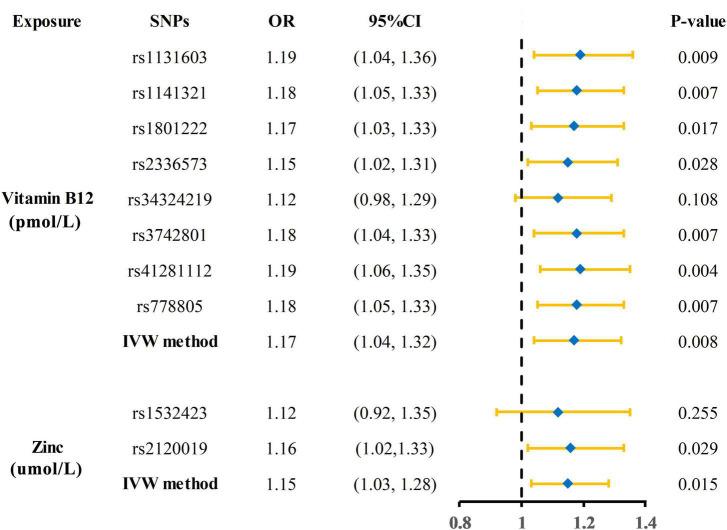
Genetically predicted circulating vitamin B12 and zinc levels were causally associated with the risk of KSD (vitamin B12: OR: 1.17, 95% CI: 1.04-1.32, = 0.008; zinc: OR: 1.15, 95% CI: 1.03-1.28, = 0.015). We found no evidence that other circulating micronutrients were associated with risk of KSD. -value for Cochrane test, MR Egger intercept test, and MR-PRESSO were >0.05, indicating no significant heterogeneity or horizontal pleiotropy in this MR analysis.
CONCLUSION
Increasing circulating zinc levels may increase the risk of KSD. More studies are needed to provide evidence on whether genetically predicted circulating vitamin B12 and zinc levels are a risk factor for KSD.
背景
目前的研究报告了循环中微量营养素水平与肾结石病(KSD)之间相互矛盾的关联。我们旨在通过两样本孟德尔随机化(MR)分析阐明循环中微量营养素水平与KSD之间的因果关系。
方法
从已发表的全基因组关联研究(GWAS)中选取与八种微量营养素(维生素B12、叶酸、镁、铁、磷、铜、锌和硒)显著相关的36个单核苷酸多态性(SNP)作为工具变量。与KSD相关的GWAS汇总数据(8060例病例和301094例对照)来自芬兰基因组联盟。逆方差加权是主要的MR分析方法。MR-多效性残差和异常值(MR-PRESSO)、加权中位数和MR-Egger用于评估多效性和异质性。
结果
基因预测的循环维生素B12和锌水平与KSD风险存在因果关系(维生素B12:比值比[OR]:1.17,95%置信区间[CI]:1.04-1.32,P = 0.008;锌:OR:1.15,95%CI:1.03-1.28,P = 0.015)。我们没有发现其他循环微量营养素与KSD风险相关的证据。Cochrane检验、MR Egger截距检验和MR-PRESSO的P值均>0.05,表明该MR分析中无显著异质性或水平多效性。
结论
循环锌水平升高可能会增加KSD风险。需要更多研究来提供关于基因预测的循环维生素B12和锌水平是否为KSD危险因素的证据。

 Zotero 插件