
印度 2006-2021 年高致病性禽流感 H5N1 和 H5N8 暴发的时空分布和季节性。
Spatio-temporal distribution & seasonality of highly pathogenic avian influenza H5N1 & H5N8 outbreaks in India, 2006-2021.
机构信息
National Institute of Virology, Indian Council of Medical Research, Pune, Maharashtra, India.
Ela Foundation, Pune, Maharashtra, India.
出版信息
Indian J Med Res. 2023 Aug;158(2):113-118. doi: 10.4103/ijmr.ijmr_2002_22.
BACKGROUND & OBJECTIVES: The highly pathogenic avian influenza (HPAI) H5N1 and H5N8 viruses have been one of the leading causes of avian diseases worldwide, resulting in severe economic losses and posing potential zoonotic risk. There are no reports on the correlation of the seasonality of H5N1 and H5N8 viruses with the migratory bird season in India, along with the species affected. The present report describes the distribution and seasonality of HPAI outbreaks in India from 2006 to 2021.
METHODS
The data on the occurrence and locations of outbreaks in India and affected bird species were collated from the Food and Agriculture Organization of the United Nations database and grouped by month and year. The distribution and seasonality of HPAI H5N1 and H5N8 viruses were analyzed.
RESULTS
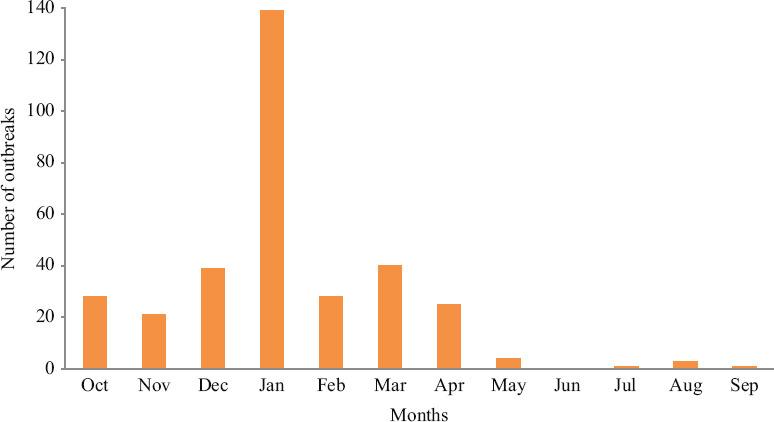
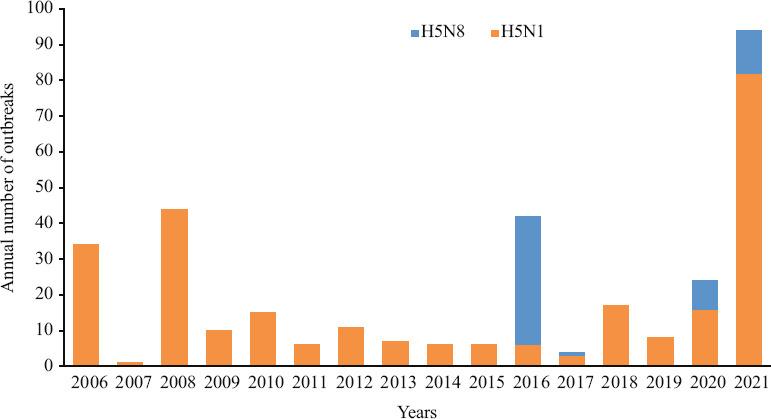
A total of 284 H5N1 outbreaks were reported since 2006, with a surge in 2021. The initial outbreaks of H5N1 were predominantly in poultry. Since 2016, 57 outbreaks of H5N8 were also reported, predominantly in wild birds. Most of the outbreaks of HPAI were reported from post monsoon onwards till pre-summer season (i.e. between October and March) with their peak in winter, in January. Apart from poultry, the bird species such as owl, Indian peafowl, lesser adjutant, crows and wild migratory birds such as demoiselle crane, northern pintail and bar-headed goose were positive for HPAI.
INTERPRETATION & CONCLUSIONS: Such studies on the seasonality of HPAI outbreaks would help in the development of prevention and control strategies. The recent human infections of H5N1 and H9N2 viruses highlight the need to strengthen surveillance in wild, resident, migratory birds and in poultry along with One Health studies in India.
背景与目的
高致病性禽流感(HPAI)H5N1 和 H5N8 病毒一直是全球禽类疾病的主要病因之一,导致严重的经济损失,并构成潜在的人畜共患病风险。目前尚无关于印度 H5N1 和 H5N8 病毒季节性与候鸟季节之间的相关性以及受影响物种的报告。本报告描述了 2006 年至 2021 年期间印度 HPAI 暴发的分布和季节性。
方法
从联合国粮食及农业组织数据库中整理了印度暴发情况和地点以及受影响鸟类物种的数据,并按月和年进行分组。分析了 HPAI H5N1 和 H5N8 病毒的分布和季节性。
结果
自 2006 年以来共报告了 284 起 H5N1 暴发事件,2021 年暴发数量激增。H5N1 的最初暴发主要发生在禽类中。自 2016 年以来,还报告了 57 起 H5N8 暴发事件,主要发生在野生鸟类中。大多数 HPAI 暴发发生在季风后至初夏(即 10 月至 3 月)期间,高峰期在冬季,1 月。除了家禽外,猫头鹰、印度孔雀、小秃鹳、乌鸦和野生候鸟,如丹顶鹤、北方针尾鸭和斑头雁等鸟类物种也对 HPAI 呈阳性。
解释与结论
此类关于 HPAI 暴发季节性的研究将有助于制定预防和控制策略。最近人类感染 H5N1 和 H9N2 病毒的情况突显了需要加强对野生、居留、迁徙鸟类以及家禽的监测,同时还需要在印度开展“同一健康”研究。
 Zotero 插件