
临床方案:使用肿瘤内微透析评估阿贝西利在弥漫性中线胶质瘤中的神经药代动力学的可行性。
Clinical protocol: Feasibility of evaluating abemaciclib neuropharmacokinetics of diffuse midline glioma using intratumoral microdialysis.
机构信息
Department of Neurosurgery, Emory University School of Medicine, Atlanta, GA, United States of America.
Pediatric Oncology Branch, National Cancer Institute, National Institutes of Health, Bethesda, MD, United States of America.
出版信息
PLoS One. 2023 Sep 8;18(9):e0291068. doi: 10.1371/journal.pone.0291068. eCollection 2023.
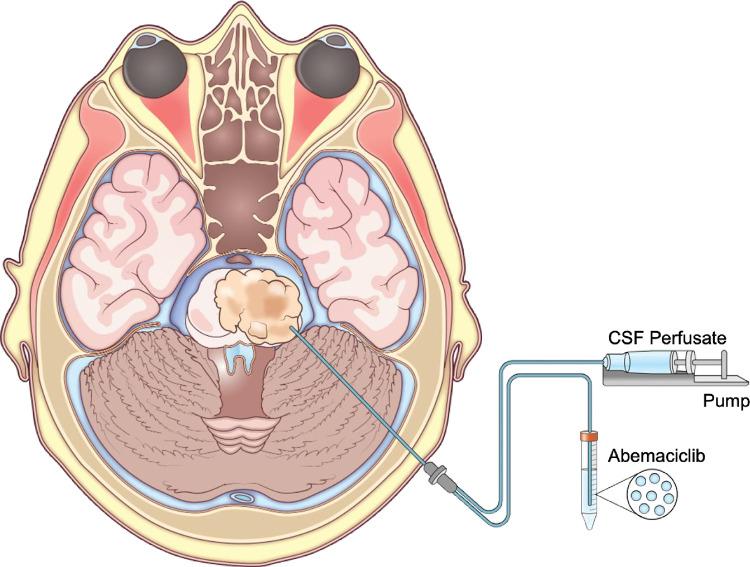
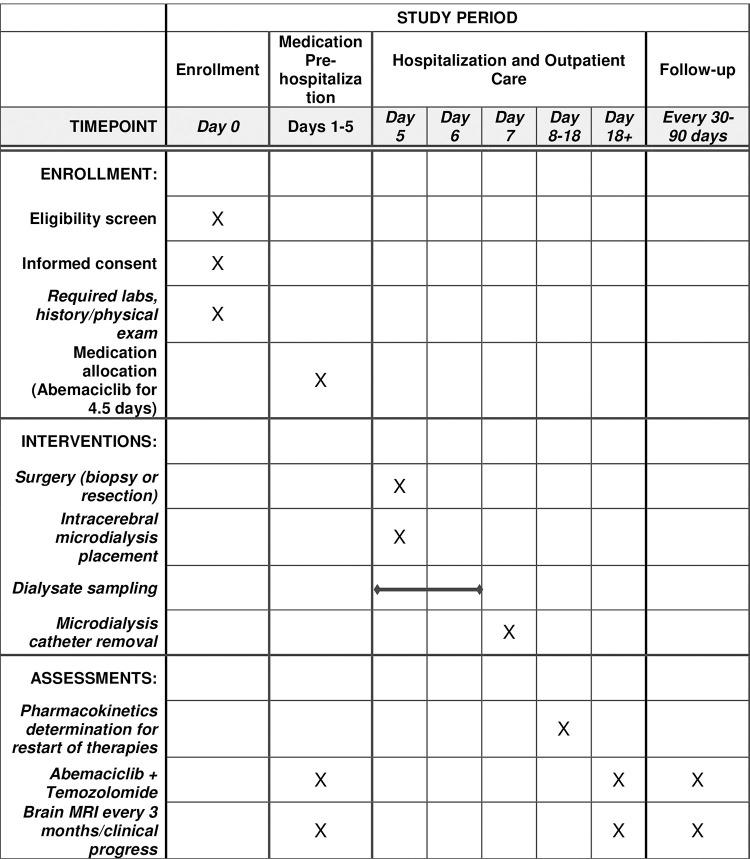
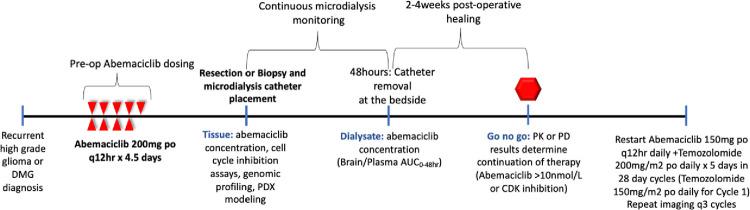
Diffuse midline gliomas (DMG) are the most aggressive brain tumors of childhood and young adults, with documented 2-year survival rates <10%. Treatment failure is due in part to the function of the BBB. Intratumoral microdialysis sampling is an effective tool to determine brain entry of varied agents and could help to provide a better understanding of the relationship of drug permeability to DMG treatment responsivity. This is a non-randomized, single-center, phase 1 clinical trial. Up to seven young adult (18-39 years) patients with recurrent high-grade or diffuse midline glioma will be enrolled with the goal of 5 patients completing the trial over an anticipated 24 months. All patients will take abemaciclib pre-operatively for 4.5 days at twice daily dosing. Patients will undergo resection or biopsy, placement of a microdialysis catheter, and 48 hours of dialysate sampling coupled with timed plasma collections. If intratumoral tumor or brain dialysate sampling concentrations are >10nmol/L, or tumor tissue studies demonstrate CDK inhibition, then restart of abemaciclib therapy along with temozolomide will be administered for maintenance therapy and discontinued with evidence of radiologic or clinical disease progression. The poor survival associated with diffuse midline gliomas underscore the need for improved means to evaluate efficacy of drug delivery to tumor and peritumoral tissue. The findings of this novel study, will provide real-time measurements of BBB function which have the potential to influence future prognostic and diagnostic decisions in such a lethal disease with limited treatment options. Trial registration: Clinicaltrials.gov, NCT05413304. Registered June 10, 2022, Abemaciclib Neuropharmacokinetics of Diffuse Midline Glioma Using Intratumoral Microdialysis.
弥漫性中线脑胶质瘤(DMG)是儿童和青年中最具侵袭性的脑肿瘤,有记录的 2 年生存率<10%。治疗失败部分归因于 BBB 的功能。肿瘤内微透析采样是确定不同药物进入大脑的有效工具,有助于更好地了解药物通透性与 DMG 治疗反应性的关系。这是一项非随机、单中心、1 期临床试验。多达 7 名患有复发性高级别或弥漫性中线脑胶质瘤的年轻成年(18-39 岁)患者将被纳入研究,预计在 24 个月内有 5 名患者完成试验。所有患者将在术前接受阿贝西利治疗,每日两次,每次 4.5 天。患者将接受切除术或活检、放置微透析导管以及 48 小时的透析液采样和定时血浆采集。如果肿瘤内肿瘤或脑透析液采样浓度>10nmol/L,或肿瘤组织研究显示 CDK 抑制,则重新开始阿贝西利治疗联合替莫唑胺用于维持治疗,并在影像学或临床疾病进展时停止。弥漫性中线脑胶质瘤的生存率较低,这突显了需要改进方法来评估药物输送到肿瘤和肿瘤周围组织的疗效。这项新研究的结果将提供 BBB 功能的实时测量,这有可能影响在这种治疗选择有限的致命疾病中的未来预后和诊断决策。试验注册:Clinicaltrials.gov,NCT05413304。于 2022 年 6 月 10 日注册,阿贝西利通过肿瘤内微透析评估弥漫性中线脑胶质瘤的神经药代动力学。
 Zotero 插件