
利用 cfDNA 和 ctDNA 作为肿瘤标志物:通往临床验证的道路。
Using cfDNA and ctDNA as Oncologic Markers: A Path to Clinical Validation.
机构信息
Long School of Medicine, University of Texas Health San Antonio, San Antonio, TX 78229, USA.
Mays Cancer Center, University of Texas Health, San Antonio, TX 78229, USA.
出版信息
Int J Mol Sci. 2023 Aug 25;24(17):13219. doi: 10.3390/ijms241713219.
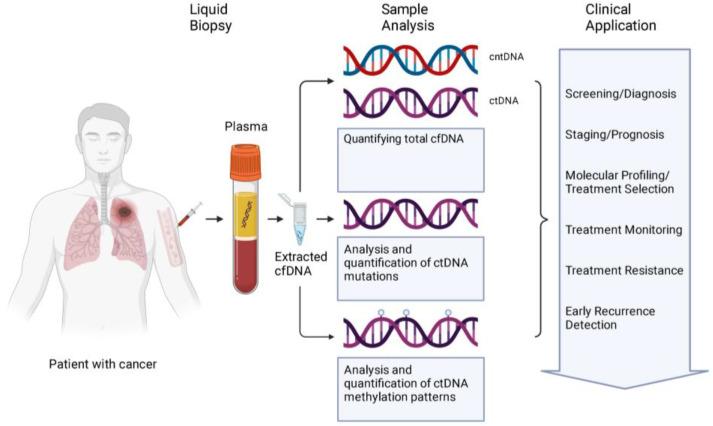
The detection of circulating tumor DNA (ctDNA) in liquid biopsy samples as an oncological marker is being used in clinical trials at every step of clinical management. As ctDNA-based liquid biopsy kits are developed and used in clinics, companies work towards increased convenience, accuracy, and cost over solid biopsies and other oncological markers. The technology used to differentiate ctDNA and cell-free DNA (cfDNA) continues to improve with new tests and methodologies being able to detect down to mutant allele frequencies of 0.001% or 1/100,000 copies. Recognizing this development in technology, the FDA has recently given pre-market approval and breakthrough device designations to multiple companies. The purpose of this review is to look at the utility of measuring total cfDNA, techniques used to differentiate ctDNA from cfDNA, and the utility of different ctDNA-based liquid biopsy kits using relevant articles from PubMed, clinicaltrials.gov, FDA approvals, and company newsletters. Measuring total cfDNA could be a cost-effective, viable prognostic marker, but various factors do not favor it as a monitoring tool during chemotherapy. While there may be a place in the clinic for measuring total cfDNA in the future, the lack of standardization means that it is difficult to move forward with large-scale clinical validation studies currently. While the detection of ctDNA has promising standardized liquid biopsy kits from various companies with large clinical trials ongoing, their applications in screening and minimal residual disease can suffer from lower sensitivity. However, researchers are working towards solutions to these issues with innovations in technology, multi-omics, and sampling. With great promise, further research is needed before liquid biopsies can be recommended for everyday clinical management.
液体活检样本中循环肿瘤 DNA(ctDNA)作为肿瘤标志物的检测在临床管理的每一个步骤中都在临床试验中得到应用。随着基于 ctDNA 的液体活检试剂盒在临床中的开发和使用,公司致力于提高便利性、准确性和相对于实体活检和其他肿瘤标志物的成本效益。用于区分 ctDNA 和无细胞 DNA(cfDNA)的技术随着新的测试和方法的出现而不断改进,能够检测到突变等位基因频率低至 0.001%或 1/100,000 个拷贝。鉴于这一技术的发展,FDA 最近给予多家公司上市前批准和突破性设备指定。本综述的目的是研究测量总 cfDNA 的实用性、用于区分 ctDNA 与 cfDNA 的技术,以及使用来自 PubMed、clinicaltrials.gov、FDA 批准和公司通讯的相关文章评估不同基于 ctDNA 的液体活检试剂盒的实用性。测量总 cfDNA 可能是一种具有成本效益的可行预后标志物,但各种因素不支持其作为化疗期间的监测工具。尽管将来在临床上测量总 cfDNA 可能有一席之地,但由于缺乏标准化,目前难以进行大规模的临床验证研究。虽然来自不同公司的具有前瞻性临床试验的 ctDNA 检测具有很有前景的标准化液体活检试剂盒,但它们在筛查和微小残留疾病中的应用可能会受到较低的敏感性的影响。然而,研究人员正在通过技术创新、多组学和采样来解决这些问题。虽然液体活检具有很大的前景,但在推荐将液体活检用于日常临床管理之前,还需要进一步的研究。
 Zotero 插件