
疫苗诱导的季节性流感病毒 H1N1 株的中和抗体反应在随后的大流行 H1N1 感染期间不会增强。
Vaccine-induced neutralizing antibody responses to seasonal influenza virus H1N1 strains are not enhanced during subsequent pandemic H1N1 infection.
机构信息
Department of Virology, Biomedical Primate Research Centre, Rijswijk, Netherlands.
Department of Medical Microbiology and Infection Prevention, Laboratory of Experimental Virology, Amsterdam UMC, Location University of Amsterdam, Amsterdam, Netherlands.
出版信息
Front Immunol. 2023 Aug 24;14:1256094. doi: 10.3389/fimmu.2023.1256094. eCollection 2023.
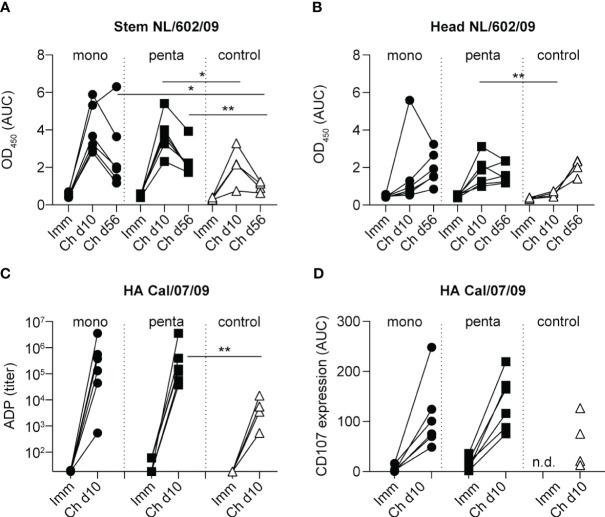
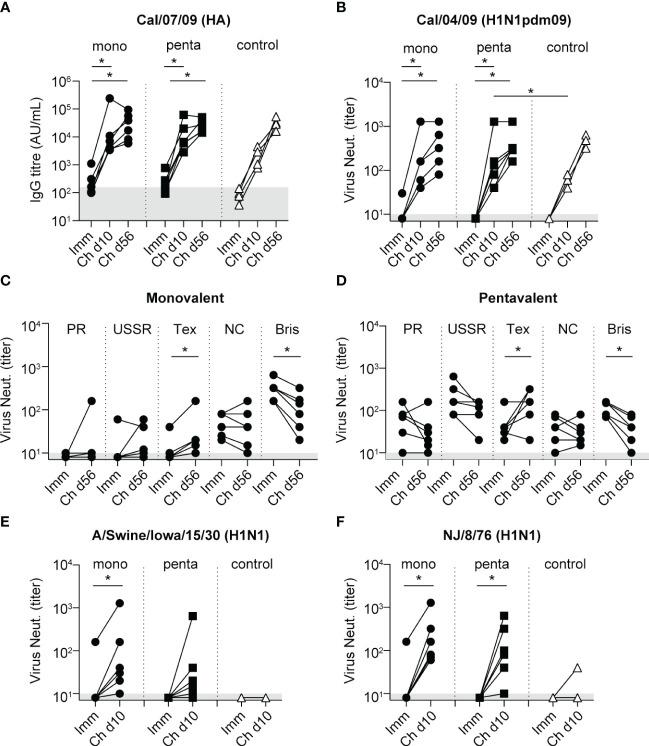
The first exposure to influenza is presumed to shape the B-cell antibody repertoire, leading to preferential enhancement of the initially formed responses during subsequent exposure to viral variants. Here, we investigated whether this principle remains applicable when there are large genetic and antigenic differences between primary and secondary influenza virus antigens. Because humans usually have a complex history of influenza virus exposure, we conducted this investigation in influenza-naive cynomolgus macaques. Two groups of six macaques were immunized four times with influenza virus-like particles (VLPs) displaying either one (monovalent) or five (pentavalent) different hemagglutinin (HA) antigens derived from seasonal H1N1 (H1N1) strains. Four weeks after the final immunization, animals were challenged with pandemic H1N1 (H1N1pdm09). Although immunization resulted in robust virus-neutralizing responses to all VLP-based vaccine strains, there were no cross-neutralization responses to H1N1pdm09, and all animals became infected. No reductions in viral load in the nose or throat were detected in either vaccine group. After infection, strong virus-neutralizing responses to H1N1pdm09 were induced. However, there were no increases in virus-neutralizing titers against four of the five H1N1 vaccine strains; and only a mild increase was observed in virus-neutralizing titer against the influenza A/Texas/36/91 vaccine strain. After H1N1pdm09 infection, both vaccine groups showed higher virus-neutralizing titers against two H1N1 strains of intermediate antigenic distance between the H1N1 vaccine strains and H1N1pdm09, compared with the naive control group. Furthermore, both vaccine groups had higher HA-stem antibodies early after infection than the control group. In conclusion, immunization with VLPs displaying HA from antigenically distinct H1N1 variants increased the breadth of the immune response during subsequent H1N1pdm09 challenge, although this phenomenon was limited to intermediate antigenic variants.
初次接触流感病毒被认为会塑造 B 细胞抗体库,从而导致在随后接触病毒变体时,最初形成的反应得到优先增强。在这里,我们研究了当主要和次要流感病毒抗原之间存在较大的遗传和抗原差异时,这一原则是否仍然适用。由于人类通常具有复杂的流感病毒暴露史,我们在未感染过流感的食蟹猴中进行了这项研究。两组六只猕猴用分别显示一种(单价)或五种(五价)来自季节性 H1N1(H1N1)株的不同血凝素(HA)抗原的流感病毒样颗粒(VLPs)免疫四次。最后一次免疫接种后 4 周,动物用大流行性 H1N1(H1N1pdm09)进行攻毒。尽管免疫接种导致针对所有基于 VLP 的疫苗株产生强大的病毒中和反应,但对 H1N1pdm09 没有交叉中和反应,所有动物均被感染。在任何疫苗组中,都未检测到鼻或咽部的病毒载量减少。感染后,诱导出针对 H1N1pdm09 的强烈病毒中和反应。然而,针对五种 H1N1 疫苗株中的四种,病毒中和滴度没有增加;仅对流感 A/Texas/36/91 疫苗株观察到病毒中和滴度的轻度增加。感染 H1N1pdm09 后,与对照组相比,两组疫苗接种组在感染后早期针对 H1N1 疫苗株和 H1N1pdm09 之间具有中等抗原距离的两种 H1N1 株的病毒中和滴度均更高。此外,两组疫苗接种组在感染后早期的 HA 茎抗体滴度均高于对照组。总之,用显示来自具有不同抗原性的 H1N1 变体的 HA 的 VLPs 进行免疫接种增加了随后 H1N1pdm09 攻毒时的免疫反应广度,尽管这种现象仅限于中等抗原性变体。


 Zotero 插件