
减重手术后硫和丁酸盐代谢菌的独特模式:对结直肠癌风险的潜在影响。
Distinctive patterns of sulfide- and butyrate-metabolizing bacteria after bariatric surgery: potential implications for colorectal cancer risk.
机构信息
Division of Gastroenterology, Department of Internal Medicine, University of California, Davis; Sacramento, CA, USA.
The UC Davis Comprehensive Cancer Center, Sacramento, CA, USA.
出版信息
Gut Microbes. 2023 Dec;15(2):2255345. doi: 10.1080/19490976.2023.2255345.
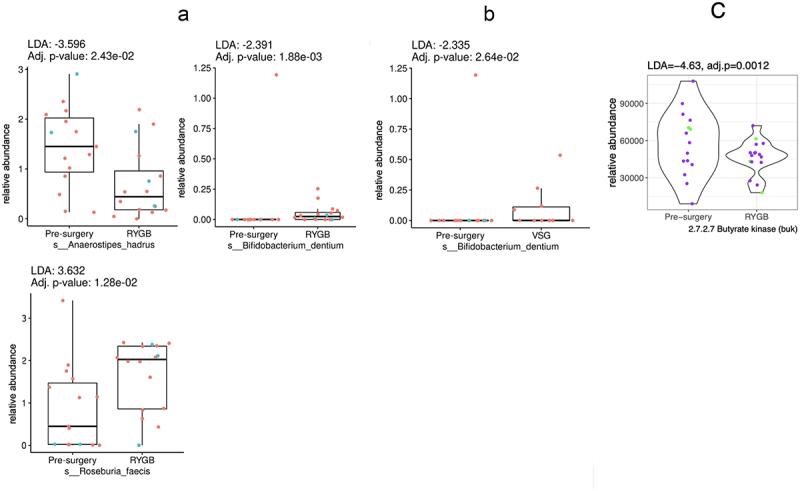
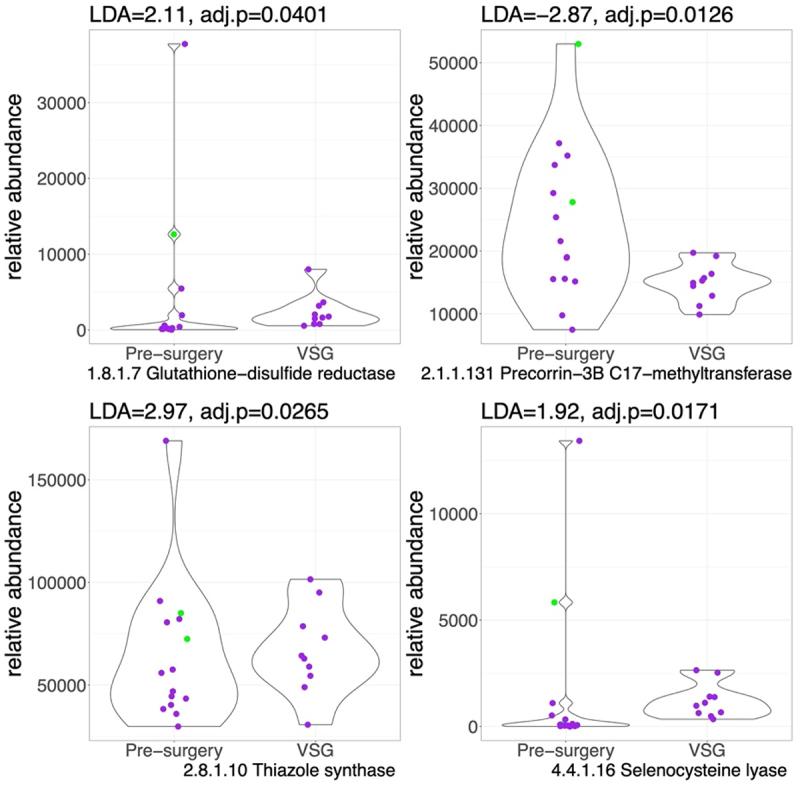
Despite improved cardiometabolic outcomes following bariatric surgery, its long-term impact on colorectal cancer (CRC) risk remains uncertain. In parallel, the influence of bariatric surgery on the host microbiome and relationships with disease outcomes is beginning to be appreciated. Therefore, we investigated the impact of Roux-en-Y gastric bypass (RYGB) and vertical sleeve gastrectomy (VSG) on the patterns of sulfide-reducing and butyrate-producing bacteria, which are hypothesized to modulate CRC risk after bariatric surgery. In this single-center, cross-sectional study, we included 15 pre-surgery subjects with severe obesity and patients who are at a median (range) of 25.6 (9.9-46.5) months after RYGB ( = 16) or VSG ( = 10). The DNA abundance of fecal bacteria and enzymes involved in butyrate and sulfide metabolism were identified using metagenomic sequencing. Differences between pre-surgery and post-RYGB or post-VSG cohorts were quantified using the linear discriminant analysis (LDA) effect size (LEfSe) method. Our sample was predominantly female (87%) with a median (range) age of 46 (23-71) years. Post-RYGB and post-VSG patients had a higher DNA abundance of fecal sulfide-reducing bacteria than pre-surgery controls (LDA = 1.3-4.4, < .05). The most significant enrichments were for fecal , and after RYGB, and for , after VSG. As for butyrate-producing bacteria, was more abundant, whereas and were lower post-RYGB vs. pre-surgery. was also lower in post-VSG vs. pre-surgery. Consistent with these findings, our analysis showed a greater enrichment of sulfide-reducing enzymes after bariatric surgery, especially RYGB, vs. pre-surgery. The DNA abundance of butyrate-producing enzymes was lower post-RYGB. In conclusion, the two most used bariatric surgeries, RYGB and VSG, are associated with microbiome patterns that are potentially implicated in CRC risk. Future studies are needed to validate and understand the impact of these microbiome changes on CRC risk after bariatric surgery.
尽管减重手术后心血管代谢结果得到改善,但长期对结直肠癌(CRC)风险的影响仍不确定。与此同时,减重手术对宿主微生物组的影响及其与疾病结果的关系开始受到关注。因此,我们研究了 Roux-en-Y 胃旁路术(RYGB)和垂直袖状胃切除术(VSG)对硫化物还原菌和丁酸盐产生菌模式的影响,这些菌被认为可以调节减重手术后的 CRC 风险。在这项单中心、横断面研究中,我们纳入了 15 名术前患有严重肥胖症的患者和术后中位数(范围)为 25.6(9.9-46.5)个月的 RYGB 患者( = 16)或 VSG( = 10)患者。使用宏基因组测序鉴定粪便细菌的 DNA 丰度和参与丁酸盐和硫化物代谢的酶。使用线性判别分析(LDA)效应大小(LEfSe)方法量化术前与 RYGB 后或 VSG 后队列之间的差异。我们的样本主要为女性(87%),中位(范围)年龄为 46(23-71)岁。RYGB 后和 VSG 后患者粪便硫化物还原菌的 DNA 丰度高于术前对照组(LDA = 1.3-4.4, < .05)。最显著的富集是 RYGB 后 和 ,VSG 后 和 。对于丁酸盐产生菌, 丰度较高,而 RYGB 后 和 丰度较低。VSG 后 丰度也低于术前。与这些发现一致,我们的分析表明,与术前相比,减重手术后,尤其是 RYGB 后,硫化物还原酶的丰度增加。RYGB 后,丁酸盐产生酶的 DNA 丰度降低。总之,两种最常用的减重手术,RYGB 和 VSG,与可能与 CRC 风险相关的微生物组模式有关。需要进一步的研究来验证和理解这些微生物组变化对减重手术后 CRC 风险的影响。


 Zotero 插件