
组蛋白甲基化调控果蝇的生殖滞育。
Histone methylation regulates reproductive diapause in Drosophila melanogaster.
机构信息
Department of Biology, School of Arts and Sciences, University of Pennsylvania, Philadelphia, Pennsylvania, United States of America.
Epigenetics Institute, University of Pennsylvania, Philadelphia, Pennsylvania, United States of America.
出版信息
PLoS Genet. 2023 Sep 13;19(9):e1010906. doi: 10.1371/journal.pgen.1010906. eCollection 2023 Sep.
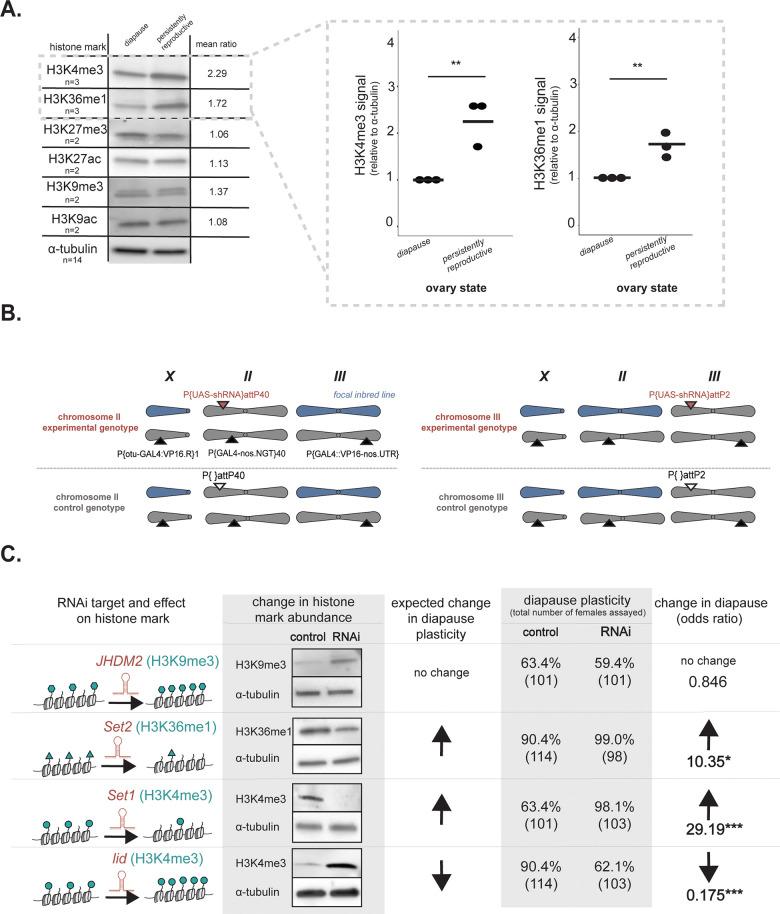
Fluctuating environments threaten fertility and viability. To better match the immediate, local environment, many organisms adopt alternative phenotypic states, a phenomenon called "phenotypic plasticity." Natural populations that predictably encounter fluctuating environments tend to be more plastic than conspecific populations that encounter a constant environment, suggesting that phenotypic plasticity can be adaptive. Despite pervasive evidence of such "adaptive phenotypic plasticity," gene regulatory mechanisms underlying plasticity remains poorly understood. Here we test the hypothesis that environment-dependent phenotypic plasticity is mediated by epigenetic factors. To test this hypothesis, we exploit the adaptive reproductive arrest of Drosophila melanogaster females, called diapause. Using an inbred line from a natural population with high diapause plasticity, we demonstrate that diapause is determined epigenetically: only a subset of genetically identical individuals enter diapause and this diapause plasticity is epigenetically transmitted for at least three generations. Upon screening a suite of epigenetic marks, we discovered that the active histone marks H3K4me3 and H3K36me1 are depleted in diapausing ovaries. Using ovary-specific knockdown of histone mark writers and erasers, we demonstrate that H3K4me3 and H3K36me1 depletion promotes diapause. Given that diapause is highly polygenic, that is, distinct suites of alleles mediate diapause plasticity across distinct genotypes, we also investigated the potential for genetic variation in diapause-determining epigenetic marks. Specifically, we asked if these histone marks were similarly depleted in diapause of a genotypically distinct line. We found evidence of divergence in both the gene expression program and histone mark abundance. This study reveals chromatin determinants of phenotypic plasticity and suggests that these determinants may be genotype-dependent, offering new insight into how organisms may exploit and evolve epigenetic mechanisms to persist in fluctuating environments.
波动的环境会威胁到生物的生殖力和生存能力。为了更好地适应当前的局部环境,许多生物会采用替代的表型状态,这种现象被称为“表型可塑性”。与那些遇到恒定环境的同种生物种群相比,那些能够预测到环境波动的自然种群往往具有更高的可塑性,这表明表型可塑性可能是适应性的。尽管有普遍的证据表明存在这种“适应性表型可塑性”,但对可塑性背后的基因调控机制仍知之甚少。在这里,我们检验了环境依赖性表型可塑性是由表观遗传因素介导的假设。为了验证这一假设,我们利用了黑腹果蝇(Drosophila melanogaster)雌性的适应性生殖暂停,即滞育。我们利用来自一个具有高度滞育可塑性的自然种群的近交系,证明了滞育是由表观遗传决定的:只有一部分遗传上相同的个体进入滞育,这种滞育可塑性至少可以通过三代遗传传递。在对一组表观遗传标记进行筛选后,我们发现活性组蛋白标记 H3K4me3 和 H3K36me1 在滞育的卵巢中被耗尽。通过卵巢特异性的组蛋白标记写入器和擦除器的敲低,我们证明了 H3K4me3 和 H3K36me1 的耗竭促进了滞育。由于滞育是高度多基因的,也就是说,不同的等位基因集合在不同的基因型中介导滞育可塑性,我们还研究了滞育决定的表观遗传标记中的遗传变异的可能性。具体来说,我们想知道这些组蛋白标记是否在基因型不同的滞育中也同样被耗尽。我们发现,在基因表达程序和组蛋白标记丰度方面都存在差异。这项研究揭示了表型可塑性的染色质决定因素,并表明这些决定因素可能依赖于基因型,为生物体如何利用和进化表观遗传机制以在波动的环境中生存提供了新的见解。

 Zotero 插件